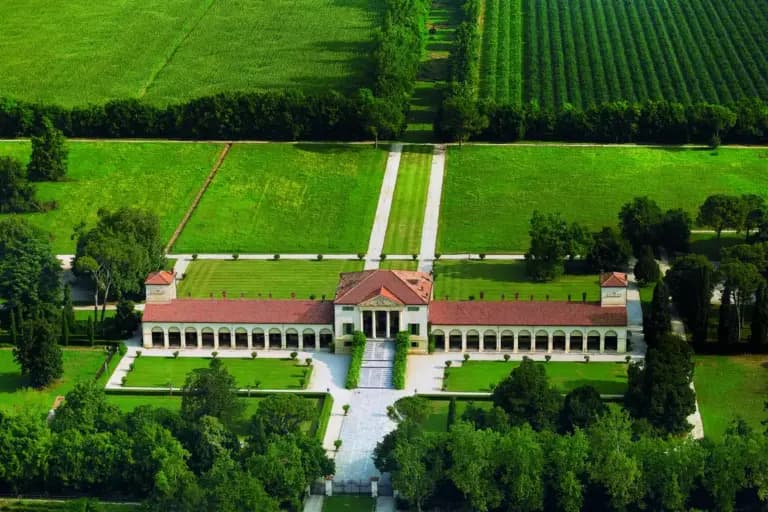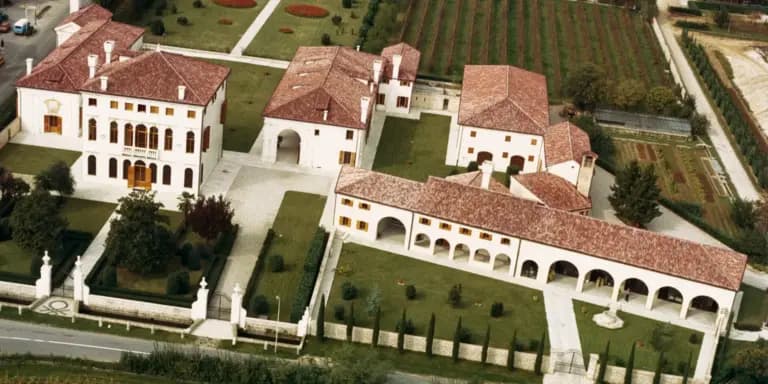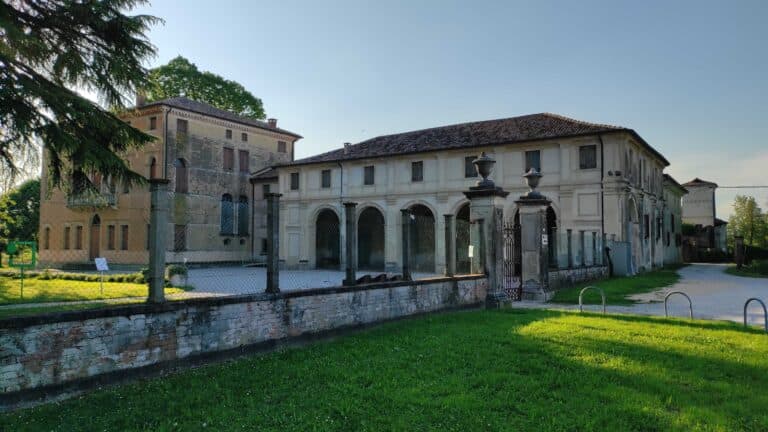

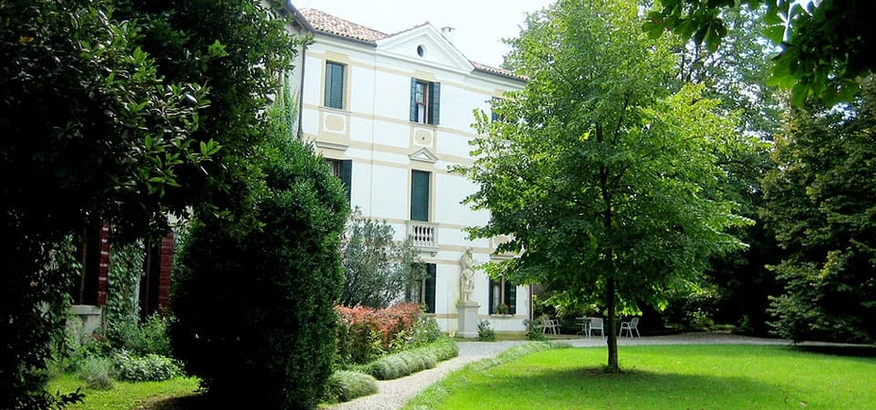
Nestled in the historic heart of Gaiarine, just a few steps from the soaring neo-Gothic bell tower of the Church of San Tomaso di Canterbury, Villa Pera is an elegant architectural complex from the second half of the 17th century wrapped in a lush centuries-old park. On either side of the main entrance, two majestic linden trees stand above the white 18th-century statues of Hercules and Deianira, placed atop the rusticated pillars to which a sinuous iron gate is hinged.
The Veneto Villas in Gaiarine
Facing northwest, this gate overlooks the roundabout where the roads leading to Sacile, Conegliano and Oderzo meet. Entering the town from Conegliano, we will find on our right the north side of Villa Porcia, Cavarzerani, an 18th-century noble estate framed by a sumptuous tree-lined garden.
Proceeding toward the town center, on our left our gaze falls on Villa Cappellari della Colomba, also dating from the 18th century. A little farther on, facing Piazza Vittorio Emanuele II, rises the main façade of Villa Cicogna, Borlini, the current town hall, consisting of a three-storey main building flanked by two symmetrical porticoed barchesse. The vast park that originally surrounded the villa has been replaced by the cobblestone square we can admire today, at the center of which stands the monument to the fallen of the Great War, crowned by an iron eagle with outstretched wings.
The origin of the Veneto Villas: Venetian expansion onto the mainland
The old saying “Coltivar el mar e assar star la tera” reflects the isolationist attitude that the Republic of Venice maintained for centuries from the city’s foundation, until on April 17, 1345, after extensive debate and internal discussion, the Great Council decided to repeal the law prohibiting Venetian citizens from purchasing land on the mainland.
The Venetian patriciate began investing huge amounts of capital in the countryside of the Veneto hinterland, continuing the reclamation work started by the Benedictine monks. New crops and cutting-edge techniques were introduced as part of an agricultural revolution centered on the Villa, the focal point of the landed estate in which the grandeur of the main building was combined with the functionality of the structures tied to the management of the estate. The Republic of Venice had also developed a thriving proto-industrial system based on mulberry growing and silkworm breeding for silk production.
The extension of the Republic of Venice onto the mainland also took place through a series of military campaigns. Particularly significant in this regard was the Venetian conquest of Friuli, which in 1420 brought the Patriarchate of Aquileia to an end.
With the discovery of America and the consequent shift of the commercial axis from the Mediterranean to the Atlantic Ocean, it became crucial for the Republic of Venice to expand its mainland domains in order to defend its economic interests and consolidate its strategic position in a rapidly changing geopolitical context.
The year 1501 saw the creation of the Magistrato delle acque, responsible for protecting the water basins of the Venetian lagoon. In 1763, the first chair of agronomy was established at the University of Padua, held by the botanist and agronomist Pietro Arduino (Caprino Veronese, July 18, 1728 – Padua, April 13, 1805).
The Riello Pera family
Ancient records show that the Pera, probably Venetian merchants, were present in Constantinople in the second half of the 15th century, where they owned a fondaco. In 1453, with the reconquest of Istanbul by Mehmed II, two members of the family, uncle and nephew, left the district known as Pera to return to their homeland.
From Istanbul to Portobuffolè
The Pera family’s origins are confirmed not only by the eponymous district of the Golden Horn, but also by the Pera Palace Hotel in Istanbul, which became famous for being the place where Agatha Christie wrote “Murder on the Orient Express”. The capital accumulated through commercial activities was initially invested in Portobuffolé. In 1570, after a Pera priest had won the parish of Gaiarine, the family began to move to these areas, taking advantage of a fire sale of land by the Republic of Venice.
The Pera family residences in Gaiarine and Pordenone
Attributed to Nicola Pera with the architectural design by surveyor Stefano Segato, the patrician residence served as the main house and a “mezà” for overseeing agricultural activity. During the winter, the family lived at Palazzo Pera in Pordenone. Located on Corso Garibaldi opposite Palazzo Loredan-Porcia, the residence was later sold after the First World War.
As the last descendant of the family, the grandmother of the current owner Camillo Riello Pera had her surname added to that of her husband, a Riello from Padua.
With the end of sharecropping in the 1970s, the villa lost its agricultural economic function but still preserves equipment and cellars with their barrels and accessories for winemaking.
Restoration work on the villa and its rustic annexes began in 2001 and was carried out in respect of the historic authenticity of the architectural complex and its decorative features.
The park of Villa Pera
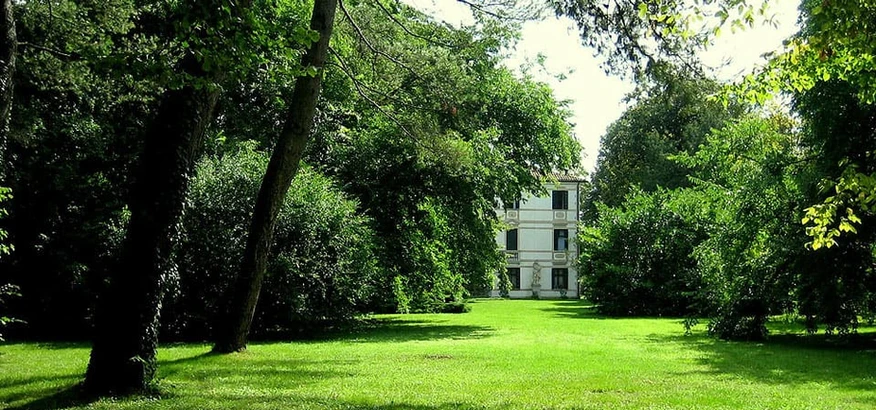
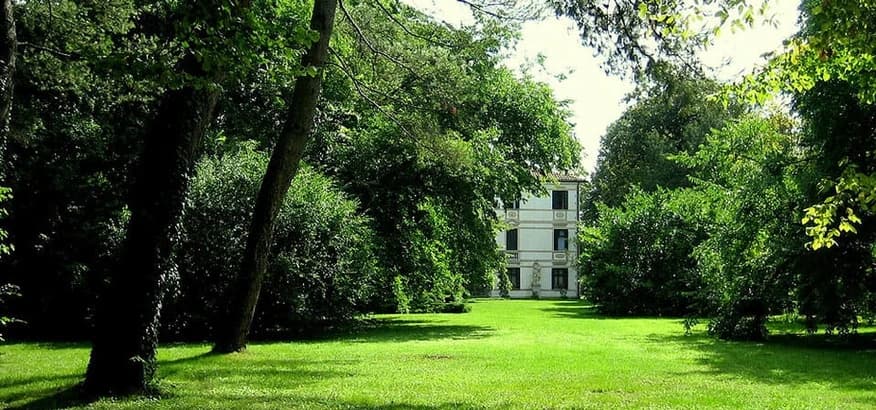
Covering more than an acre and a half, the centuries-old park of Villa Pera provides the ideal setting for memorable events in a fairytale atmosphere surrounded by greenery, where time seems to have stood still.
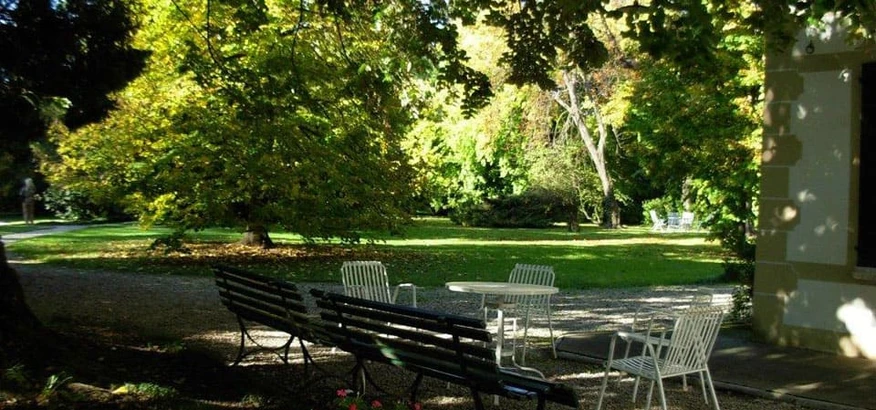
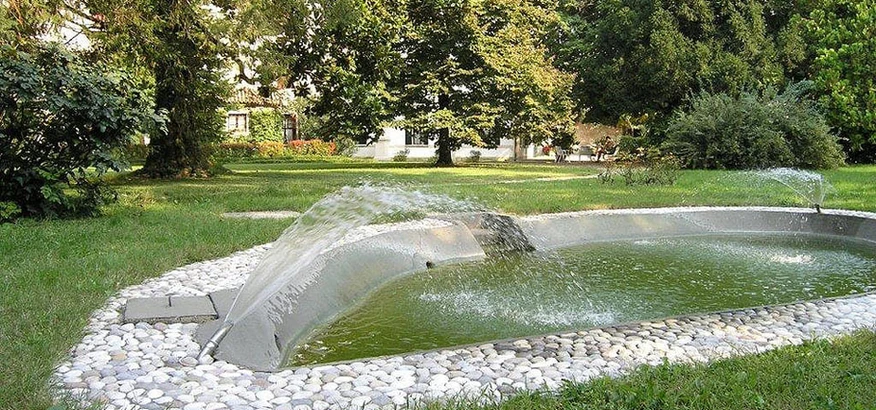
Adorned with ancient fountains and bubbling water basins, the radiant English-style garden is dotted with linden trees, cedars, yews, field maples, hazels, magnolias, mulberries, and vivid flowering species such as roses, lantanas and oleanders, as well as ornamental plants like bay, laurel, holly and acanthus.
Near the main entrance of the villa, one is struck by a magnificent Liriodendron tulipifera, also known as the tulip tree for the beauty of its fragrant cup-shaped flowers, distinguished by a delicate yellow-green hue. Next to it, a splendid Lagerstroemia enchants in August with its lush clusters of blossoms.
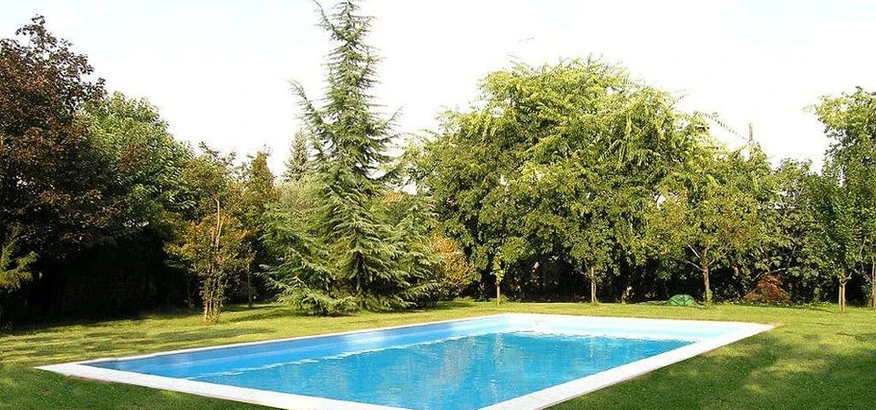
The most secluded area of the park, where the pool is located, is perfect for setting up buffets, cocktail receptions, cake cutting and any other type of event you may desire. The spacious, well-kept outdoor areas can host up to three hundred guests, with the possibility of organizing food and cultural events, theatrical performances, festivals and historical reenactments.
Architecture of Villa Pera
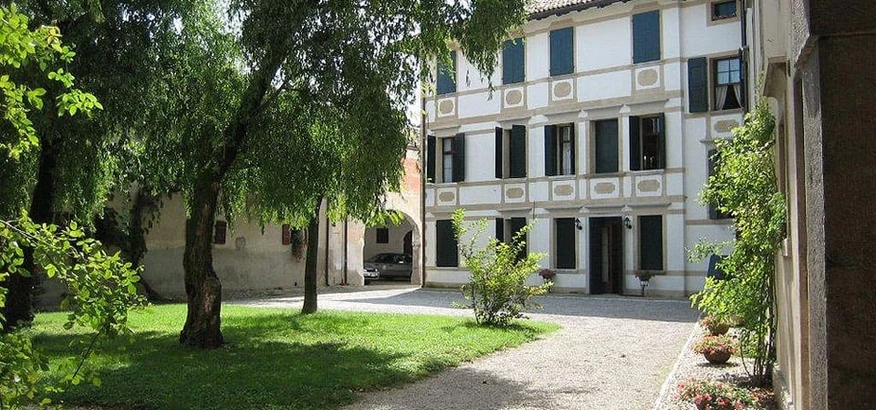
The noble estate consists of a three-storey main building, whose construction began in 1670, around which the annexes used for processing and storing agricultural products are arranged in a spiral.
Divided vertically into three sections, the northwest-facing façade is adorned with two 18th-century statues in soft white stone symbolizing summer and winter. Finished with a triangular pediment, the middle section of the façade is softened on the first floor by an elegant balcony.
Topped by an arched closure, the main façade features on the piano nobile, in a central position, a small terrace crowned by a triangular tympanum. The latter is surmounted by the Pera family coat of arms depicting a lion and a pear tree. Above the blazon stands an astronomical clock beside which, at the lower right, appears the Latin phrase: “gutta cavat lapidem”, meaning “the drop hollows out the stone”.
The layout of the rooms in the residential core reflects the classic plan of the Venetian palazzo, with a through hall and four side rooms. Traditionally, the reception room is arranged between the porta de tera and the porta de mar, facing the street and the canal respectively. In the case of Villa Pera, the main entrance is located opposite the one overlooking the inner courtyard.
Once past the southwest entrance, one is struck by the fine Venetian terrazzo that enhances the bright main hall. On our right are the studies. On our left opens the domestic area with a refined sitting room and the staircase leading to the piano nobile, where an elegant room aligned with the one below is located.
The walls are decorated with paintings of French origin and a fresco depicting the Madonna and Child, Saint Roch and Saint Sebastian, removed shortly after the end of the First World War from a 17th-century chapel scheduled for demolition.
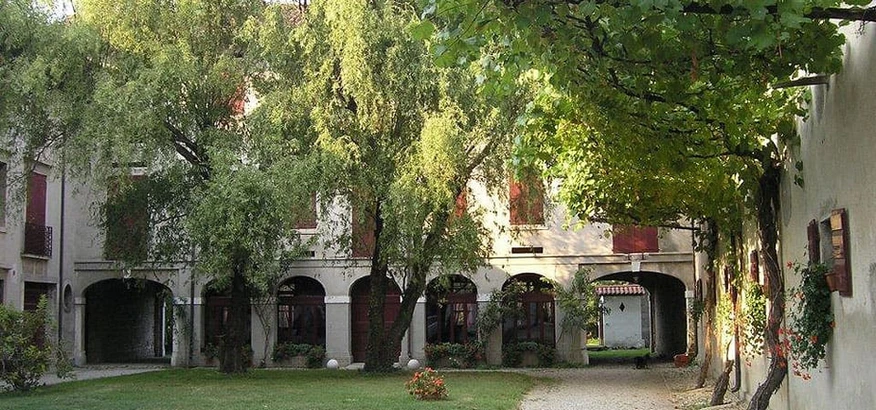
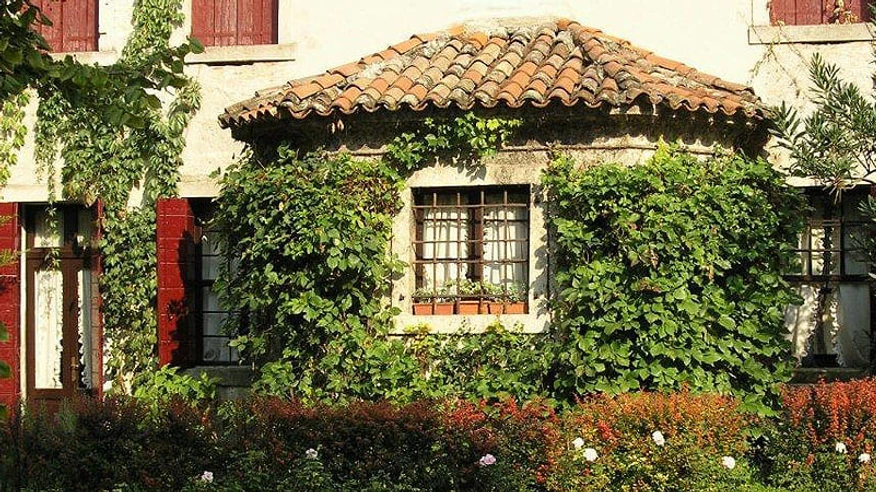
Across the inner courtyard, shaded by a tall twisting willow and framed on the east side by a flourishing vine pergola, you enter a large room with a fireplace capable of hosting up to one hundred people. Above the room is the granary, from whose privileged position, on clear days, there is a breathtaking view of the Cansiglio.
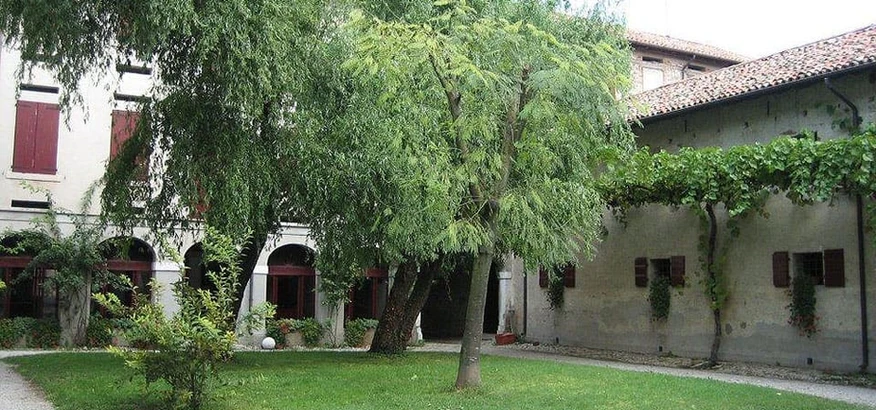
Used for drying and storing corn, wheat, tobacco and silkworms, the large rooms of the granary were ventilated through openings at floor level and above the windows. When needed, the rooms were heated with braziers placed along the walls. Before a pulley for lifting loads was installed, the grain sacks were carried on the shoulders of the sharecroppers up a stone staircase.
Along the east side of the building complex extend the cellar, with period barrels made of chestnut wood, and the grape-processing room with an exposed-beam ceiling, capable of hosting one hundred and fifty people. The entrance to the cellar is flanked by a wooden staircase leading to the Museo Arti e Mestieri de ‘na Volta, an engaging exhibition route that preserves objects from local rural life dating back to the early 19th century.
Always belonging to the same family, Villa Pera is associated with AVV (Associazione Ville Venete), ARVV (Associazione Regionale Ville Venete) and ADSI (Associazione Dimore Storiche Italiane).
If you wish to enjoy an unforgettable experience in the setting of a spectacular 17th-century noble residence, Villa Pera and its charming romantic park offer the ideal backdrop for celebrating major events in an atmosphere of refinement, serenity and exceptional elegance.