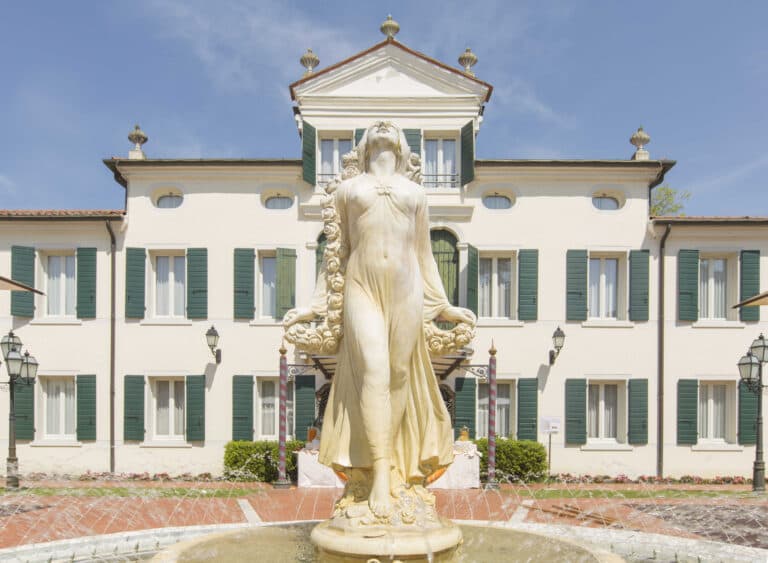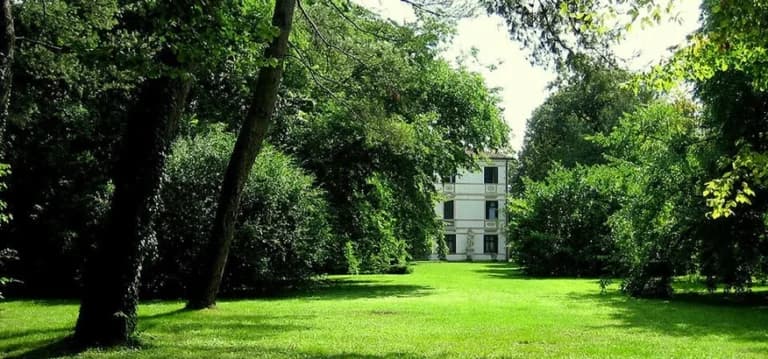

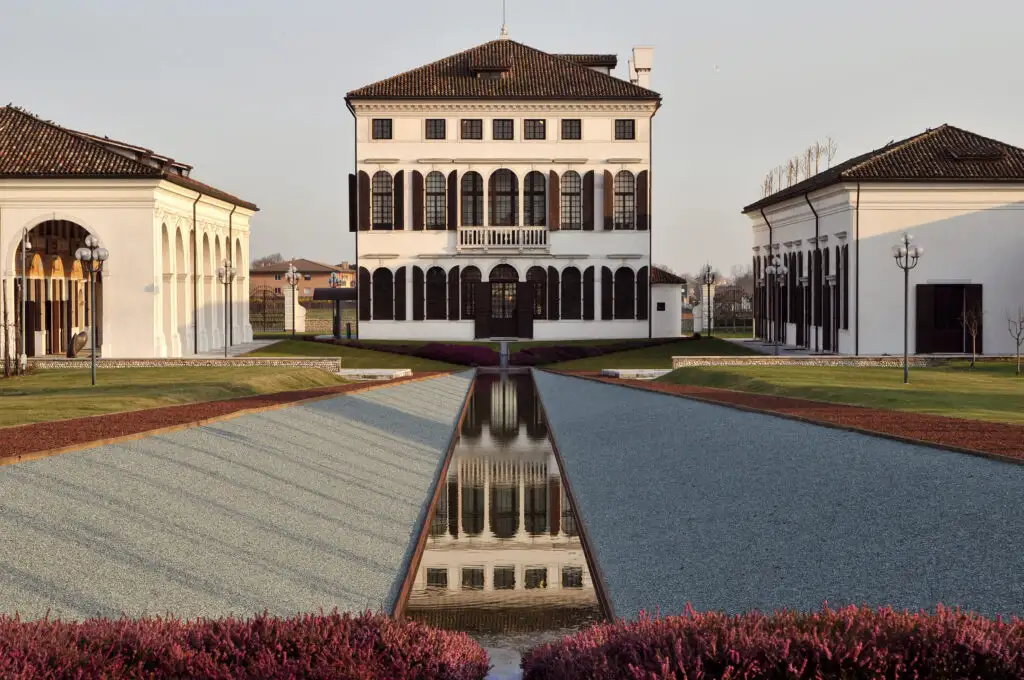
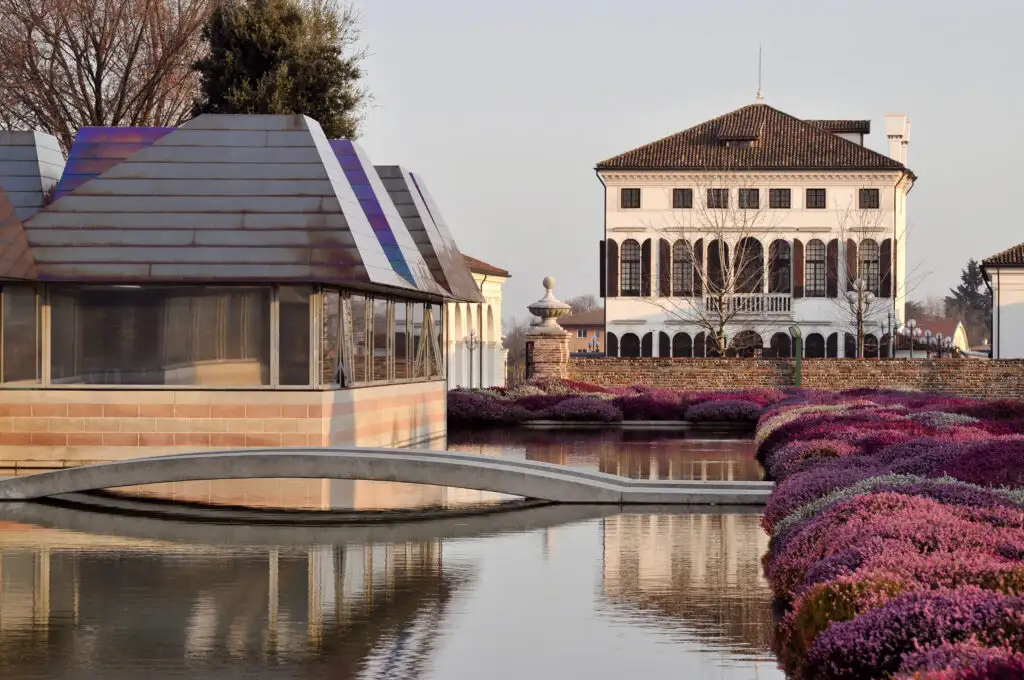
Villa Minelli, internal garden, 2009
Credits: Corrado Piccoli/Benetton Group
Nestled in the heart of Ponzano in the fertile setting of the Treviso plain, the Villa Minelli complex is a jewel of 17th-century architecture surrounded by a thriving vineyard and a bright, tree-lined garden.
Located at Via Villa Minelli, 1, the stately residence stands a short distance from the via Postumia, a Roman consular road dating to 148 BC that linked Genoa and Aquileia.
Ponzano Veneto’s ancient bond with Roman civilization is confirmed by the place name of the town, which identifies Pontius as the leader of the colonists to whom the lands were assigned to be made cultivable and on which an agricultural settlement was founded.
The origins of Villa Minelli
The Villa Minelli – Benetton complex stands on the foundations of a medieval monastic site that included several porticoed structures, probably built between the 11th and 12th centuries. The origin of these buildings, later incorporated into the noble estate, is the subject of two hypotheses. According to the first, they were founded as a monastery and hospice for pilgrims by the Ospedale del Talpon.
The second hypothesis attributes to the Nonantolani friars, present in Ponzano Veneto from the early 11th century, the construction of a small convent to shelter travelers.
Between the 15th and 16th centuries, these buildings were converted into stables, barns, rustic outbuildings and farmhouses to house farming families, oxen and agricultural tools.
On 20 April 1621, Christoforo Minelli, founder of the family, purchased from the convent of Santa Maria Maggiore in Treviso the estate on which he would have the main house, the barchesse and the oratory dedicated to Saint John the Baptist built, which can still be admired today.
The Minelli family
The Minellis were a family of merchants from Bergamo who, after moving to Venice in the 16th century, amassed considerable wealth thanks to thriving commercial activities. Their economic success was such that it allowed them to obtain the title of Venetian patricians for themselves and their descendants, following the payment, made on 27 March 1650, of 100,000 ducats to the Republic of Venice.
A further step in their social ascent came in 1661, with the marriage of Zuan Battista Minelli to Caterina Maccarelli, only daughter of Zuanne Maccarelli. With the extinction of the Maccarelli family, their estate passed to the Minellis. Having consolidated their power, the Minellis abandoned their mercantile activities to invest in landholdings in the Treviso area.
The park and surroundings of Villa Minelli in the 17th century
A 1680 map shows the manor house, the rural surroundings and the farmhouses among which once stood a tower, now no longer in existence. Looking at the document, it is clear that the road connecting Ponzano to Treviso, today corresponding to provincial road 55, ended in front of the villa, then continued north as a mule track.
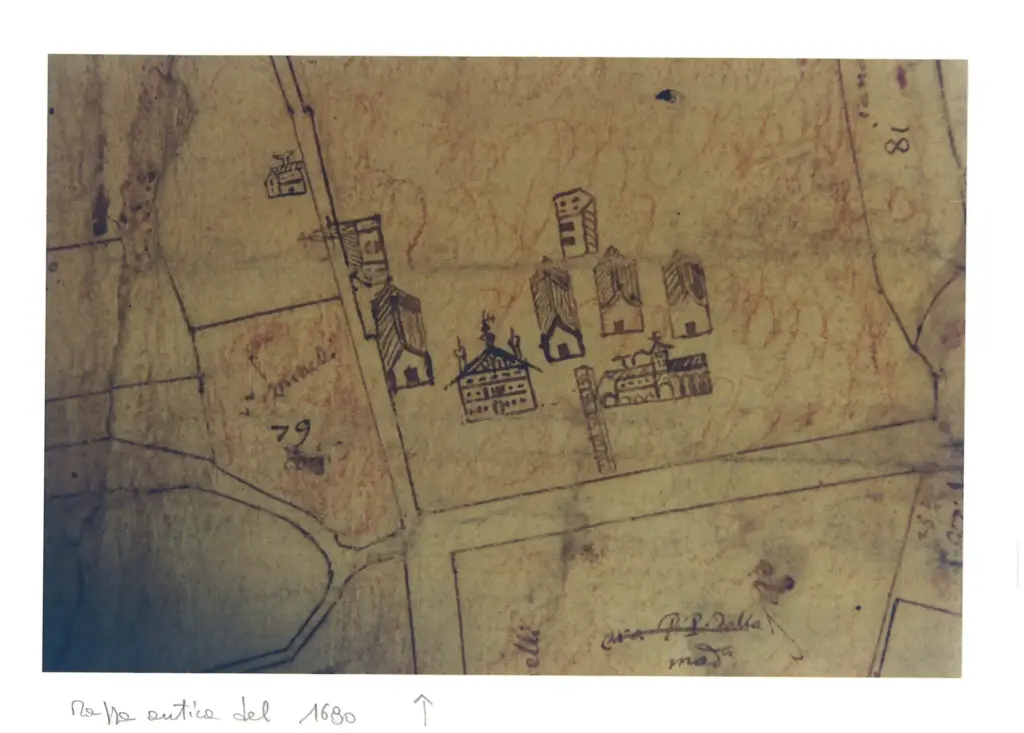
Map of 1680 (State Archive of Treviso, B. 17, F. 136)
From the cadastral maps of the period, it emerges that the noble complex probably stood in correspondence with a park of tall trees dotted with valuable statues (sold at auction in the 19th century). The green area in front of Villa Minelli was crossed by avenues framed by well-kept flowerbeds that reflected the symmetry and geometric rigor of Italian-style gardens. On the southern side of the park, the estate included a stone fishpond.
Topped by refined Sansovino-style beams, the vast and bright rooms of Villa Minelli follow a tripartite floor plan, made up of the central hall flanked by two side rooms with valuable period fireplaces. The ceiling on the top floor features a lower, decorated wooden ceiling.
Villa Minelli in the 18th and 20th centuries
A 1714 map reveals a greater resemblance between the noble complex and its current appearance: some houses and the tower depicted in the 1680 document disappear.
With the death of Cristoforo, Zuanne Abate Minelli, in 1793, the family estate passed to the nieces Elisabetta, Laura, Camilla and to their sons and daughters. This succession led to a legal dispute with the Governors of the Pio Ospedale della Pietà, to whom, according to the testamentary provisions of 3 July 1686 by Cristoforo (known as Andrea) Minelli, the administration of the Ponzano property would have been bequeathed had he died without leaving male heirs.
This dispute was settled on 26 May 1800 with the bequest of three quarters of the property to the institute of the Esposti of Santa Maria della Pietà in Venice. The remaining quarter went to the Minelli sisters.
The institute’s archive documents a series of restoration works carried out on the main house, the barchesse, the farmhouses, the brolo, the garden, the sheds, the stables and the small church, in the period between the end of the 18th and the beginning of the 19th century.
During the First World War, from 1916 to 1918, the barchesse of Villa Minelli housed a British unit, an Italian unit and a supply unit, whose presence worsened the already advanced state of deterioration of the stately complex.
The restoration of Villa Minelli
In 1969 the Villa Minelli complex was purchased by Maglierie Benetton, now Benetton Group srl.
The serious state of decay in which the estate had fallen after a century and a half of neglect made a careful restoration and redevelopment project necessary, carried out under the direct supervision of the Venice Superintendency of Monuments.
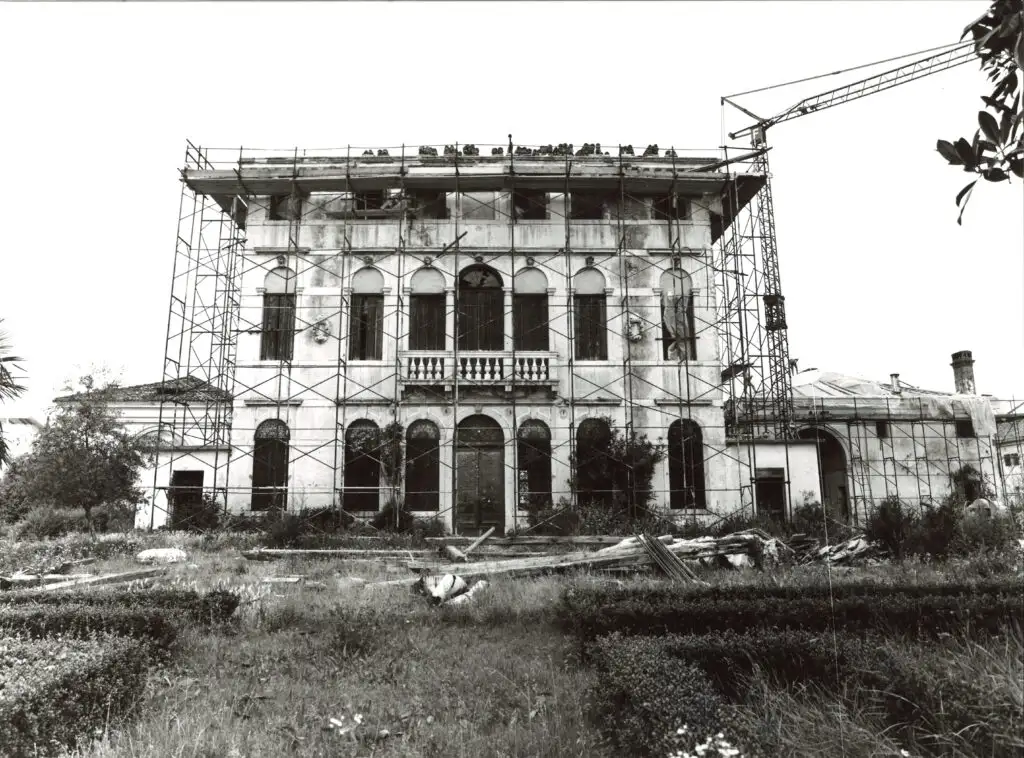
Villa Minelli during restoration, 1970s
Credits: Foto Film di Pozzobon e Mattiuzzo/Benetton Group
Entrusted to architects Afra and Tobia Scarpa, the restoration and functional adaptation works at Villa Minelli were carried out in two phases, from 1971 to 1979 and from January 1989 to September 1990, using materials and techniques of the time to preserve the historical authenticity of the architectural complex and its decorative features.
The projects involved the main villa, the west barchessa and the reception rooms, the east barchessa used as guest quarters and stable, and the small church dedicated to Saint John the Baptist.
Hidden for centuries beneath several layers of lime, the enchanting frescoes adorning the rooms of Villa Minelli and its surroundings resurfaced in the 1970s and returned to their former splendor during a further restoration phase carried out from 1991 to 1994.
During a plague epidemic in the early 18th century, lime had been dusted onto the masonry surfaces of the building complex because of its caustic and disinfecting properties.
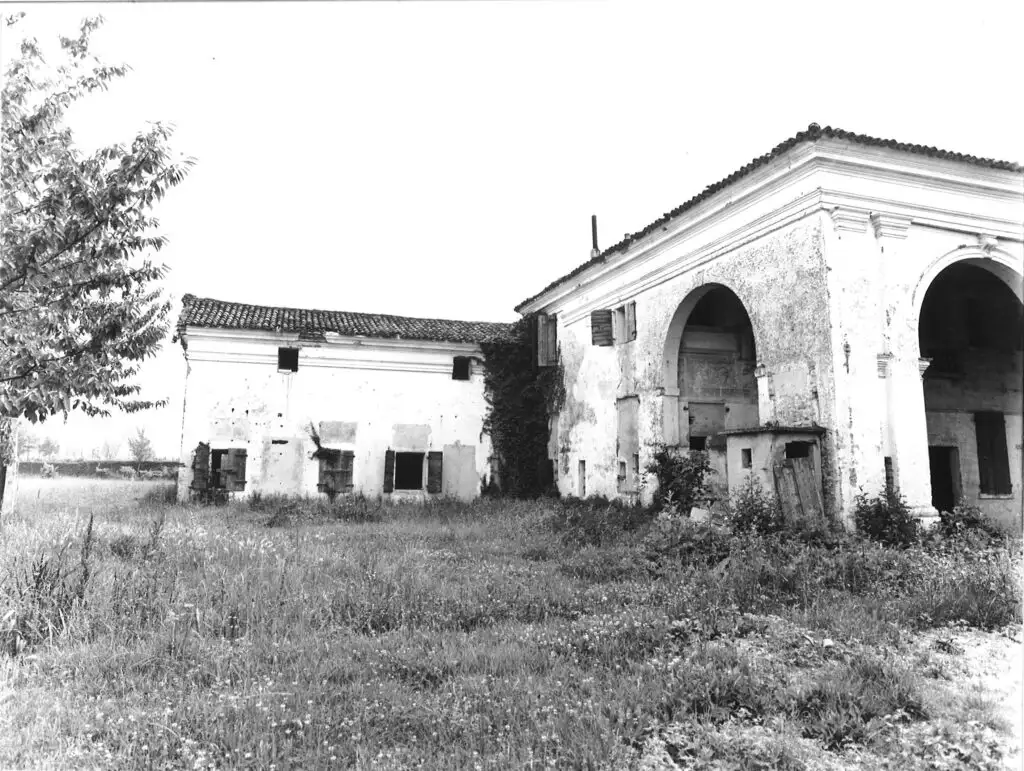
East side barchessa, facade of the annex before restoration, early 1970s
Credits: Benetton Group
The architectural complex of Villa Minelli
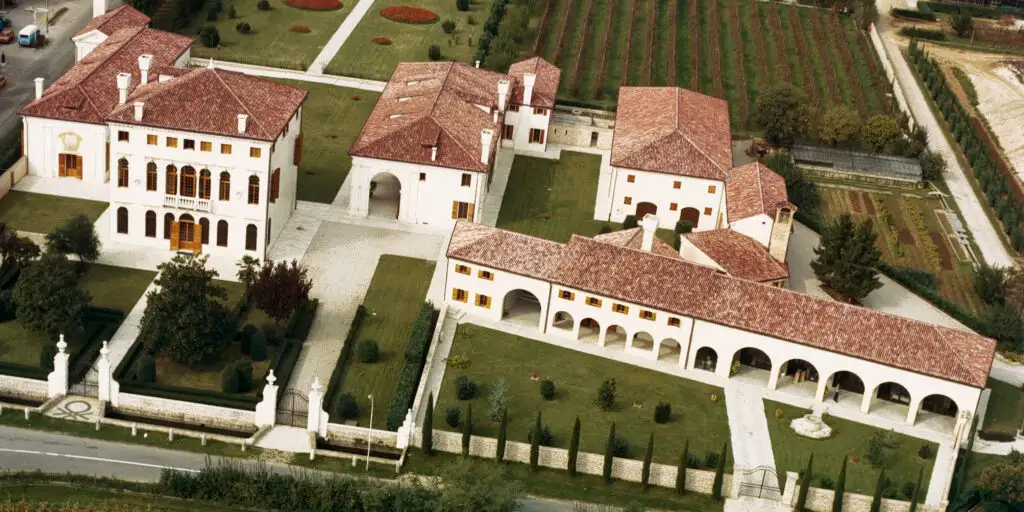
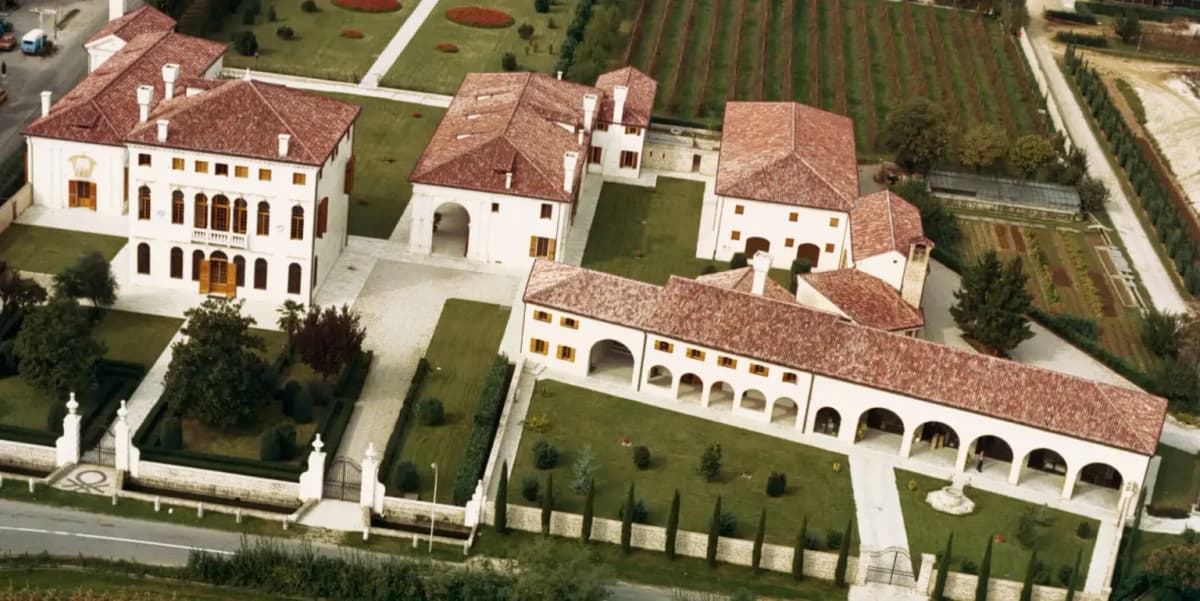
Villa Minelli, aerial view. 1990s
Credits: Benetton Group
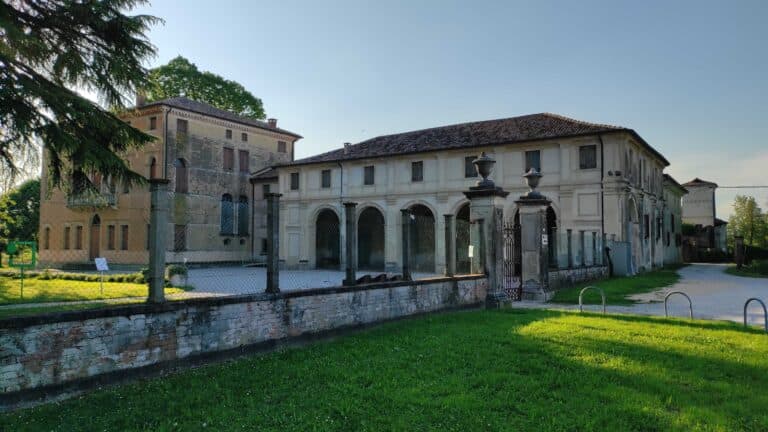
the Villa Minelli complex consists of a central body flanked on both sides by two rectangular-plan annexes, according to the classic Palladian scheme typical of Venetian villas. The porticoed barchessa to the east housed the guest quarters and stable, while the one to the west housed the reception rooms. Behind the western barchessa stands the ancient oratory dedicated to Saint John the Baptist, in which a 18th-century painting depicting the Assumption, by Nicolò Bambini, is preserved.
The property is framed by a perimeter wall in which three elegant wrought-iron gates open on the Via Villa Minelli side. The entrances are marked by rusticated pillars, decorated with vases and connected to the low wall by white scrolls.
The main building of Villa Minelli
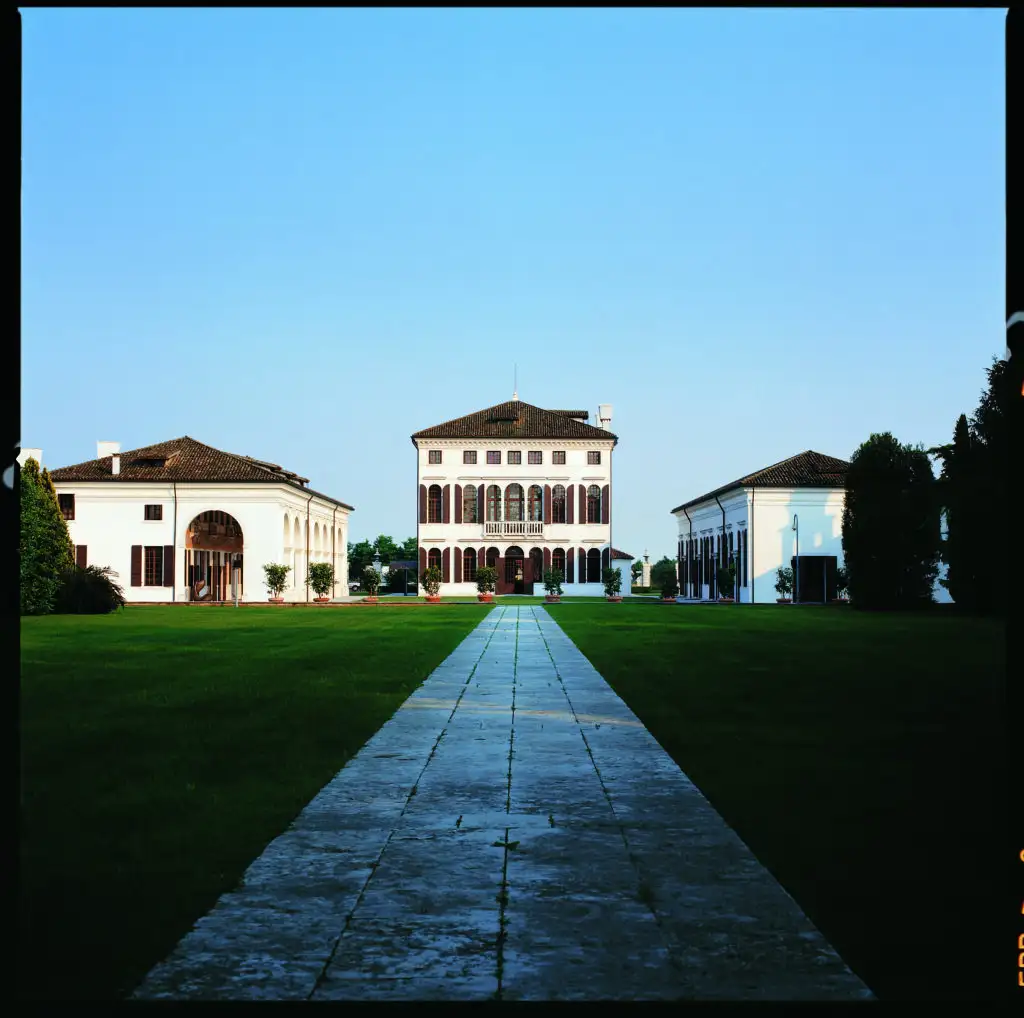
Villa Minelli, internal garden, 1990s.
Credits: Antonia Mulas/Benetton Group
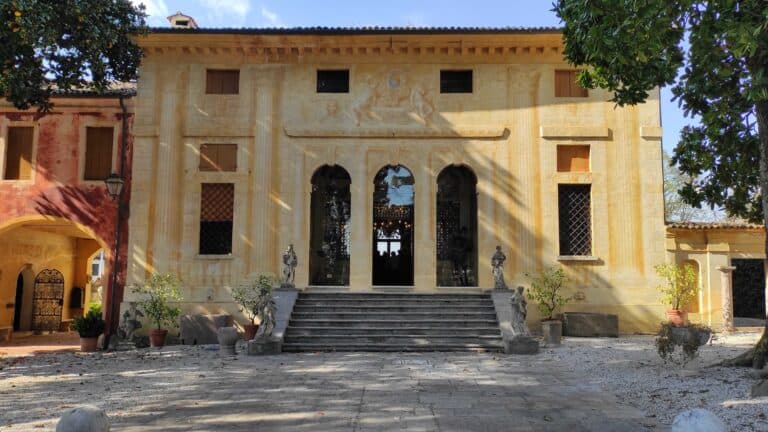
Characterized by through halls and side rooms, the square-plan main house develops over two floors plus an attic. The latter is marked by quadrangular windows, aligned with the openings below. The top part of the building is crossed by a dentil motif that frames the four-pitched roof, crowned by a soaring pinnacle.
The facade facing Via Villa Minelli, identical to the one oriented toward the internal garden, is marked on the ground floor and the piano nobile by openings with arched profiles. Flanked by three single-light windows on each side, the entrance portal is surmounted by a triple-light window, whose central opening is larger. Located at the center of the piano nobile, the triple-light window is enhanced by a stone balcony and flanked by pairs of single-light windows. All the first-floor windows are crowned by mask heads at the keystone.
On the western facade, two chimneys stand out, slightly projecting from the wall surface.
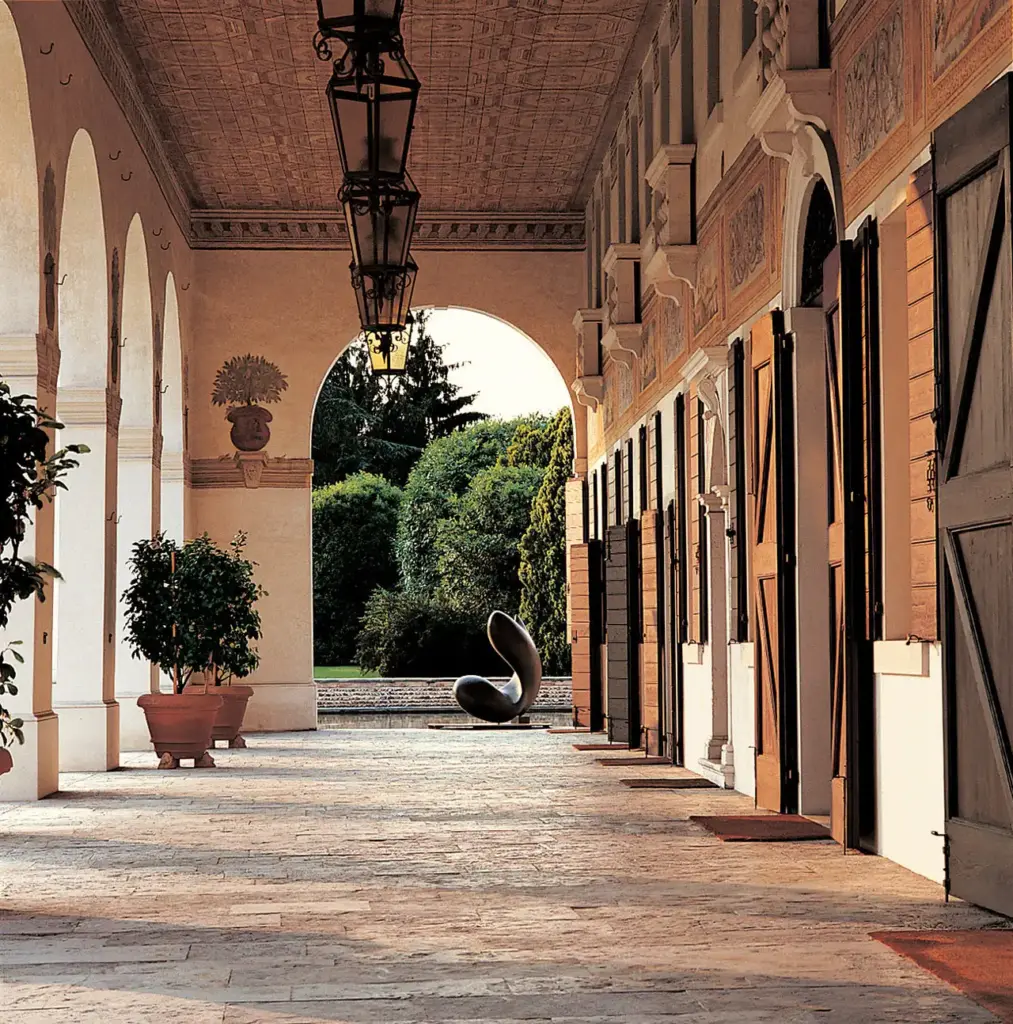
Villa Minelli, east barchessa after restoration
Credits: Antonia Mulas/Benetton Group
The gardens of Villa Minelli
Since 1987, Fondazione Benetton Studi Ricerche has been working concretely on the protection and enhancement of heritage and memory.
In 2006, the joint work of architect Domenico Luciani with landscape architect Ippolito Pizzetti made it possible to restore the landscape that centuries ago distinguished the lush gardens of Villa Minelli, characterized by the presence of the so-called “brolo”, the orchard, the garden and the vineyard.
The frescoes of Villa Minelli
The frescoes on the ground floor of the main house were created between the last years of the 16th century and the early 17th century.
Once inside Villa Minelli, one is enchanted by the splendid fresco depicting the Teatro Olimpico in Vicenza that adorns the left wall.
The first floor houses a painting of the Last Supper, attributed to Palma il Vecchio, executed between the end of the 16th and the beginning of the 17th century.
The frescoes of the west barchessa
Created in a classicist style between 1643 and 1650, the wall decorations in the first three rooms of the western annex (of the Four Liberal Arts, of the Columns, of Galatea) are attributed to the painter Pietro Liberi, nicknamed Libertino (Padua, 1605 – Venice, 1687). The first room depicts the personifications of the Four Liberal Arts, namely Painting, Music, Sculpture and Poetry. On the ceiling, representations of female deities and painted cornices supported at the corners by powerful telamones are visible.
The Hall of Giants
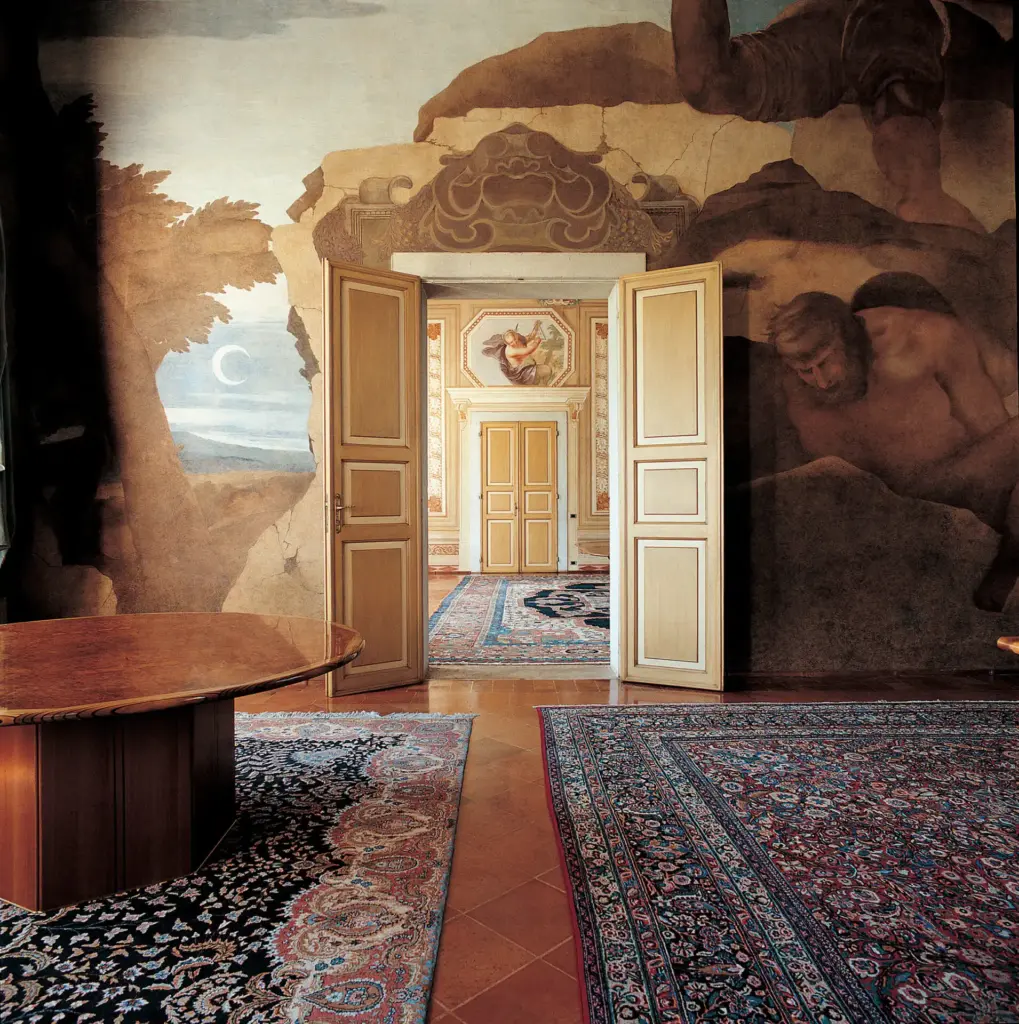
Villa Minelli, west barchessa, frescoes of the “Hall of Giants”
Credits: Antonia Mulas/Benetton Group
The fourth and last room takes its name from the fresco cycle attributed to Pietro della Vecchia (Venice, 1603 – Vicenza, 8 September 1678). The work is a satirical reinterpretation of the mythological theme of the fall of the giants.
The restoration of the wall decoration, hidden for one hundred and fifty years under several layers of lime, was entrusted to professors Laura and Paolo Mora, renowned Roman restorers who handled the restoration of the Egyptian tomb of Nefertari.
Benetton Group
Since the 1980s Villa Minelli has housed the headquarters of Benetton Group.
Benetton Group is one of the best-known fashion companies in the world, present in the main markets with a commercial network of around 4,000 stores; a responsible Group that designs the future and lives in its time, attentive to the environment, the dignity of people and the transformations of society. The Group has a well-established identity of style, color, authentic fashion, quality at democratic prices, and passion, values reflected in the strong and dynamic personality of its brands: United Colors of Benetton and Sisley.
Credits: Corrado Piccoli/Benetton Group