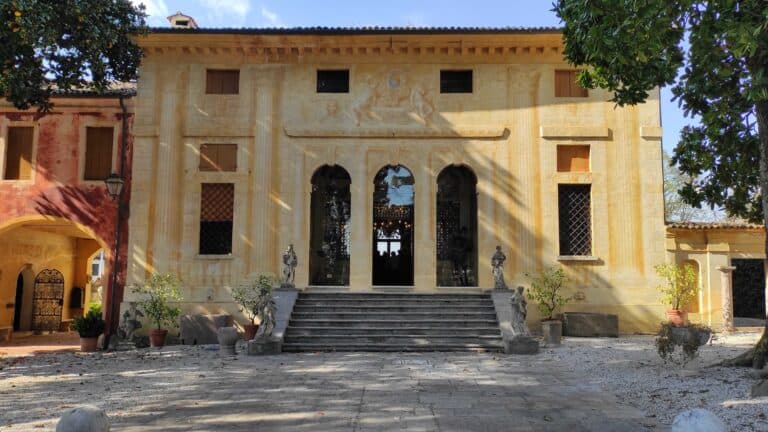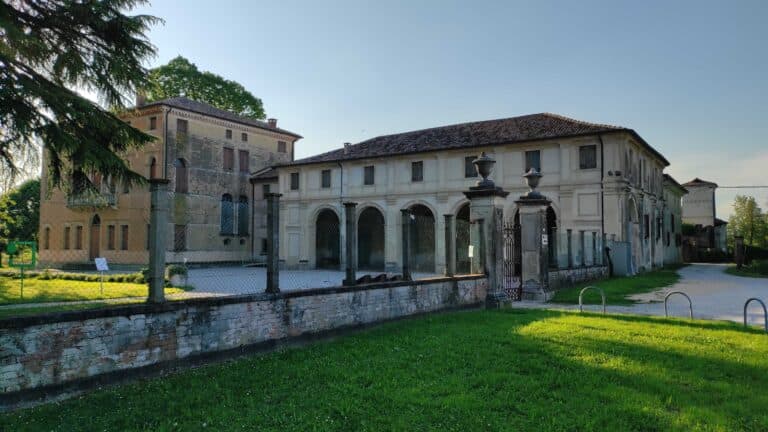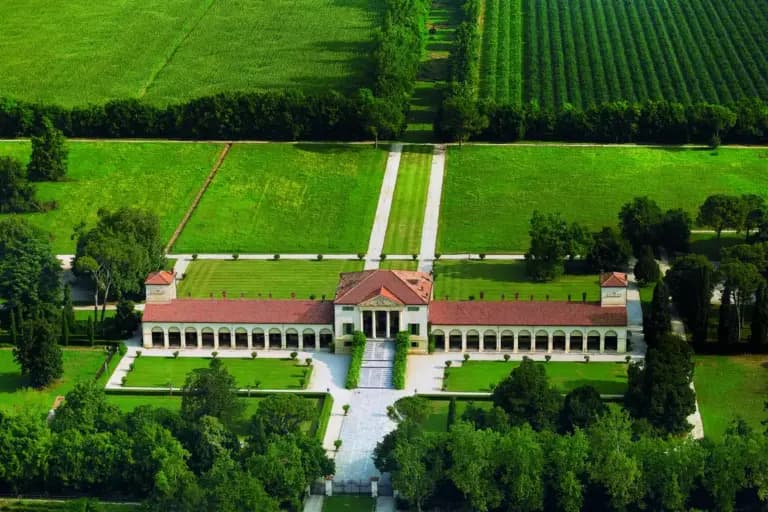

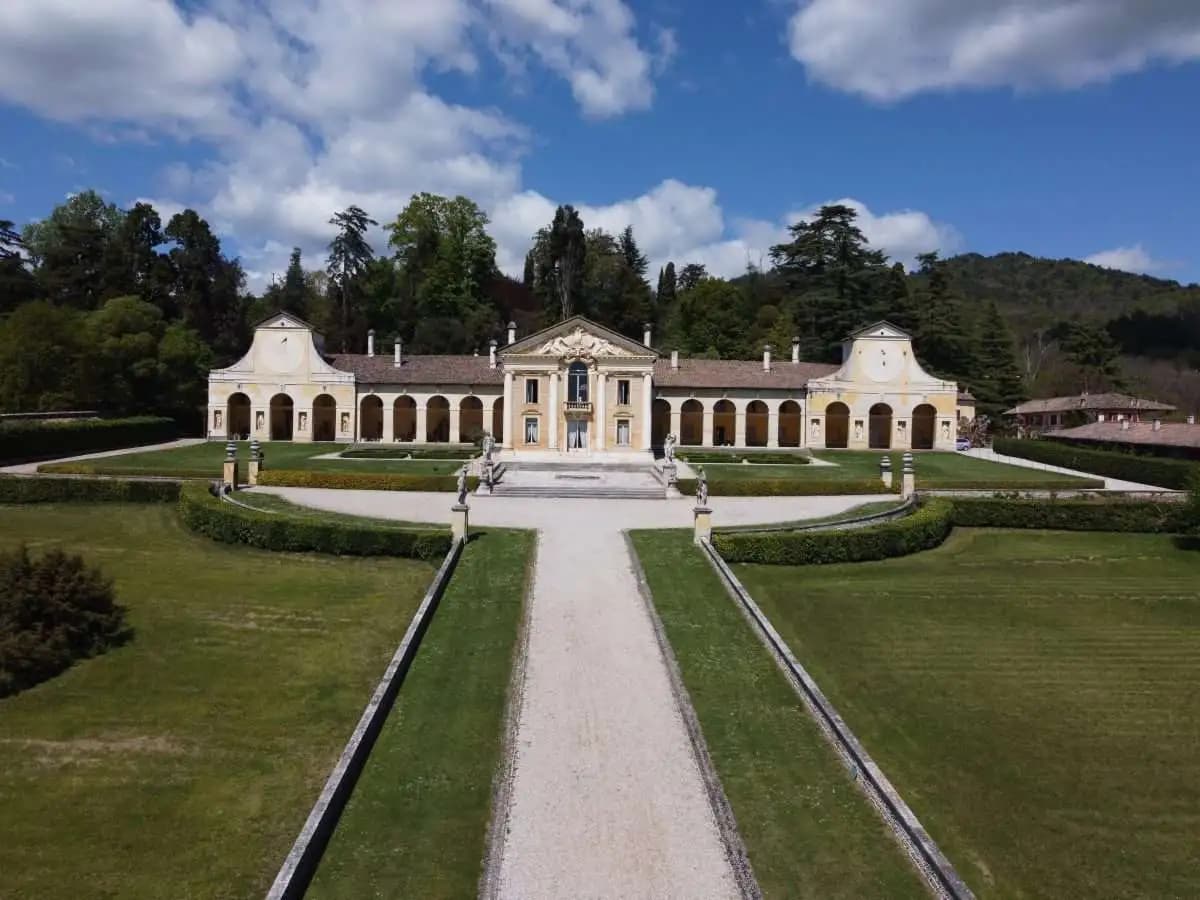
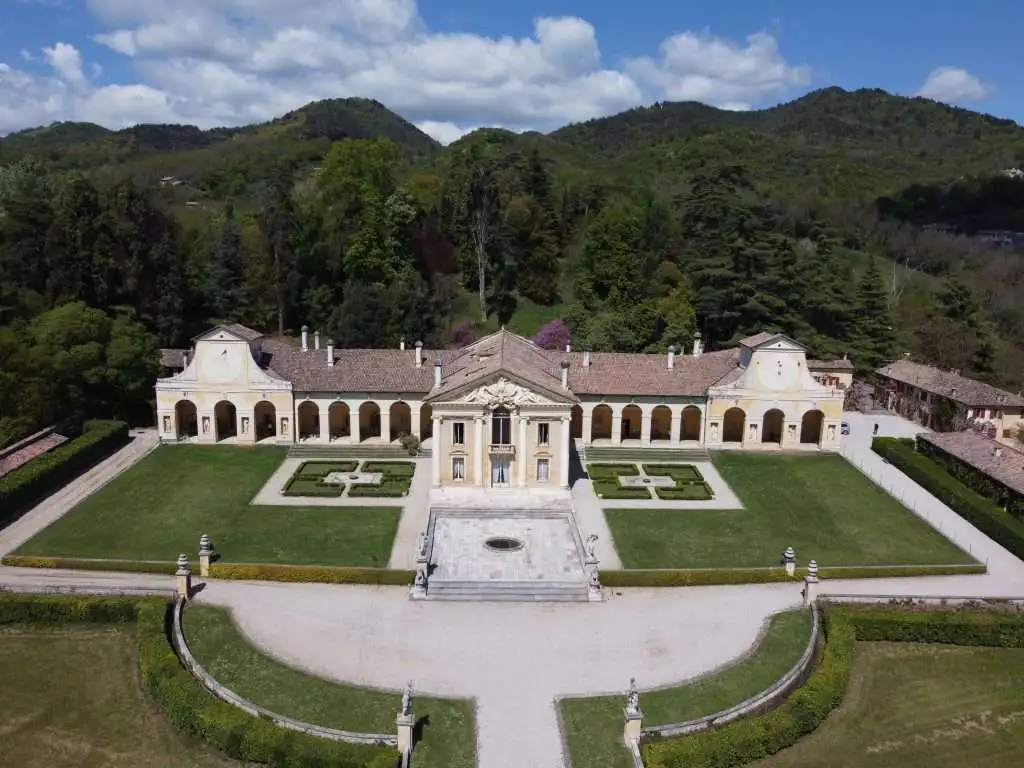
Designed by Andrea Palladio and built from 1549 to 1558, Villa di Maser (also known as Villa Barbaro) stands halfway up a lush wooded slope where the fertile plain meets the gentle tree-lined hills of the Asolani Hills.
Located at Via Cornuda, 7, the Renaissance residence is part of a two-hundred-hectare estate, of which one hundred hectares are woodland, the rest vineyards and partly olive groves.
Declared a UNESCO World Heritage Site in 1996, the architectural complex harmonizes with the gentle slopes of the hill thanks to the balanced connection between the two main levels of the manor house and the external spaces: the ground floor with the garden facing the boundless Trevigiana plain, the piano nobile with the exedra Nymphaeum set against sunny wooded hills.
How to access Villa di Maser?
Past the wonderful circular temple designed by Andrea Palladio in 1580, the gentle climb of Via Barbaro leads to the Villa’s parking lot and then to the entrance courtyard cloaked in roses, wisteria, and climbing begonias that in spring offer a suggestive spectacle of scents and colors.
Architecture of Villa di Maser
The master’s residence
Conceived by Andrea Palladio as the seat of the agricultural estate of the brothers Daniele and Marcantonio Barbaro, the majestic building visible today is the result of the renovation of an ancient manor house that belonged to the patrons.
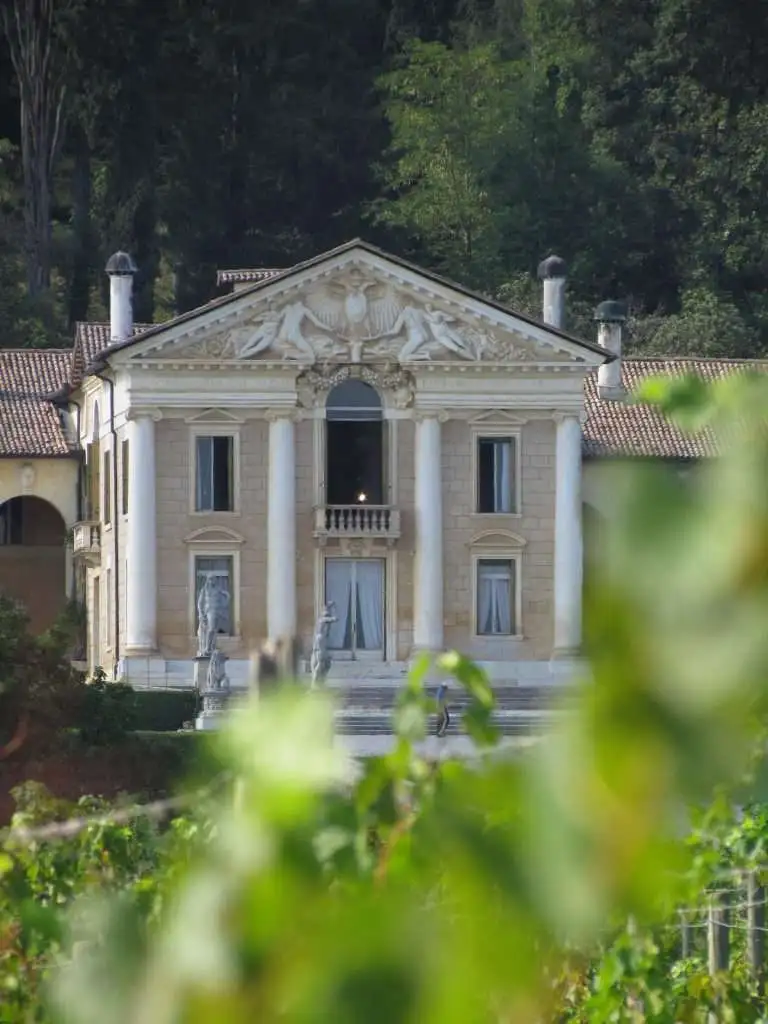
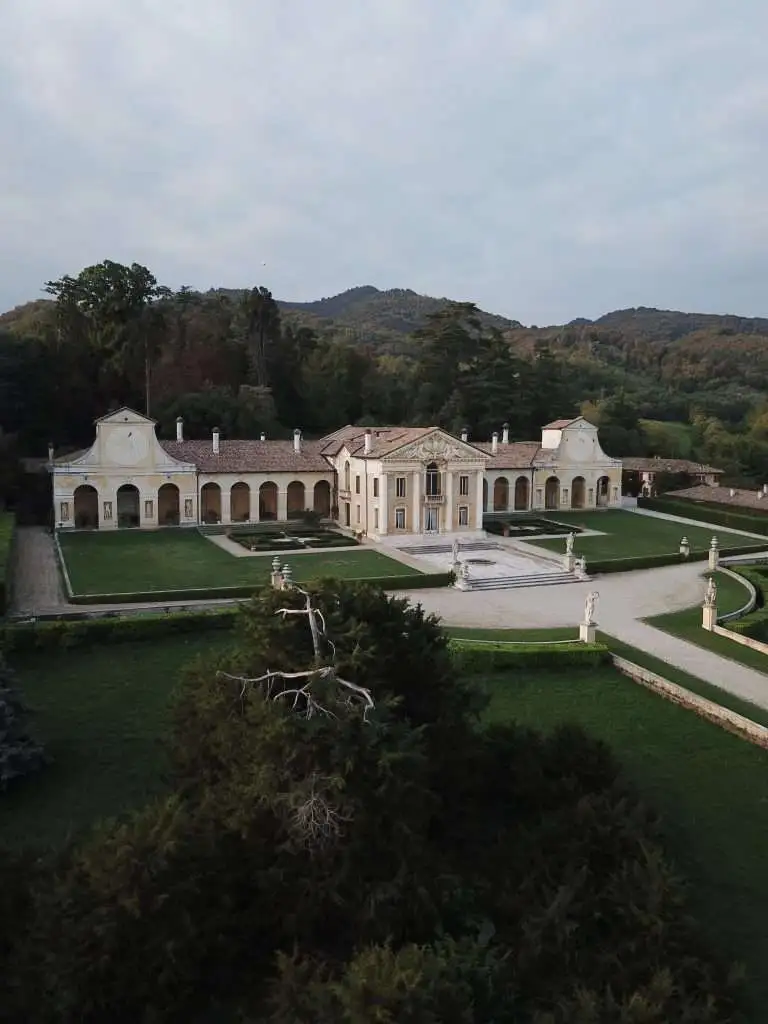
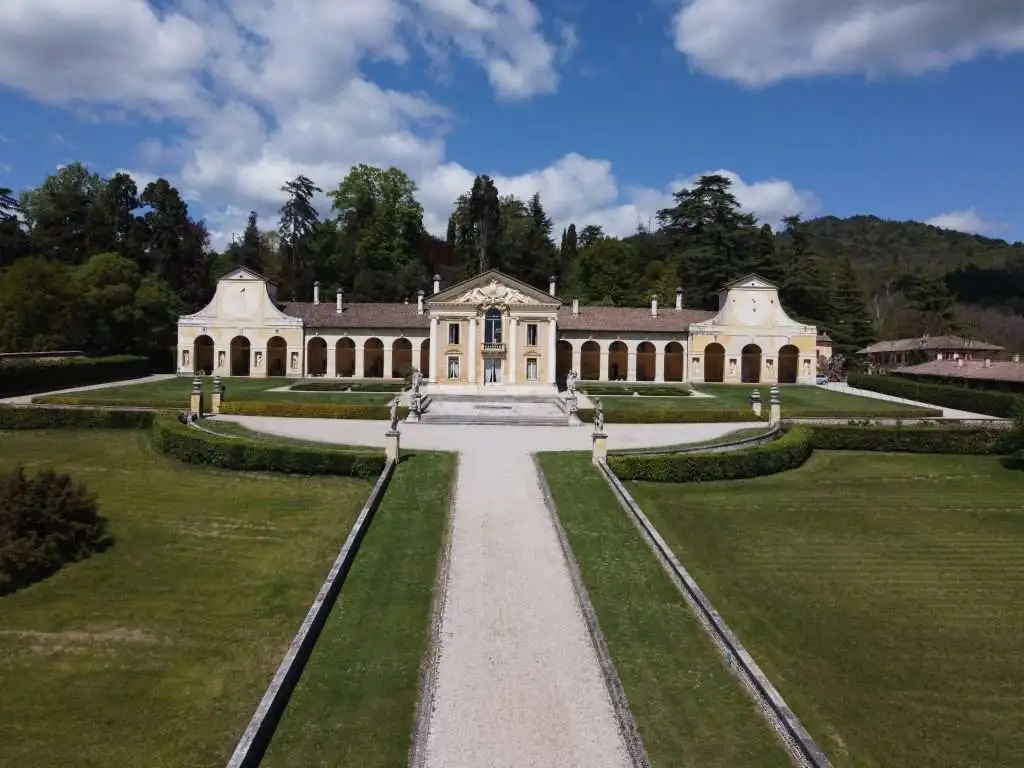
The facade of the main body is vertically tripartite by four Ionic half-columns flanking the central entrance portal. Above the entrance stands a arched single-lancet window adorned with an elegant parapet. In the lateral sections, two rectangular windows open, surmounted by pediments, curved on the ground floor, triangular on the piano nobile.
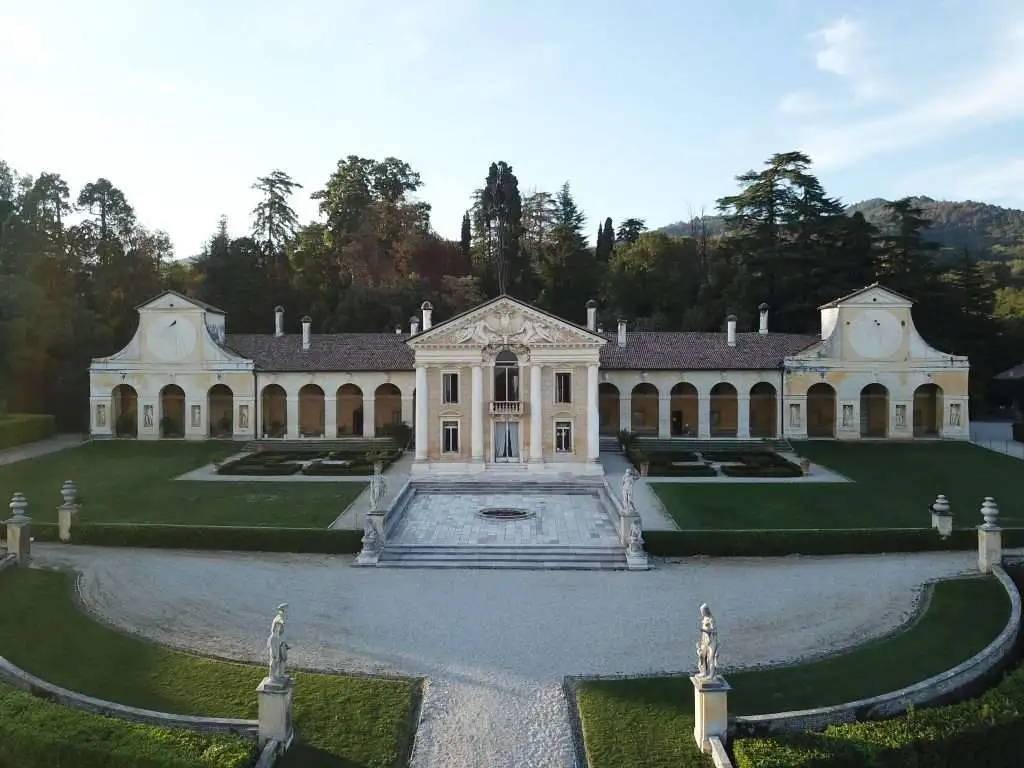
Defined by Andrea Palladio as “That part of the building that projects somewhat outward“, the residential core of the architectural complex is advanced relative to the arcades and fits into the slope of the hill behind.
Interrupted by the archivolt of the single-lancet window, the entablature culminates in a triangular dentilled pediment embellished by fine high-relief stucco ornaments, work of Alessandro Vittoria, depicting the allegory of peace and harmony. The Barbaro coat of arms, placed at the top of the tympanum, is supported by two figures riding dolphins, turned towards a bucranium. The frieze below bears the inscription DAN•BARBARUS•PAT•AQUIL – ET•MARCUS•ANT•FR•FRANC•E.
The arcades and dovecotes
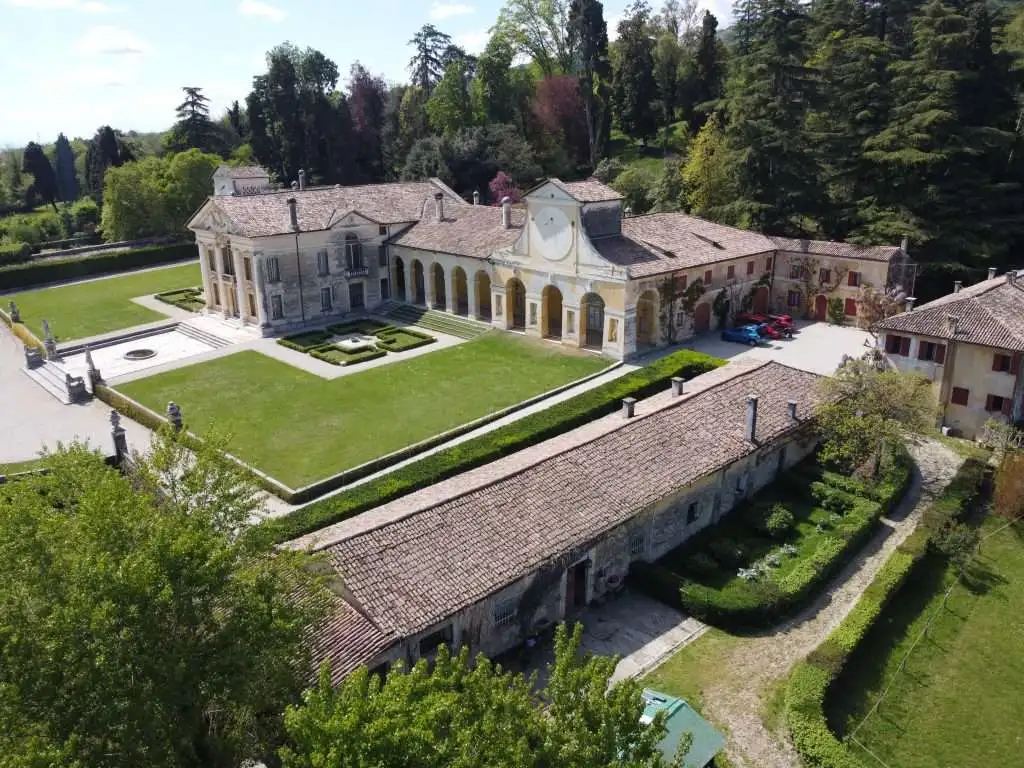
Symmetric with respect to the central body, the wide and bright arcades are marked by five arches supported by pillars and adorned with masks at the keystone point.
At the ends of the porticoed wings rise two dovecotes, lightened at the base of the front by three wide arches above which splendid sundials stand out. The western one marks the hour and the beginning of the seasons, the eastern one is a zodiacal calendar and indicates monthly the date of the Sun’s entry into the corresponding zodiac sign. The facade of the dovecotes is further ennobled by four niches, carved into the pillars, housing precious statues.
The two buildings at the ends of the lateral loggias extend to the rear, framing the back courtyard, from which one accesses one of the most magical and bewitching places of Villa di Maser.
The Nymphaeum
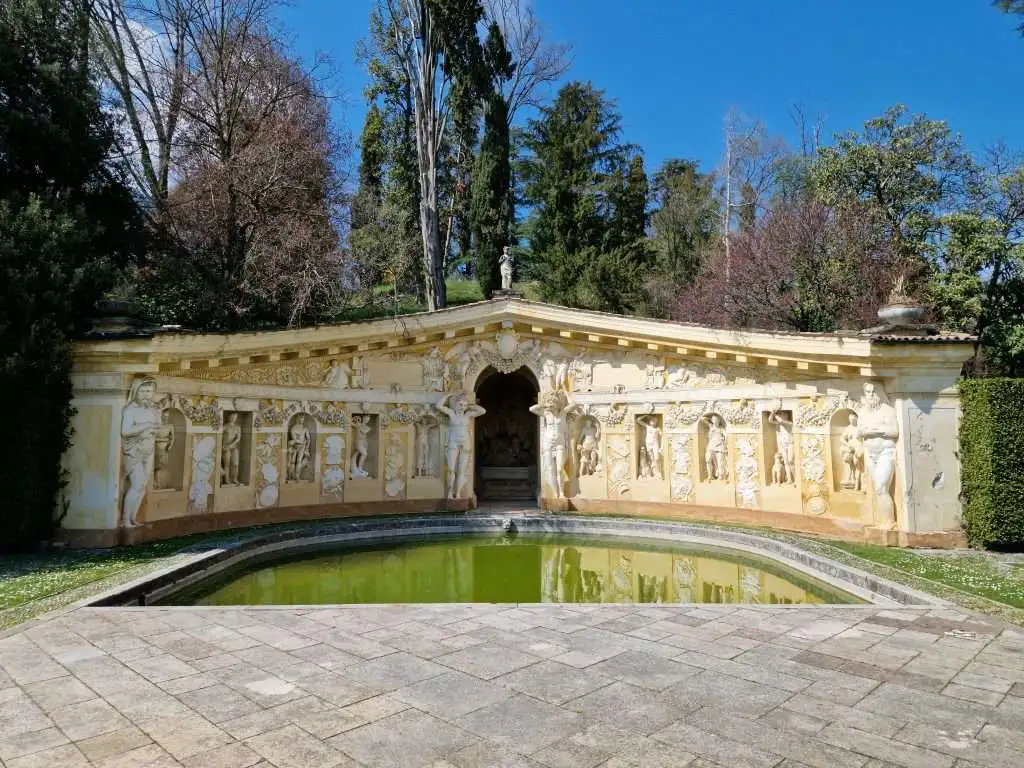
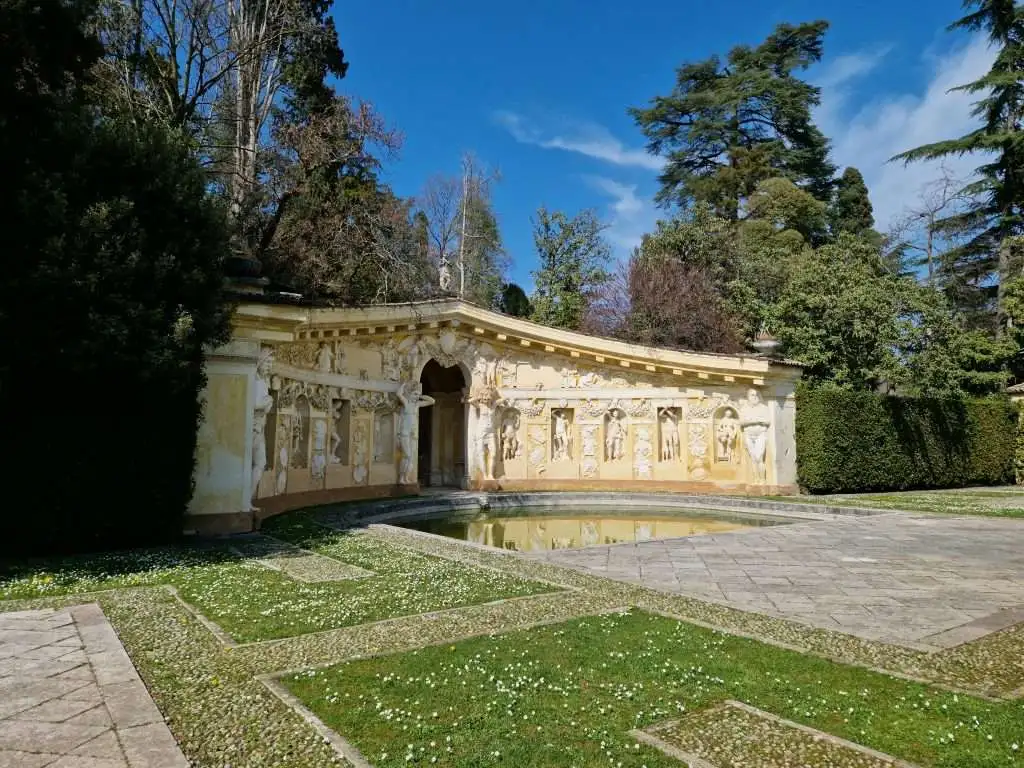
From the hill behind the villa, studded with dark and regal centuries-old trees, Andrea Palladio had an enchanting Nymphaeum carved out.
The hydraulic system that feeds the cistern at the top of the wood powers, by gravity, the splashing water games of the Nymphaeum, serves the Villa, and through the garden, reaches the plain in front marked by the tree-lined avenue with lindens.
The decorations of Alessandro Vittoria
The exedra of the Nymphaeum is adorned with refined statues of sylvan and Olympian deities placed in ten niches. Four imposing telamones, attributed to Marcantonio Barbaro, support the entablature decorated with putti and fasce.
The keystone of the arch giving access to the grotto is decorated with the Barbaro coat of arms, supported by two winged figures.
The rooms frescoed by Paolo Veronese
Cross-vaulted room
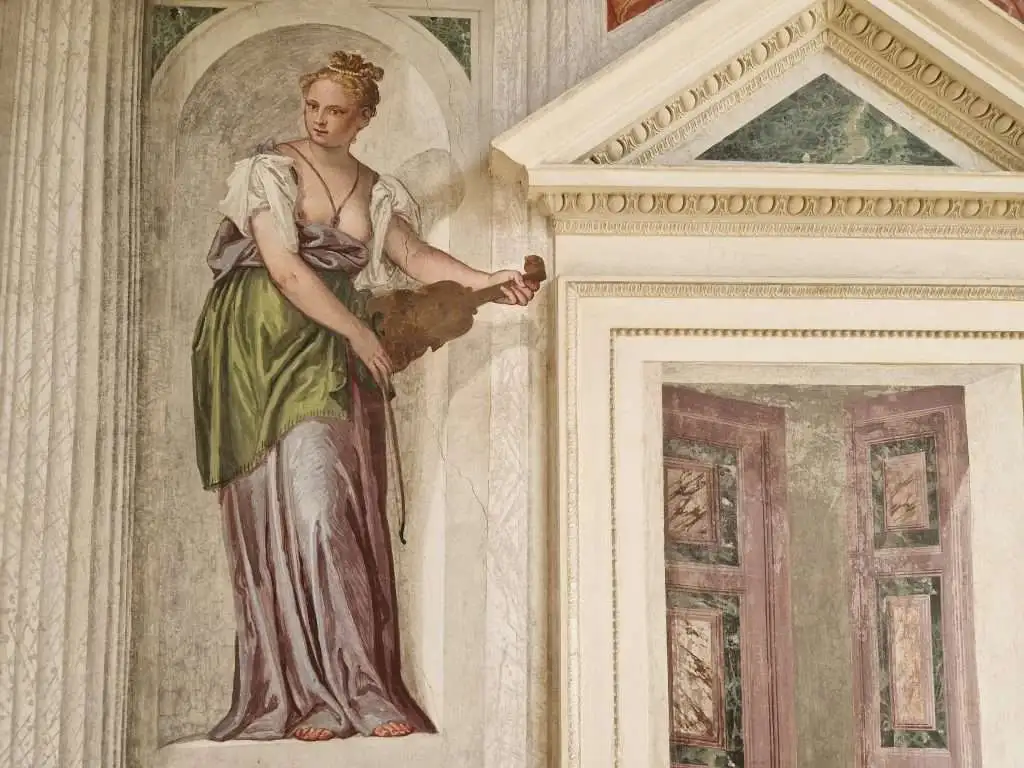
Created from 1560 onwards, the painted architectures of Paolo Veronese skillfully integrate with the spaces of the cross-vaulted room, creating a delicate balance in which the environments designed by Andrea Palladio gently fade into the illusory perspectives of Veronese.
A triumph of Venetian colorism, this masterpiece of trompe l’oeil enlivens the heart of the noble residence. White columns and wide balustraded arcades offer pleasant views of lush sixteenth-century tree-lined gardens, a page and a little girl appear to welcome from the doors, while in the niches two female musicians greet those present with pleasant melodies.
Spears and halberds placed near the windows invite one to lighten worries and immerse in the dreamlike atmosphere of the estate.
Room of Bacchus
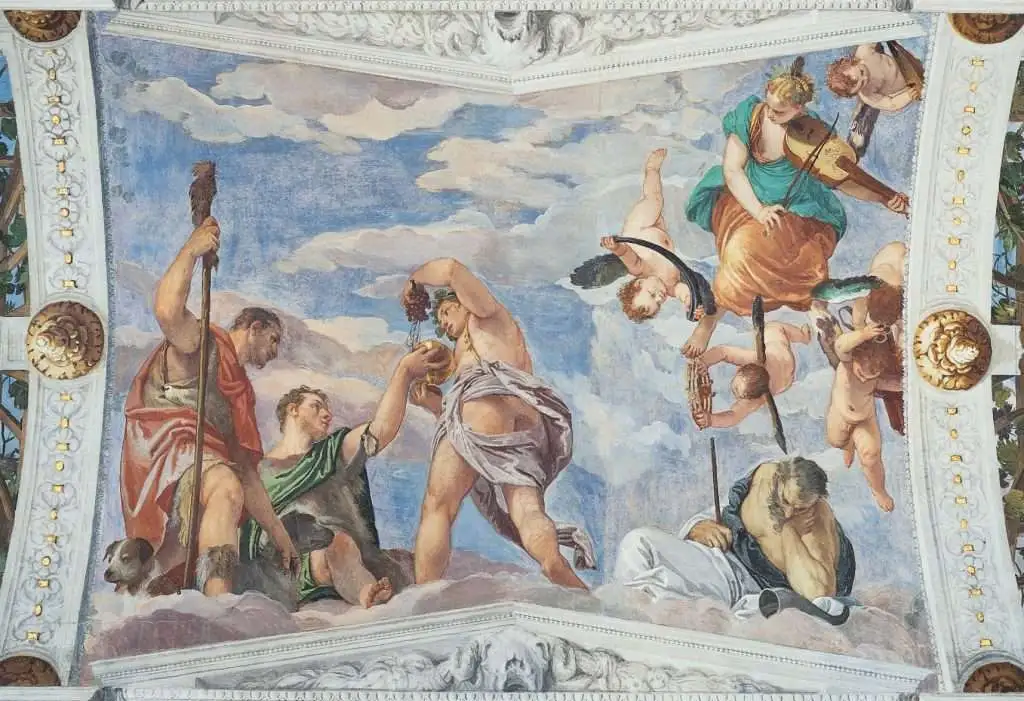
The Room of Bacchus celebrates the fertility, abundance and quality of the grapes produced in the prosperous vineyards of the estate since the 16th century.
The fresco on the vault immortalizes Bacchus in the act of offering grapes to shepherds suspended on soft clouds. Another shepherd rests serenely lulled by the melodies of a female musician and four fluttering putti. The scene is framed by lush pergolas.
Veronese’s complex geometries seem to expand and give brightness to the room through scenes of daily life set among ancient ruins and celestial scenarios that generate the illusion of a boundless ascent.
Suggestive chiaroscuro contrasts enhance the illusory volumes of fluted Ionic columns and niches housing elegant statues. The grand simulated structure frames painted tree-lined avenues crossed by carriages drawn by majestic steeds. A scene symbolizing love and procreative passion illustrates Apollo and Venus exchanging intense glances.
Room of the Court of Love
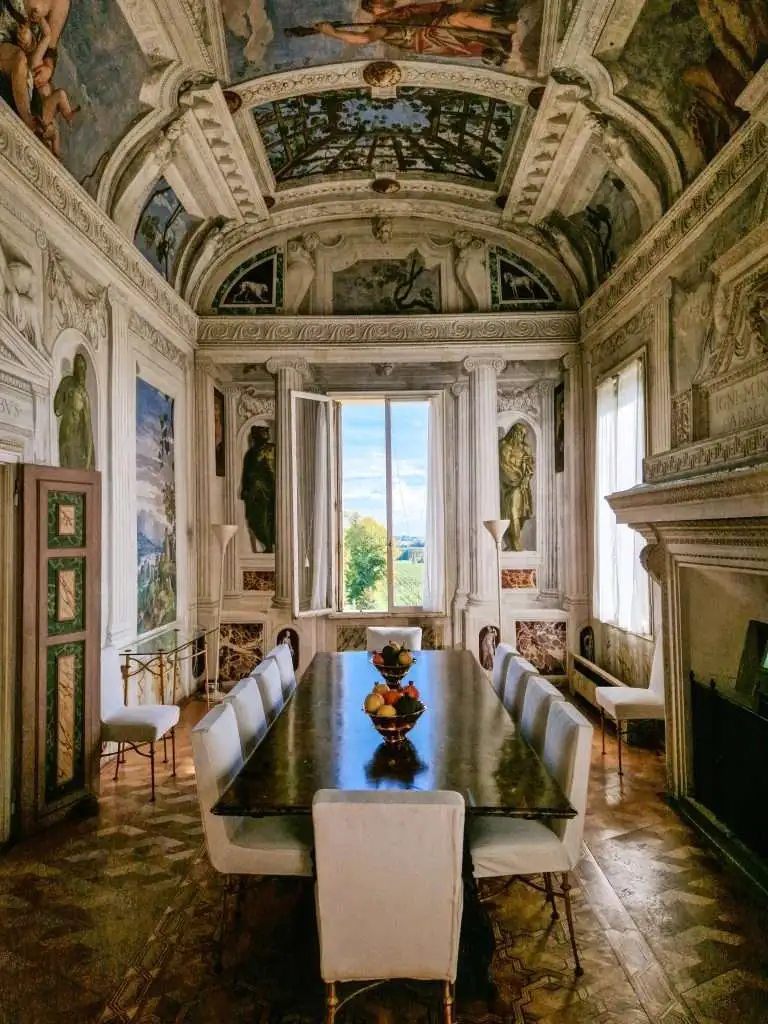
The theme of conjugal love is represented by a celestial court tasked with evaluating the behavior of the young bride, kneeling between her husband and the defender. Seated on a plump cloud, the judge is flanked by Justice, with a club in one hand and a bouquet of flowers in the other.
The happy conclusion of the trial is implied by the presence of joyful putti who shower bright flowers on those present while three female musicians, above the stucco fireplace by Vittoria, cheer the environment with their music.
The fascinating depictions of daily life are echoed by the splendid glimpses of the garden visible from the large windows. Adding dynamism to the composition is a group of winged cupids who, vying for the precious silver service of the Barbaro family, highlight their coat of arms.
Room of Olympus
Facing the white parapet, Giustiniana Giustiniani, wife of Marcantonio Barbaro, welcomes us into the Room of Olympus, the heart of the noble residence, together with her nurse and three children.
With proud and elegant bearing, Lady Barbaro rests her hands on the edge of the balustrade where a parrot and a little dog are depicted. Below Giustiniana Giustiniani, a representation of Villa Barbaro can be seen.
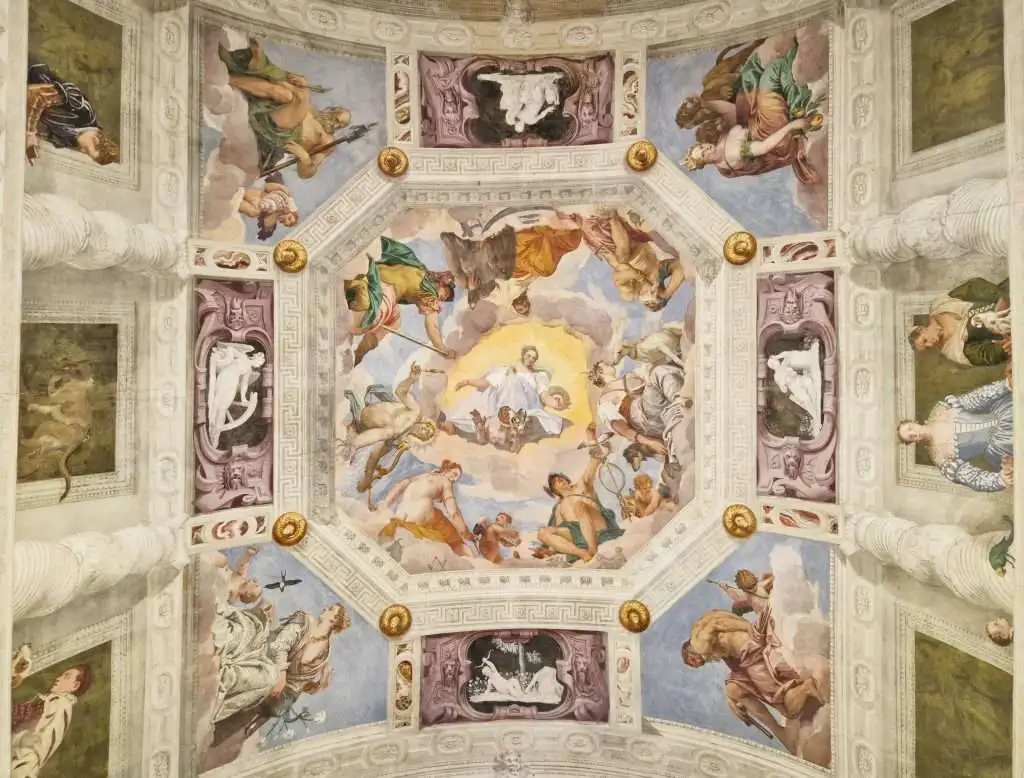
An expression of Veronese’s mastery and creative genius, imposing twisted columns adorned with plant motifs accentuate the verticality of the room. The simulated columns support the fake octagonal architectural frame that houses the main divinities of Olympus with their respective symbols. In the lunettes and corners, the seasons and the four elements are painted.
From the center of the brilliant vault of light emerges the figure of a woman on a winged monster carrying a message of salvation, of universal Harmony.
Room of the Dog
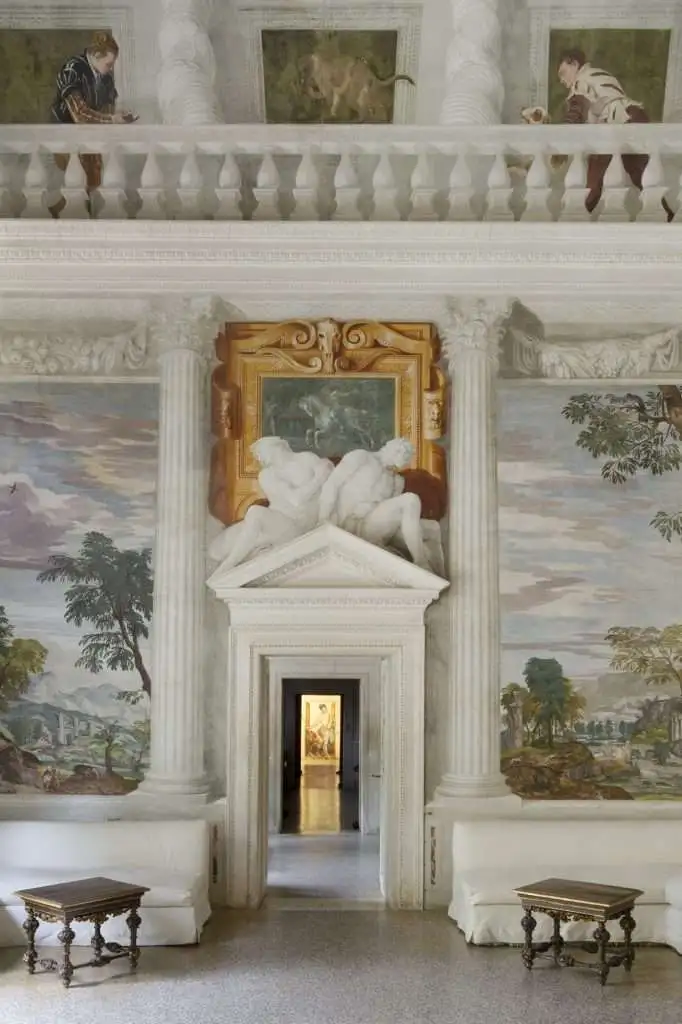
The room is named after the pretty little dog on the left wall, crouched in front of the fake marble base. The allegory on the vault shows three women vying for a cornucopia. The female figures represent Venice, Ambition, and Envy hiding a knife. Soaring pairs of Ionic columns frame a romantic marine landscape dotted with ruins cloaked in vegetation.
On the wall opposite the entrance, one can admire the Holy Family with St. Catherine, protector of the Barbaro family.
Room of the Lamp
Rich in biblical symbolism, the Room of the Lamp is adorned with an allegory of Faith, with the Holy Chalice in one hand and the open Bible at her feet, showing the sinner the way to eternity, a concept embodied by a serpent that encircles the earth biting its tail. Charity guides the sinner and disdainfully crushes a chest of jewels before the Heavenly Father who emerges from the clouds.
Noteworthy is certainly the splendid optical illusion generated by the putto with spread wings holding the elaborate metal lamp hanging from the ceiling.
Portrait of Elena Caliari
Paolo Veronese’s wife is portrayed in elegant attire, with a fan, on the wall at the end of the sequence of rooms. The size of the lady, larger than life, is deliberately studied to confer a sense of proximity through an ingenious perspective effect.
Self-portrait of Paolo Veronese
Dating back to 1562, the self-portrait of Paolo Veronese shows the artist wearing a refined hunting outfit. The work is a precious testimony of the affection felt by the painter for this place, to whose extraordinary beauty he contributed with his works.
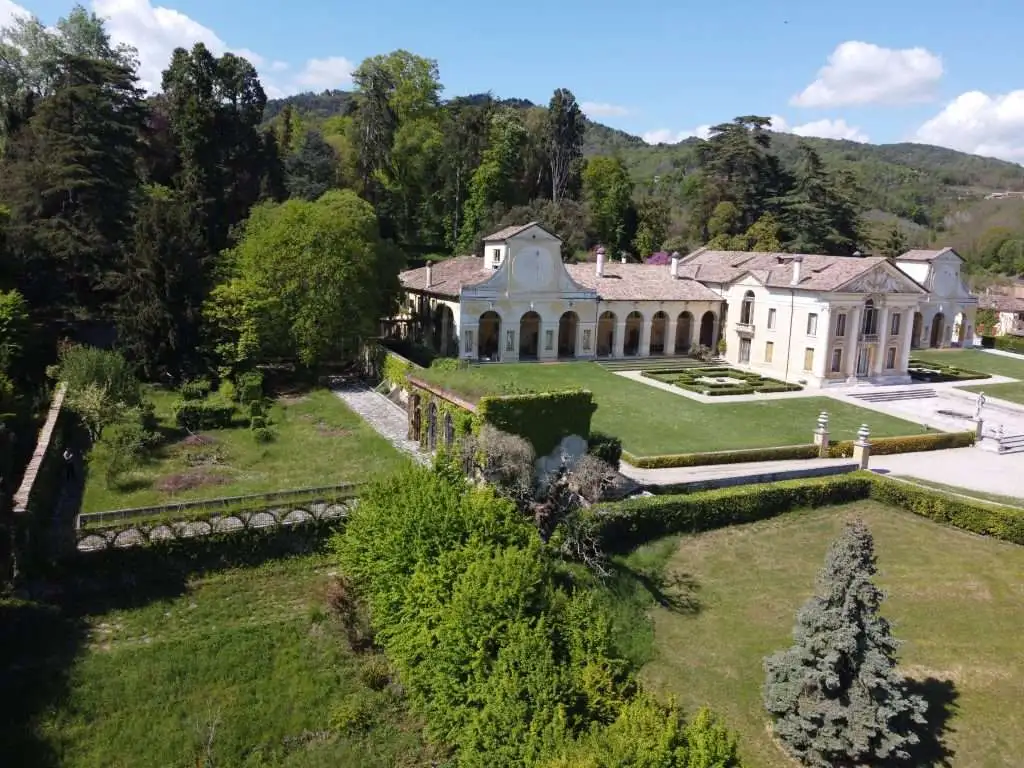
Villa di Maser
What it was……..and what it will be again
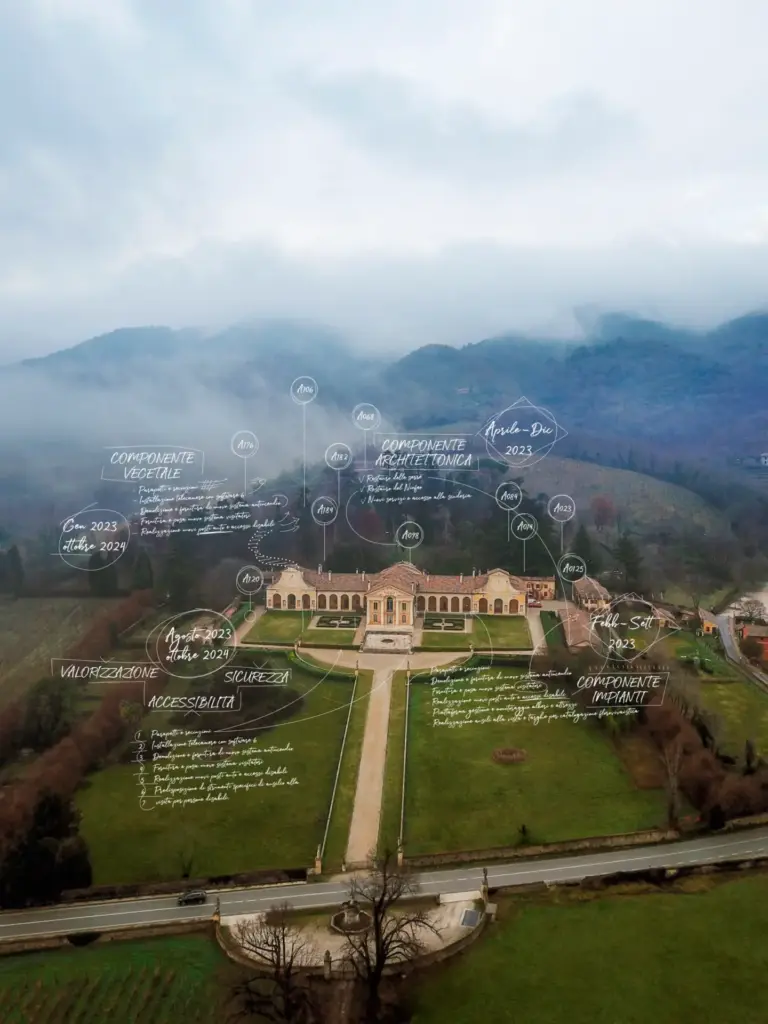
“That part of the building, which projects somewhat outward, has two orders of rooms, the upper floor
is level with the courtyard behind, where a fountain is cut into the hill opposite the house, with infinite stucco and paint ornaments. This fountain makes a small lake, which serves as a fishpond; from this place the water flows into the kitchen and then irrigates the gardens that are on the right and left side of the road, which gradually ascends to the building; it makes two fishponds with their drinking troughs above the common road; from there it flows to water the orchard, which is very large and full of excellent fruits and various game”.
Andrea Palladio, The Four Books of Architecture, Book II, Venice 1570
Thus Palladio describes in a few lines the nature of Villa di Maser, where the water flowing from the source generates architecture, landscape and agricultural production, in an extraordinary synthesis that has preserved its unitary character over time.
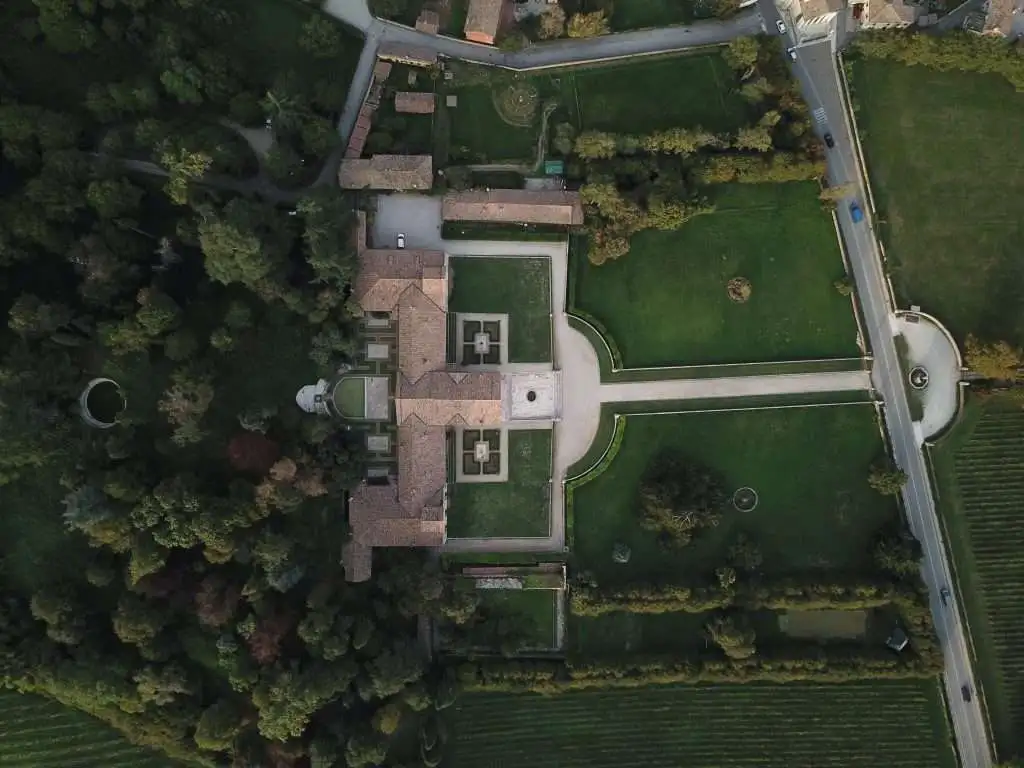
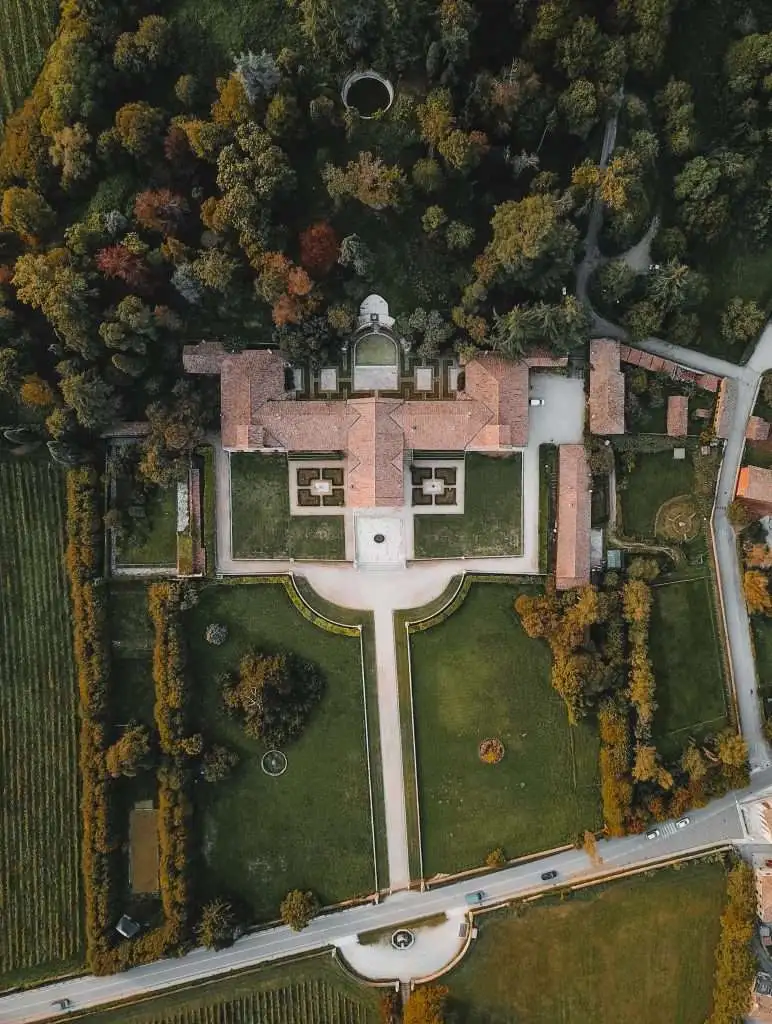
The Villa includes the arcades, the temple, the Nymphaeum served by the hydraulic system described and the large garden.
Time has partly erased the functionality of the great architect’s thought, but not the memory, and the project’s goal is to bring back to life, as far as possible, also by innovating it, the Palladian idea.
The complex grows over the decades
In the park, two circular fountains alternate in the large lawns south of the Villa, the Nymphaeum garden with lawn and pebble floor, the wood on the hill behind with conifers, cedars, holm oaks, yews and other valuable trees, and the vegetable gardens to the east. In 1930, by Tomaso Buzzi and Marina Volpi, owner of the complex, a rose garden, a sequence of three gardens with greenhouses, lemon house and pool, and an extraordinary hornbeam gallery, typical of Venetian gardens, were created. The Villa, garden and its landscape have been protected since 1964, considering the whole as the true asset to be safeguarded.
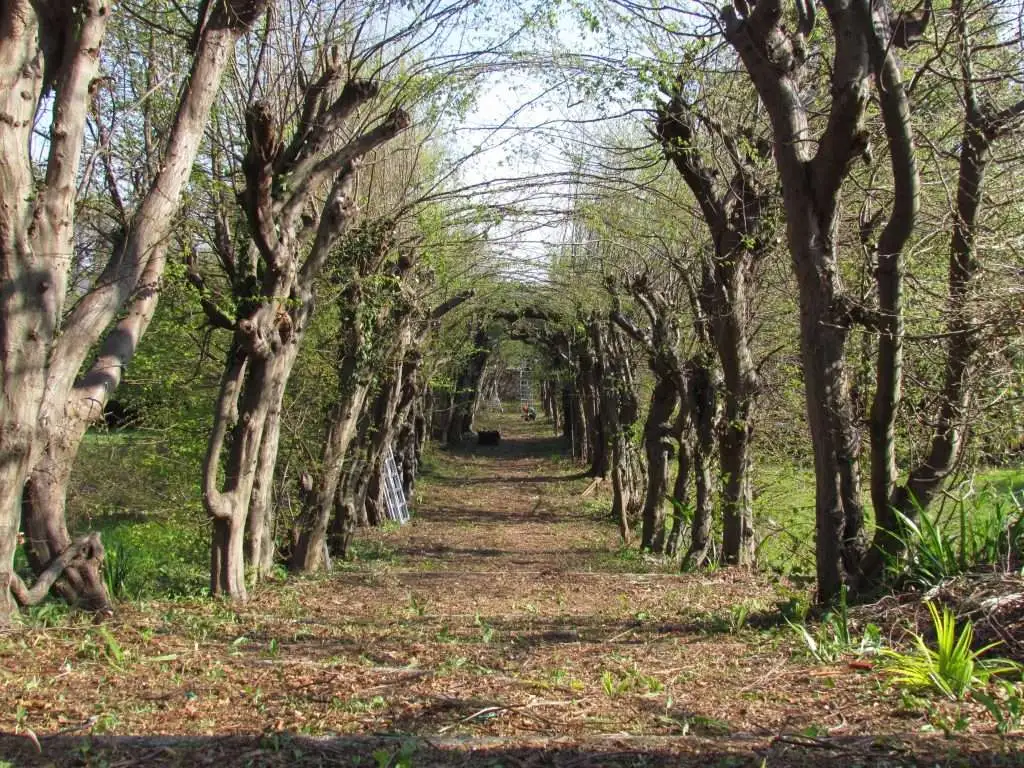
The uniqueness of a place with strong roots
An emblematic place of the civilization of the Venetian villas, it also constitutes a reference for initiatives to enhance the wine production of the area, the hills of Prosecco. Part of the Architecture Roads, Wine Road and Great War, and a system of cycling and nature trails. The exceptional nature of the site is due to the integrity of the historical relationships between the components, the botanical and historical value of some trees (Juniperus communis, Sophora japonica), the hydraulic system that feeds the cistern at the top of the wood and, by gravity, powers the water games of the Nymphaeum, serves the Villa, and through the garden, reaches the plain in front marked by the tree-lined avenue with lindens.
Bringing beauty to light again
The complex and its garden have some areas that have suffered damage both from lack of maintenance and from extraordinary weather events. The wood behind, which in the early 19th century was covered with olives and fruits, and later rearranged with conifers and other trees of first magnitude, was severely thinned by a storm and caused static and phytopathological problems to some tree specimens also near the Villa. The historical hydraulic circuit is currently interrupted due to incongruous interventions carried out over time and, as for the trees, is urgent as it deprives the Villa of the water games that characterize it.
Giving life again does not consist in a return to the past, but a recovery of present and partly hidden meanings, in the light of contemporaneity.
This will is also concretized through the use of modern technologies, which allow the park and the contained architectures to pursue a conservative approach, based on innovative and experimental principles.
The steps of the Project
- the computerization of data on the plant component and lawns, and the drafting of a general master plan of the complex, both for the park-garden and for the part of the landscape protected as a monumental asset, will allow to start a programmed maintenance with monitoring and care of the trees, with the enhancement of the naturalness of the lawns and the wood behind, with a process of botanical enrichment in the three gardens to the west in a balanced control between design and nature;
- the recovery of the Palladian hydraulic system will restore to the complex a functional and updated system that combines innovation with history, becoming an engine for the enhancement not only of the Villa but of the entire territory;
- the Nymphaeum will be restored and its state of conservation monitored continuously with sophisticated digital control systems;
- as an example of enhancement, it will be outsourced thanks to collaborations, including scientific ones, resulting from the framework agreement with the IUAV University of Venice, with which scientific and training activities at various levels are planned, with publications and research that will involve local, national and international institutions and associations.
Enhancement and its objectives
- the management of the complex aims to increase visitor flow, but also to offer a picture of the integrated values to the primary one of architecture with the intention of highlighting the importance of all its parts including the garden and landscape;
- safety and accessibility will be adapted through the identification of a path equipped with special devices also for users with disabilities;
- the Park and Villa di Maser will be promoted and enhanced through their inclusion in itineraries for visits to structures in the territory belonging to the UNESCO network and heritage, and the most internationally renowned Villas and Gardens, as well as in specialized artistic-cultural circuits for historical parks and gardens and eno-gastronomic tours. Series of events and exhibitions will be designed through specific partnerships with local institutions, tourist operators in the botanical, cultural, environmental hiking, slow tourism and cycling sectors, in combination with the historical, artistic, naturalistic and museum excellences of the territory;
- the use of web-based technology will allow to improve the experience of access, visit and use of the Park and Villa also for an audience with reduced mobility and visual perception.
Villa di Maser reborn in the sign of Palladio and sustainability
with funds from the PNRR – Ministry of Culture
2 million euros for conservation and enhancement of the exterior parts
Villa di Maser, UNESCO World Heritage Site since 1996, hosted in the Cross-Vaulted Room Rosa the press conference presenting the conservation and enhancement interventions underway, made possible by the National Recovery and Resilience Plan-PNRR-M1C3, Ministry of Culture (European Union, NextGenerationEU*).
Guest of the day Vittorio Dalle Ore, owner of the Villa. Speakers included, in addition to authorities, Paolo Faccio, Designer and General Coordinator of the Project, Professor of Restoration at the IUAV University of Venice; Annachiara Vendramin, Designer and Director of Works for the plant component, landscape agronomist; Andrea Di Lenna, Coordinator of the enhancement activities of the Project, Professor of Organization at the University of Padua.
During the press conference, the conservation and enhancement Project concerning the exterior of the complex conceived by Andrea Palladio in the mid-16th century was described in detail.
The state of the art and the planned interventions
(…) Where a fountain is cut into the hill opposite the house, with infinite stucco and paint ornaments. This fountain makes a small lake, which serves as a fishpond; from this place the water flows into the kitchen, and then irrigates the gardens, which are on the right and left side of the road, which gradually ascending leads to the building; it makes two fishponds with their drinking troughs above the common road; from there it flows to water the orchard, which is very large and full of excellent fruits and various game (…).
Andrea Palladio, The Four Books of Architecture, Book II, Venice 1570
Villa di Maser (also known as Villa Barbaro) is a complex of bold magnificence. The building is, as per Andrea Palladio’s will, symbiotically linked to the surrounding environment and has an agricultural vocation. It combines great visual impact – columns, pediments, arcades – and high-level functionality: a true “territorial machine”, embellished by the artistic component by the painter Paolo Veronese and the sculptor Alessandro Vittoria. 200 hectares of associated land, of which 100 hectares are woodland, the rest vineyards and partly olive groves.
The intervention funded by PNRR M1C3 dedicated to “Historical Parks and Gardens”* for a total of 2 million euros concerns the conservation of the architectural and plant systems (Palladian hydraulic system, use of water resources in a functional way; restoration of the Nymphaeum and decorative apparatus with bio-eco compatible and sustainable materials). The tree component of the Villa, with particular attention to the oldest specimens, will be cared for and integrated with other plant elements. The rose garden and three other gardens will be restored and renewed with the introduction of plants and flowers particularly loved between the 16th and 17th centuries. The vegetable garden and orchards will be redeveloped, as well as the lawns, which will be enriched from a floristic and aromatic point of view. All this will contribute to making Villa di Maser even more welcoming and will allow the visitor to stroll through the gardens and greenhouses, supported by adequate informative signage; accessibility of paths will be guaranteed even for people with disabilities.
A concurrent enhancement plan will include the complex not only in the itineraries of the UNESCO World Heritage, the most internationally renowned Villas and Gardens, but will make it a perfect location for high-profile cultural events and a destination for slow tourism in all its forms (botanical, cultural, sporting, enogastronomic…).
Further insights
In his speech, Vittorio Dalle Ore conveyed to those present his love and personal dedication for an incredibly fascinating work: “Supported for this Project by the intervention of the public body, through the European Union. These investments are intimately connected to the life of the Villa, where the building and exterior parts constantly dialogue and represent an indivisible whole of inestimable value. Finally, the beauty that can be lived and breathed every day at Villa di Maser can be shared even more deeply with the visitor: people will be able, besides admiring the frescoes and sculptures of the Villa, to also stroll through the gardens, the greenhouses, see the water springing from the Nymphaeum. An experience that changes every day, a wonder that renews itself infinitely.”
“When we talk about innovation, in the specific case of Villa di Maser – explains Paolo Faccio – we mean the recovery of Palladio’s original project, which was already extremely futuristic even then. The reference is above all to the optimization of resources, particularly water, for both functional and aesthetic use. The Nymphaeum, a prodigy of architecture and engineering, the greenhouses and gardens will return to their original splendor. For these works, highly specialized local suppliers have been selected, capable of guaranteeing the use of innovative, sustainable and patented techniques and materials. At the end of the conservation intervention, Villa di Maser will return to what it has always been, with a plus: it will be able to involve many different types of users, from young people to tourists, from scholars to professionals.”
Green in its declinations – gardens, park, vegetable garden, grove – is the subject of the conservation project curated by Annachiara Vendramin: “For an agronomist, for a landscape architect, it is a privilege to be able to contribute to the rebirth of Villa di Maser, also through the enhancement of tree components of great value and the reintroduction of rare flowers and plants. The work will be very articulated: the historic garden will be redeveloped with an eye to environmental sustainability; the paving will be restored. The orchard will be recovered, with the planting of dwarf fruit trees, ancient varieties, and medicinal plants; the grove behind will also be redeveloped. At Villa di Maser, two languages will live together and dialogue: that desired by Palladio and that imprinted in the 1930s by the architect Tomaso Buzzi and Maria Teresa Parpagliolo Shephard, by the will of the then owner, Marina Volpi di Misurata. Precious curiosities will catch the eye of the attentive visitor, such as the terracotta pots that will bear the numbers MM, exactly as before.”
“Specific to the spirit of the PNRR – comments Andrea Di Lenna – is, in addition to the focus on the technical nature of the interventions, the enhancement of the existing heritage, so as to provide the local community and then all those who will come to visit Villa di Maser with adequate tools to enjoy the spaces. Concretely, the Project linked to PNRR funds will aim to increase the number of visitors to Villa di Maser and its external areas; to digitize information and make it accessible to everyone, both on site and via the web; to ensure that the park and gardens are protagonists of events for different target users. Also changing will be the welcome provided, which, as desired by the owner, will lead people to feel like guests and not simple visitors, for a true, valuable experience out of the ordinary. Also to be enhanced will be the story of the entire restoration and conservation process, which will last a year and a half, which already now reveals small treasures of beauty capable of surprising even the professionals involved in the Project.”
*PNRR M1C3 – INTERVENTION 2.3 – HISTORICAL PARKS AND GARDENS – RECOVERY INTERVENTION
For further information
Silvia Borsani – ufficiostampa@atelier-esse.com – cell. 335 8355368