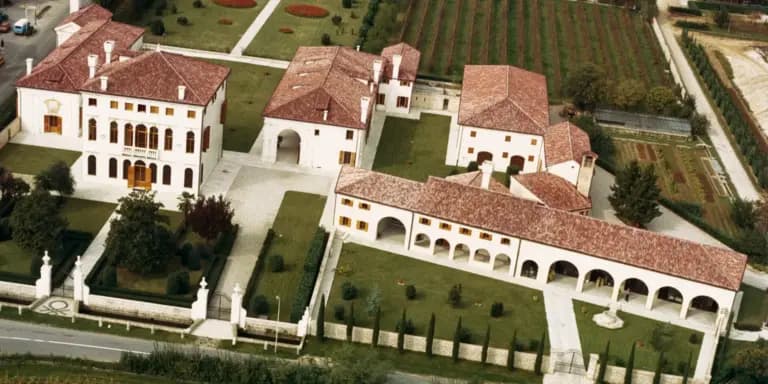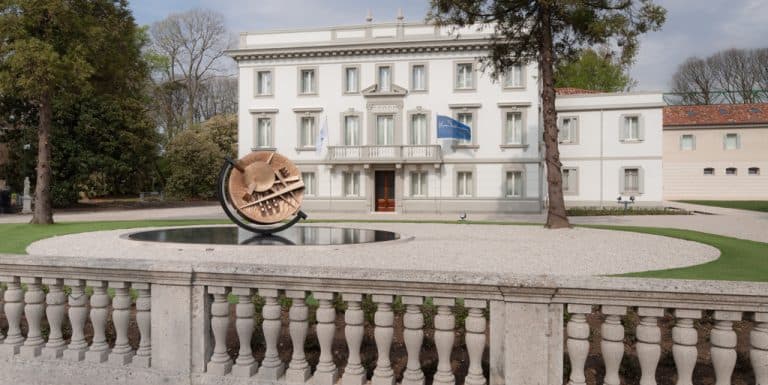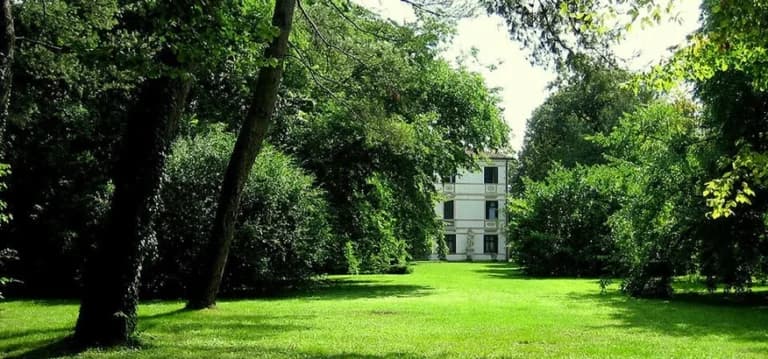

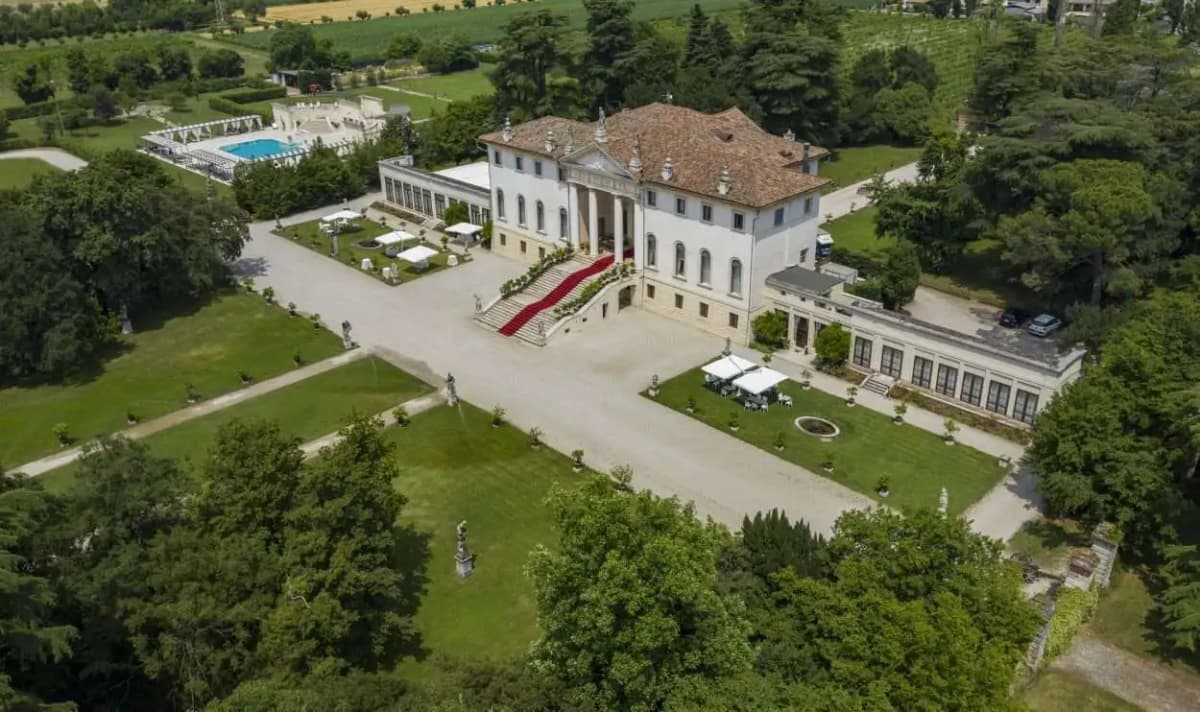
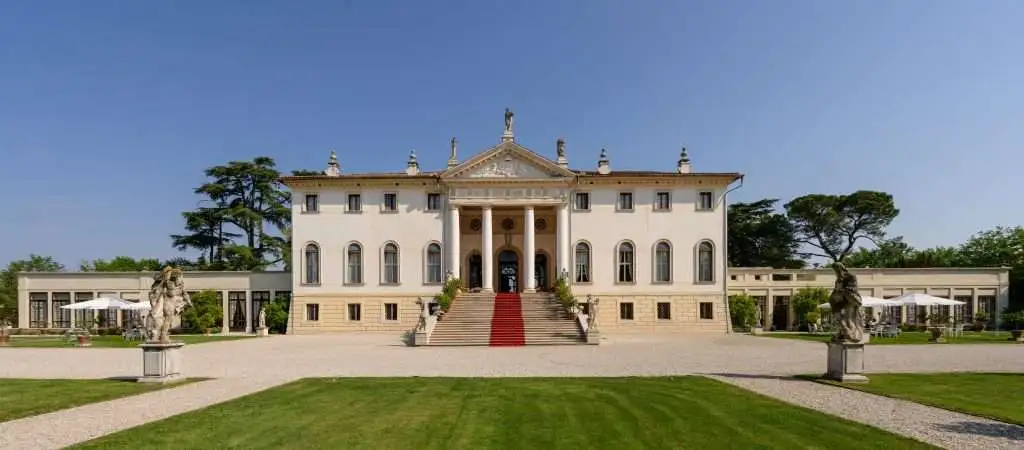
A masterpiece of neoclassical architecture inspired by Palladio, Villa Cornér della Regina stands on a radiant tree-lined garden nestled in the Treviso plain, lapped by the icy springs of the Sile and dotted with majestic Renaissance villas.
The origins of the grand stately residence are linked to significant geopolitical changes that involved the Republic of Venice between the late 15th and early 16th centuries.
The discovery of the American continent and the consequent shift of the trade axis from the Mediterranean to the Atlantic, the expansionism of the Ottoman Empire, and the creation of the League of Cambrai, a coalition formed in 1508 against Venice, made it clear that the Republic of Venice needed to find an important bastion on the mainland to consolidate its international influence.
Venetian aristocratic families thus began investing their capital in the hinterland of Veneto, where they had magnificent country residences built by master architects.
Having settled in Cavasagra between the 15th and 16th centuries, the Cornér Piscopia family was the oldest branch of the Cornér lineage, a powerful Venetian family whose most illustrious members included four doges and the famous Caterina, who became queen after marrying James II of Lusignan, King of Cyprus.
Caterina Cornér
Caterina Cornér’s Childhood
Born in Venice on November 25, 1454, Caterina Cornér was the daughter of knight Marco Cornér (Venice 1406 – Venice, 1479), great-grandson of the doge of the same name who lived from 1286 to 1368, and of Fiorenza Crispo, Duchess of Naxos, daughter of the lords of the islands of Syros and Santorini. Caterina’s maternal great-grandfather, John IV Komnenos, was Emperor of Trebizond from 1429, a title he held until his death on April 22, 1459.
The young girl spent her childhood first in the bright rooms of Ca’ Cornér della Regina, the family palace overlooking the Grand Canal, and later, from 1464, in the medieval monastery of San Benedetto Vecchio, nestled in the heart of Padua along the Bacchiglione.
The Marriage
In 1468, at the age of fourteen, Caterina was given in marriage by proxy to James II of Lusignan, King of Cyprus.
This union was aimed at favoring both the Republic of Venice, intent on expanding and consolidating its presence in the Mediterranean and the Levant thanks to the strategic position of the island of Cyprus, and King James II of Lusignan, who sought in the Republic the political support needed to counter Turkish expansionism and the claims of his half-sister Charlotte, the legitimate queen of Cyprus whom he had deposed in 1464.
The Death of James II
Between July 6 and 7, 1473, James II died before Caterina Cornér could give birth to their first and only child, James III. Having gained control of the Eastern Mediterranean, the young sovereign was effectively excluded from the kingdom by a college of commissioners predominantly pro-Neapolitan.
The Conspiracy
On the night of November 13-14, 1473, a conspiracy plotted to oust the queen led to the assassination of Caterina Cornaro’s collaborators, including her uncle Andrea (1419-1473) and her nephew Marco Bembo.
Caterina was forced to cede the strongholds of Cyprus and was even separated from her newborn son, who was later entrusted to her mother-in-law.
Unable to tolerate the plots hatched by the Neapolitans and Catalans against the Queen, on December 31 the Venetians landed with ten galleys at Famagusta and executed the conspirators. With the arrival of the rest of the fleet in 1474, Venice fully restored control over the island. That same year, Caterina suffered the tragic loss of her son, who died of malaria.
The Abdication
In 1488, following a new conspiracy organized by Catalan nobles, the Republic of Venice intervened to quell the revolt and forced Caterina Cornér to abdicate in favor of the Republic. Welcomed with a triumphal celebration, on June 6, 1489, the sovereign entered the city aboard the Bucintoro, the ceremonial galley of the Venetian doges.
Queen of Asolo
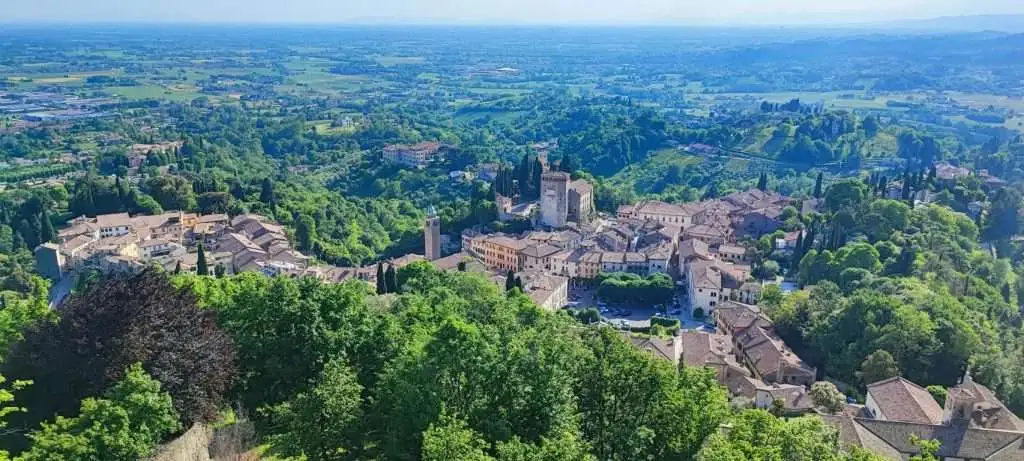
Following her abdication, Caterina Cornér became Domina Aceli (Lady of Asolo).
Pietro Bembo (Venice: May 20, 1470 – Rome: January 18, 1547) was one of the leading figures in the cultural landscape of his time to have the privilege of being welcomed at the court of the Lady of Asolo. A cardinal, writer, and poet, Pietro Bembo set one of his most famous works, The Asolani, in the sumptuous rooms of the Castle of Queen Cornér.
Having passed away on July 10, 1510, Caterina Cornér was one of the most emblematic and fascinating figures of the Cornér family.
Villa Cornér della Regina from the 16th to the 18th Century
It is documented that in 1567, Giorgio Corner (1523-1579), appointed Bishop of Treviso at the age of fifteen by his maternal uncle, Cardinal Francesco Pisani, spent about a month each year at his country residence in Cavasagra and stayed there during pastoral visits to the territory.
Among the oldest records of the noble residence, an inventory from 1638 describes Villa Cornér della Regina as a “tripartite Venetian-style house,” consisting of a ground floor, a piano nobile with a central hall flanked by four rooms.
In the first half of the 18th century, the architect Giorgio Massari (Venice: October 13, 1687 – December 20, 1766) carried out a renovation of the ancient Renaissance palace, whose 16th-century structure can still be admired on the rear facade of the Villa.
A map from that period shows a rectangular building with four stone pinnacles on the sides, similar to the current one but still lacking the central loggia.
The present appearance of the residential core, with the addition of the Palladian atrium, is attributed to the architect Francesco Maria Preti (Castelfranco Veneto: May 19, 1701 – December 23, 1774), who “made additions, expansions, and reduced it, in Palladian style, happily in the body, adorning it with wings and barchesse.”
Other scholars attribute this intervention to Giovanni Miazzi (Bassano del Grappa: August 2, 1698 – July 19, 1797), recognizing Francesco Maria Preti as the designer of the lateral barchesse and perhaps the greenhouses.
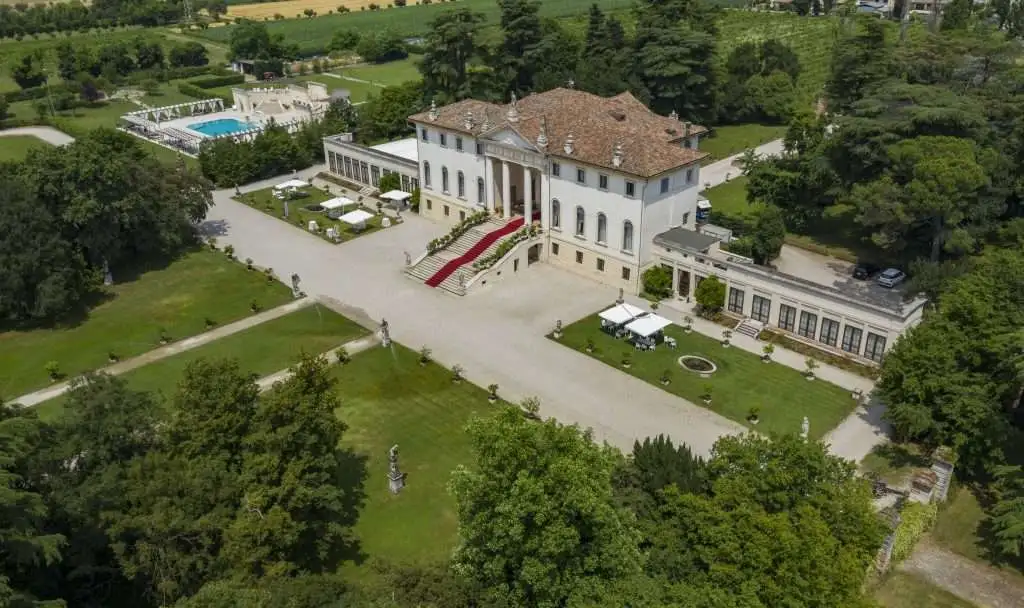
Architecture of Villa Cornér della Regina
Symmetrical and vertically tripartite, the southern facade of the main building is punctuated at the center by a monumental tetrastyle pronaos of Doric order, accessible via a solemn staircase.
Above the colonnade stands the entablature with metopes and triglyphs. The denticulated triangular pediment, embellished at the center by the coat of arms of the Cornér Persico family, is crowned at the vertices by three statues. Other fine sculptures adorn the garden and the columns of the gates.
Slightly set back from the central loggia, the lateral sections are articulated over three levels. Decorated with a faux rustication, the ground floor has eight slightly elongated quadrangular openings.
In line with the openings below and the square windows on the second floor, the round-arched single-lancet windows on the piano nobile are inspired by those of Palazzo del Paradiso by Scamozzi in Castelfranco Veneto.
The facade with the central loggia and the grand entrance staircase imitates instead Palazzo Spineda in Venegazzù, as do the three central arches of the rustic building on the right, surmounted by a pediment.
The barchessa is flanked by two one-story porticoed buildings and vertically joins at the right corner a long building for staff use.
The doors and windows carved into the walls that delimit the property to the west bear clear signs of doors and windows, now walled up, that once gave access to the splendid lemon house.
The Halls of Villa Cornér
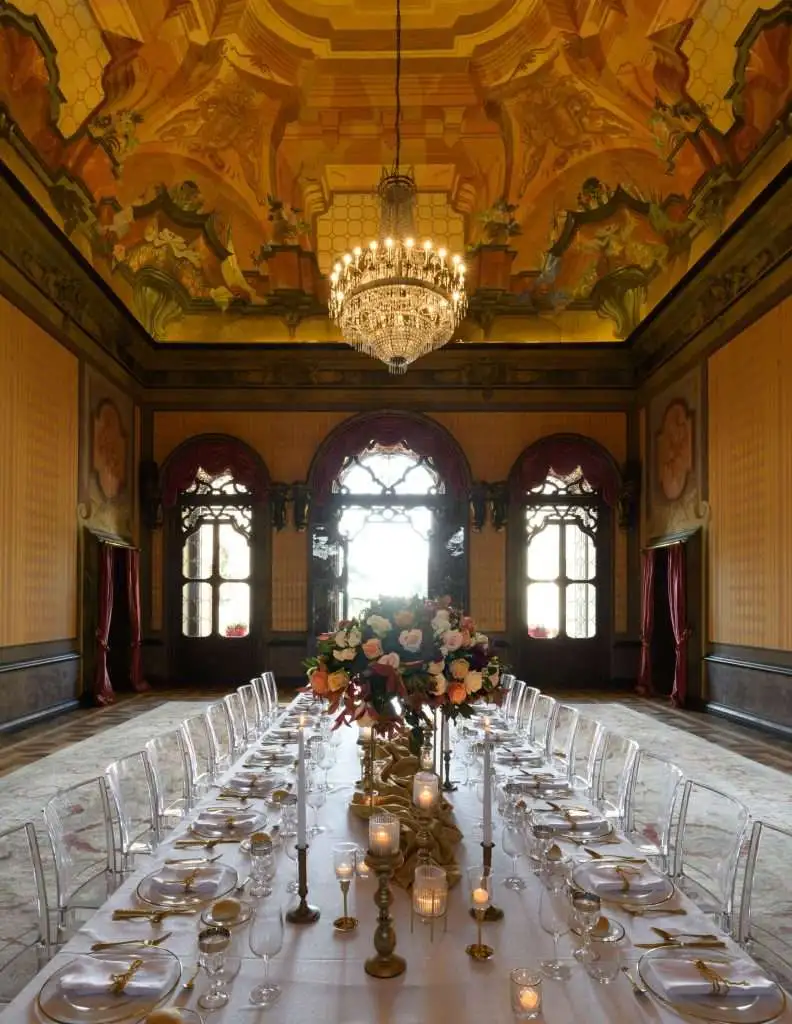
One of the most extraordinary rooms of the noble complex, the sumptuous central hall of the villa is embellished with a spectacular tempera on mortar by Angelo Sala (1823-1890), dating from 1851.
Restored to its former glory through careful restoration work, the illusionistic architecture adorning the vault of the hall reproduces a rusticated surface in which six painted windows open. A masterful example of trompe-l’œil, the leaded glass panes reveal a celestial scene dotted with clouds. Particularly evocative are the rays of a red sun filtering through the fake south window.
At the base of the remarkable fictitious structure, stucco decorations with grotesque faces, masks, animals, and winged cherubs stand out.
The doors of the hall are crowned by four female figures, placed atop capitals wrapped in clouds, symbolizing the continents then known. To the southwest, Europe is depicted riding a noble steed and wearing a laurel crown. The representation of Africa, with an Ethiopian headdress and ivory necklace, poses beside a small elephant. To the northeast and northwest are respectively Asia, with bare chest and turban, and America, depicted from behind, naked, with quiver, bow, and feathers characteristic of natives.
Upon entering the hall, one is enveloped by an enchanted, almost dreamlike atmosphere, in which the boundaries between architectural genius and pictorial creativity, between reality and imagination, blur.
The southeast hall is richly decorated with four stunning 18th-century perspective illusions framed by stuccoes. From the circular windows, with curtains held back by ribbons, pleasant painted landscapes are glimpsed. Above each door are the allegories of Painting, Architecture, Sculpture, and Poetry, while the ceiling is adorned with the figure of a woman holding a rifle, with game at her feet.
The Landed Property
From Marshland to Paradise on Earth
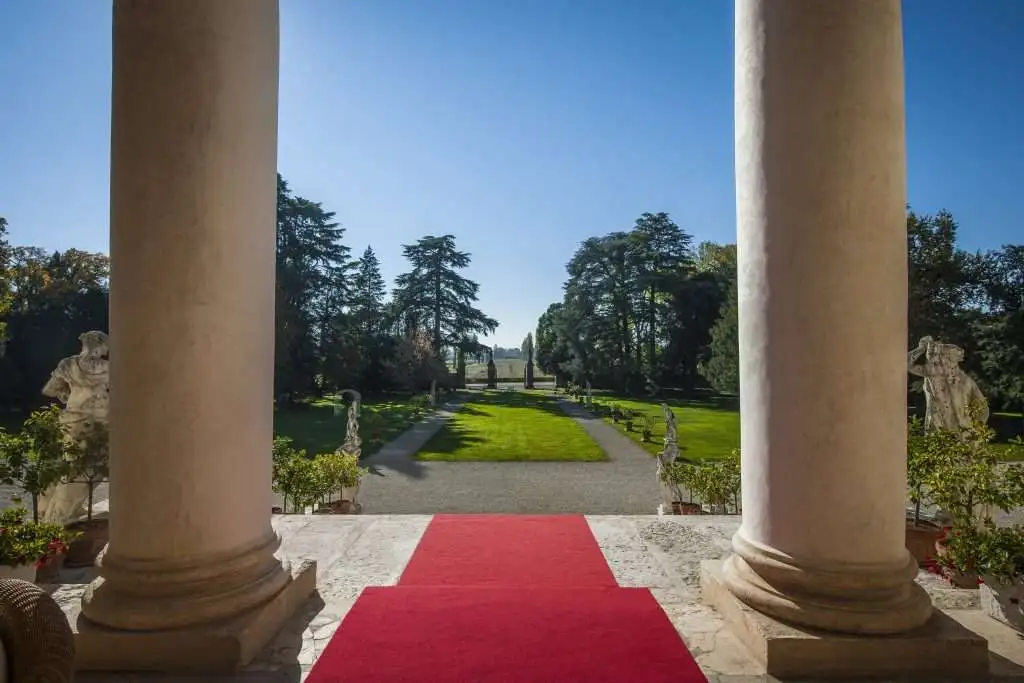
Scattered with Atlas cedars, firs, privets, maritime pines, holm oaks, and other majestic tall trees, the regal centuries-old park of Villa Cornér della Regina blends gracefully into the rural landscape of Vedelago, amid vast cornfields, lush hedges, flourishing vineyards, and golden wheat fields crossed by ancient avenues of cypress poplars.
When between the late 15th and early 16th centuries the Cornér Piscopia family, the oldest branch of the illustrious lineage, settled in Sant’Andrea di Cavasagra, the estate where they decided to build their country residence was quite different from how it appears today.
The Water Office and the Intervention of Fra Giocondo
Covered by dense woodlands infested with wolves, the land was partly marshy, due to the proximity of the Sile springs, and partly covered with stones and gravel, due to the presence of the ancient riverbed of the Cordevole Piave.
Thus, in 1469, the Republic of Venice established the Water Office in Treviso with the aim of arranging “all the Bretelle of the region, i.e., the rivers, canals, and spring waters, so called from the major Bretella that was then dug from the Piave in the village of Pederobba.”
The engineer Giovanni Monsignori, better known as Fra Giocondo (c. 1433-1515), was tasked with creating hydraulic works to ensure the supply of drinking water to men and animals in the territory.
In the garden north of Villa Cornér della Regina, the well for supplying drinking water to the inhabitants is still present, while the irrigation ditch of the Brentella that flowed, and still flows, along the west side was used to water the animals.
The Garden Sculptures of Villa Cornér
In the early 18th century, Gerolamo III commissioned the sculptor Orazio Marinali (Angarano, February 24, 1643 – Vicenza, April 6, 1720) and his school to embellish both the pediment of the Villa and the pleasant Italian garden with statues in soft white Vicenza stone depicting Greek mythology deities.
The Persico Family
In 1810, the property passed to the Persico family, a lineage of Bergamo origin granted noble title in recognition of civil and military merits performed in the service of the Venetian Republic. Thanks to their foresight and authority, the owners expanded the estate to over six hundred hectares. The Persico also built some water mills for grinding grain, traces of which remain in the rural toponyms and the ruins of the former Persico mill, south of Cavasagra.
Well-liked by the local population, the Persico played a significant role in the public administration of the territory. When Cavasagra became a municipality in 1867 with its seat in the house of Simioni Luigi, owned by the same family, Count Matteo Persico was elected mayor.
Five years later, the municipality of Cavasagra was merged with that of Vedelago.
In 1886, to commemorate the end of a cholera epidemic, the Persico family donated the side altars of St. John and the Holy Family to the parish church.
Antonio Frova
Of Lombard origin, Antonio Frova purchased the property in 1905. The first owner of the villa without noble titles, Antonio Frova initiated reclamation works and prioritized the cultivation of fodder for livestock breeding.
Antonio Frova also built two three-story houses, equidistant from the manor house. The two houses, one on the southeast side and the other on the northwest side of Villa Cornér, are inhabited by the Sartoretto families, whose surname reveals the ancient profession of tailors performed in the service of the owner.
Unlike previous owners, Antonio Frova generated discontent among the sharecroppers and tenants of the property by imposing feudal-like agricultural contracts. His despotic attitude may have been one of the causes of the assault on Villa Cornér, which occurred on November 30, 1907, by the tenants and sharecroppers of the villa. During the raid, the barn and stable were set on fire. The 18th-century statues were vandalized, as well as the rustic annexes and greenhouses.
The Frova family donated various furniture and furnishings to the parish church, including the Via Crucis that decorates its internal walls, and financed a parish kindergarten attached to the rectory. Antonio Frova also built the elementary schools in front of the rectory and donated land to the Bishop’s Curia to be rented to the less well-off at a modest price.
Villa Cornér della Regina in World War I
As command headquarters of the VIII and X Army of General Enrico Caviglia (1862-1945) during World War I, the villa inside displays a white marble plaque framed by bronze ornaments depicting laurel and oak leaves, a tondo with the Lion of Saint Mark in high relief, and, at the top, a Savoy coat of arms and a winged victory. The inscription reads:
Enrico Caviglia
Commanding General of the VIII and X Army
in the hospitable silence of this villa
from June to November MCMXVIII
pondered the resurgence and ensured the triumph of Vittorio Veneto
The Frova Family in perpetual memory XXVIII-X-MCMXXIII
C.Lorenzetti
The avenue of cypress poplars extending to the south, beyond Via Corriva, also continues north for a few hundred meters.
The current rows of cypress poplars were planted between the two world wars. The previous trees, dating from the 18th and 19th centuries, had been felled after the defeat of Caporetto on the orders of General Caviglia to make poles for the trenches on the Piave and Grappa fronts.
The Last Owners
Upon Antonio Frova’s death, the property was bought by Mr. M. Orefice, of Jewish origin. In the early 1970s, Sir Stafford Sands, Governor of the British protectorate of the Bahamas, purchased the Villa and gave it as a gift to his wife.
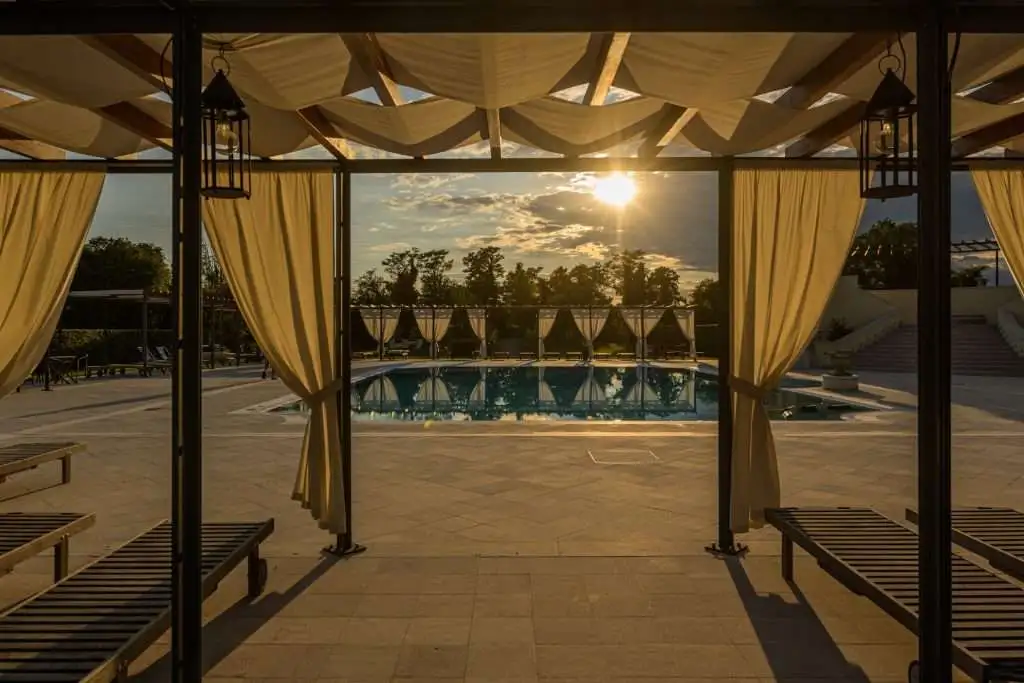
The English lord modernized the noble property without betraying its historical soul, but rather enhancing it. Sir Stafford oversaw the creation of a swimming pool with whirlpool (designed by architect Malgaretto of Treviso and surveyor Gritti Ivo of Albaredo).
Upon Sir Stafford’s death, the property passed to Agricola Corner of Count Dona’ delle Rose, which converted Villa Cornér della Regina into a sophisticated Country Hotel with an attached restaurant.
The barchesse were renovated in 1991 and 1992, from which 34 apartments of great value were created.
The Presidential Suite at Villa Cornér della Regina
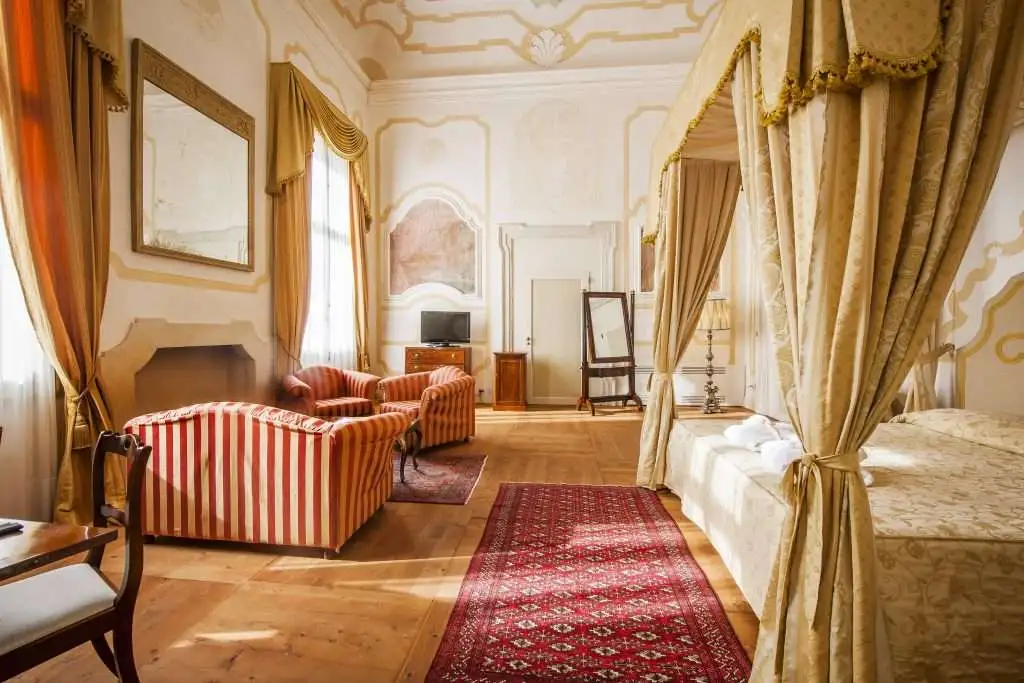
With ceilings over six meters high, period furniture, and walls decorated with fine stuccoes and frescoes, the bright presidential suite is the most beautiful suite at Villa Cornér della Regina. It features a canopy bed, whirlpool bathtub, whirlpool shower, and walk-in closet.