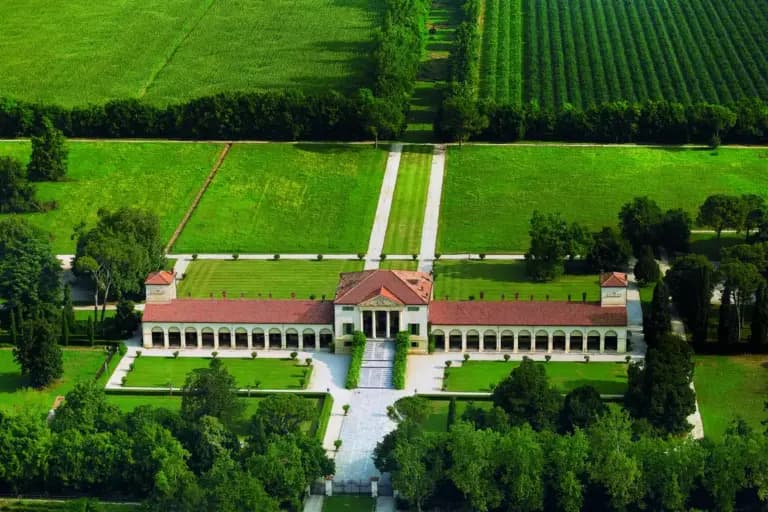

Where is Villa Fiorita located?
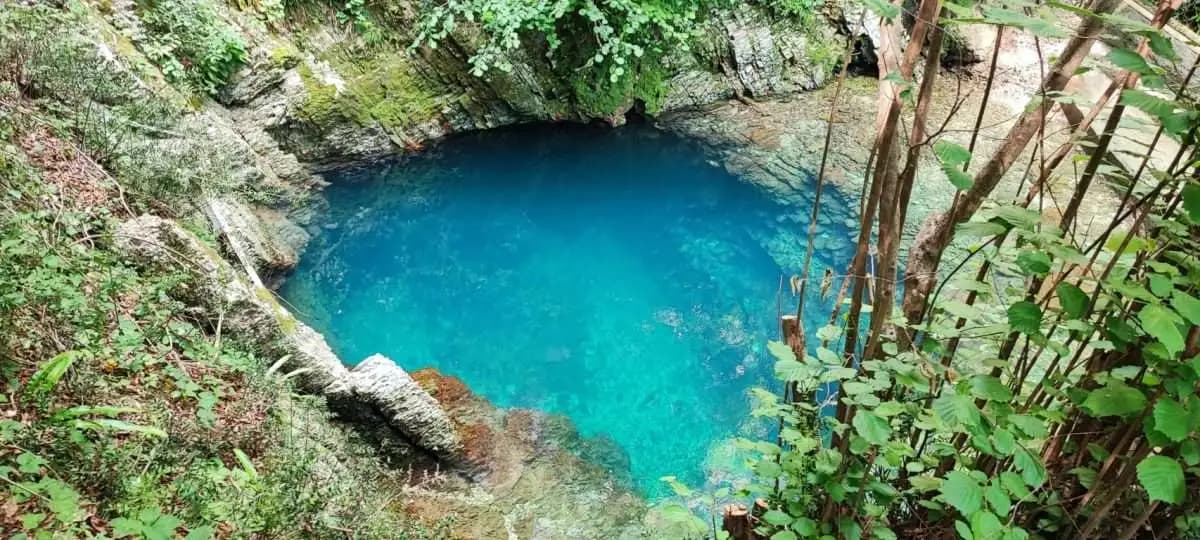
The green expanse of the lower Treviso plain into which the noble estate fits is crossed by the Vallio and the Meolo, icy spring-fed streams whose waters have favored trade and rural development in this fertile territory, long devoted to agriculture.
Villa Fiorita and the Abbey of Santa Maria di Pero
The noble estate is located to the southeast of the monastic complex, whose foundation is linked to a bequest by Otto I in 958 AD.
The name of the estate, from which the municipality’s place name derives, recalls the ancient name of the Meolo, emerging from the crystal-clear springs in the Campagne area of Breda di Piave.
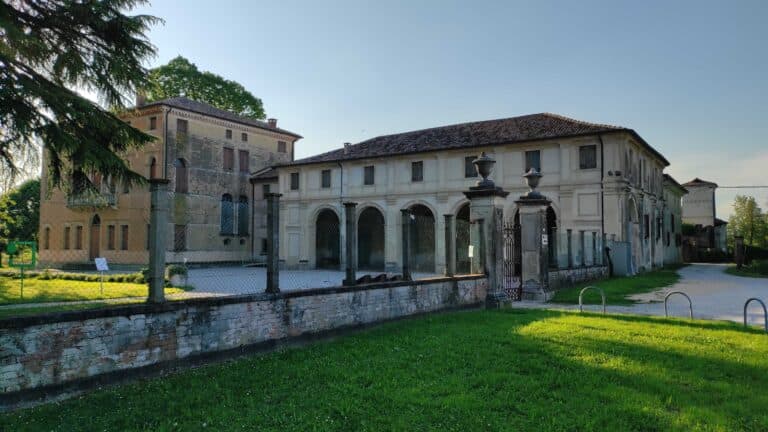
The watercourse that runs along the Abbey to the north was decisive in defining its spatial layout, feeding with its waters the 9,000-square-metre orchard that makes the Benedictine complex, with its Renaissance cloister, airy porticoes and soaring 44-metre bell tower, one of the region’s most fascinating cultural and natural landmarks.
The river then crosses the town centre, skirts the south-western edge of the municipality and continues south until it reaches the settlement of the same name in the province of Venice, where it flows into the Vallio about twenty kilometres from its source.
The presence of the Pirense port, a thriving crossroads of river traffic, together with the Claudia Augusta, a Roman road from the 1st century AD that led from Hostilia and Altinum to the Danube, gave impetus to the flourishing economy of this enchanting corner of the Po Valley, whose landscape, marked by renowned vineyards of Prosecco wrapped in lush hedges, is ennobled by the sumptuous residences that the Venetian entrepreneurial aristocracy had erected as part of a far-reaching agrarian revolution, in which the Venetian villa represented the monumental and economic centrepiece.
History of Villa Fiorita
Villa Fiorita from the 17th to the 20th century
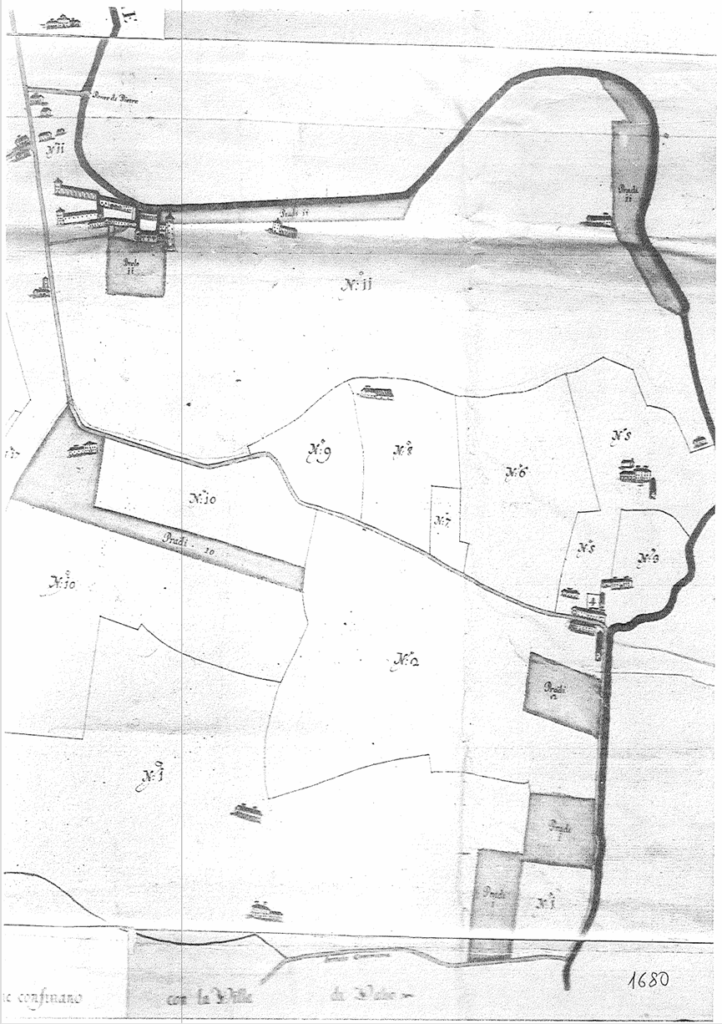
Conceived as a country residence, the aristocratic estate was built between 1680 and 1710 at the behest of the Bragadin family. This dating emerges from the property records of the time, which show that before 1680 there was only a large farmhouse on this site.
One of the twenty-four patrician families that formed Venice, the Bragadin, originally Ipato, are listed in the golden book as Doges, Patriarchs, Senators and procurators of St. Mark.
The property of the illustrious family is described as follows in a map of 1713:
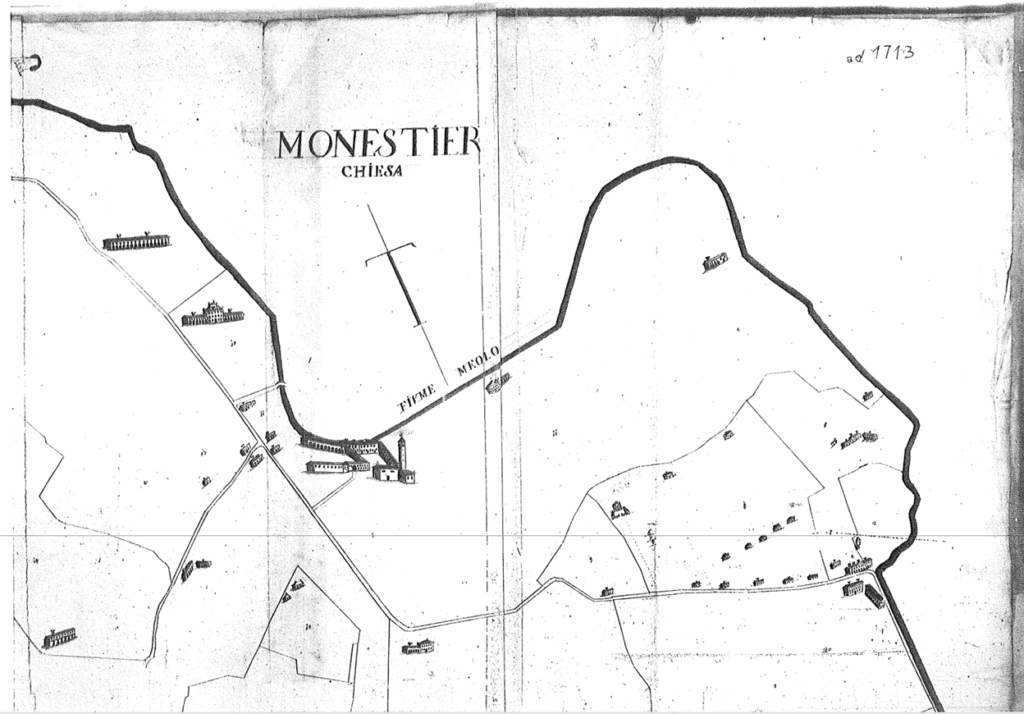
“N.H. Alvise Bragadin has a piece of land A.P.V. with manor house, barchesse and twelve small houses in the place called Fornaci held by various people, of 26 fields and 3 quarti. It borders to the east with N.H. Vincenzo Bragadin, to the south with the road and N.D. Lucrezia Foscarini, uphill with the Monastery of San Giorgio Maggiore. The manor house is leased by N.H. Domenico Gritti”.
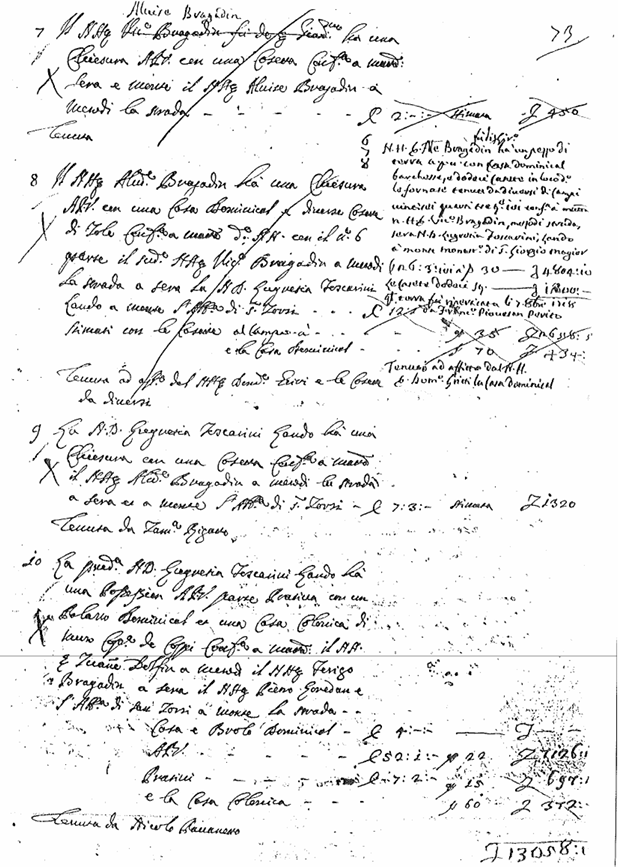
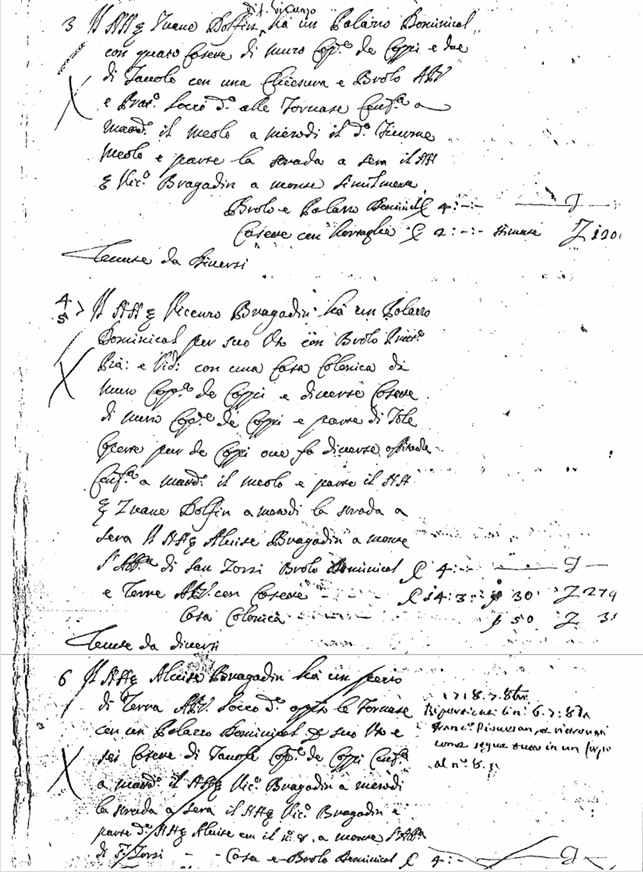
Owned at the beginning of the 19th century by Mr. Tramonti, accountant and municipal secretary of the municipality of Monastier, the property passed in 1873, during Austrian rule, to the Counts Ninni, Venetian nobles originally from Thessaloniki, who, by purchasing the nearby monastery of Madonna di Pero and many surrounding lands in the same year, created one of the largest estates in the area.
Monastier di Treviso during the First World War
During the Great War, the Abbey of Santa Maria di Pero hosted several military units and a detachment of the American Red Cross, in which the then nineteen-year-old Ernest Hemingway had enlisted.
The façade of the abbey church, the only surviving element of the place of worship apart from the bell tower, spared by Austrian artillery fire, is significant testimony to the impact of the First World War on the area.
The reconstruction costs of the archpriest’s church, built in neo-Romanesque style in the Fornaci area between 1923 and 1927, were so high that they led the Bank of Italy, in 1934, to place the Monastier rural bank under special administration.
Ernest Hemingway, from Casa Botter to Villa Fiorita
With the outbreak of the Battle of the Solstice, the future Nobel Prize in Literature winner was transferred along the front line of the Lower Piave. Coming from Schio, the young volunteer arrived in Fossalta di Piave at the end of June 1918. In Monastier di Treviso he stayed at Casa Botter, where American Red Cross Relief Station No. 14 was set up.
During his service with the ARC, Ernest Hemingway gave aid to soldiers engaged in trench warfare, moving along the winding country lanes that linked Fossalta di Piave with the localities of Monastier, Fornaci and Pralongo. The latter is known for the ancient sanctuary of the Madonna Nera, used as a military hospital, which saw the presence of the celebrated journalist and writer.
Ernest Hemingway’s involvement in this crucial phase of the conflict is also documented at Villa Albrizzi and Villa Fiorita. Described as “the house of the silkworms” in insonnia, one of the short stories in the anthology I quarantanove racconti (The Fifth Column and the First Forty-Nine Stories), Villa Albrizzi dedicated part of its rooms to the “Soldier’s House”.
Summer residence of Count Emilio Ninni, in the final year of the war Villa Fiorita was abandoned and occupied by military troops and the American Red Cross. Today, its vast and bright rooms provide the setting for a detailed exhibition retracing the events that involved Ernest Hemingway in these war-torn places, from which the young officer drew inspiration for the novels A Farewell to Arms and Across the River and Into the Trees, masterpieces in which the localities of Monastier and Fornaci are described.
On the night of July 8, while carrying a wounded Italian soldier, the young volunteer was struck by fragments from a mortar shell and a machine-gun bullet. Admitted to the hospital in Milan, Ernest Hemingway was awarded the American War Cross and the Italian Silver Medal for the valor he showed at the front.
Villa Fiorita from the Seventies to today
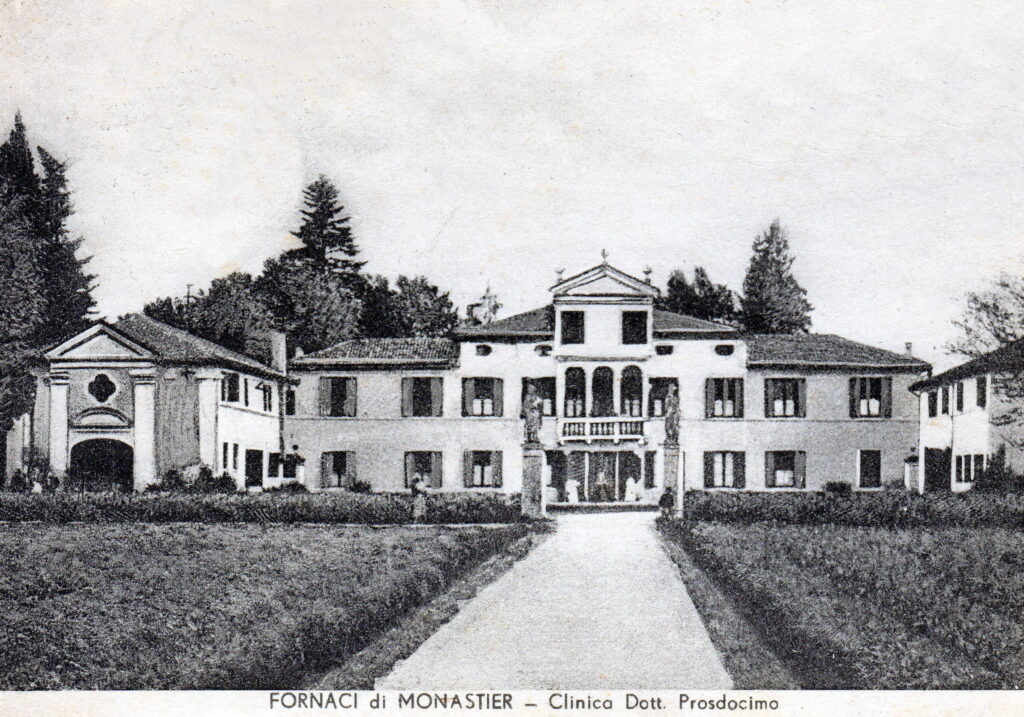
Used as a hospital in 1932 by Dr. Guido Prosdocimo, Villa Fiorita was purchased in 1970 by Dr. Calvani, founder of the Sogedin group, who changed its use by transforming it into a nursing home.
The success of the business made it necessary to build a new building to house healthcare activities. With the transfer of these services to the new structure, the villa underwent a careful renovation and was transformed into a luxury hotel, in keeping with its original vocation as a residence for leisure and well-being.
The Sogedin group
The Sogedin group is a complex and multifaceted organization able to combine expertise in healthcare, social care, education and hospitality.
Affiliated with the National Health Service, the Casa di Cura Giovanni XXIII, where more than eighty doctors and over four hundred paramedics work, is equipped with state-of-the-art radiology technology. Alongside this facility is a specialist medical center with more than thirty-five doctors.
Home to the elderly service center, “Villa delle Magnolie” has one hundred and eighty beds, hosts an Alzheimer center and a hospital discharge center, while the micro-nursery school “La casa sull’albero” meets the needs of the local area and of Sogedin group employees.
Completing the picture of activities is the hotel group Sogedin Hotels, which manages four hotels for a total of over four hundred and fifty rooms distributed across the Venice area.
Architecture of Villa Fiorita
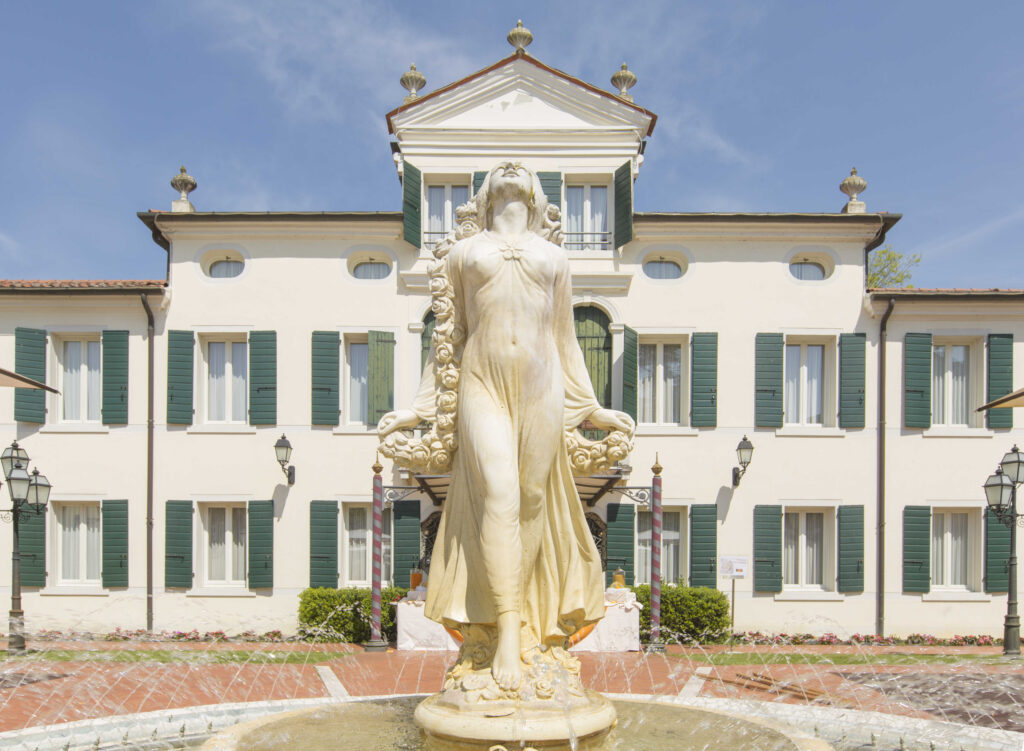
The main façade of Villa Fiorita
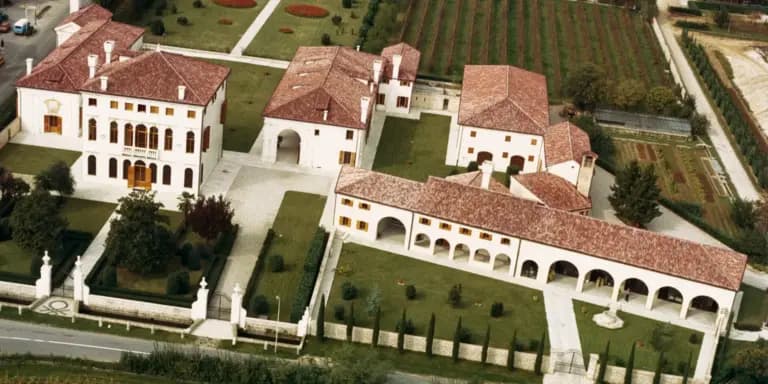
Spread over three levels including the attic, the noble residence is crowned by a central raised passage on which a double-pitched roof is set.
Enriched on the façade by a finely molded triangular pediment, beneath which two windows open, the upper volume is crowned at the corners by three vase-shaped pinnacles. The same stylistic solution is repeated at the ends of the roof of the central body.
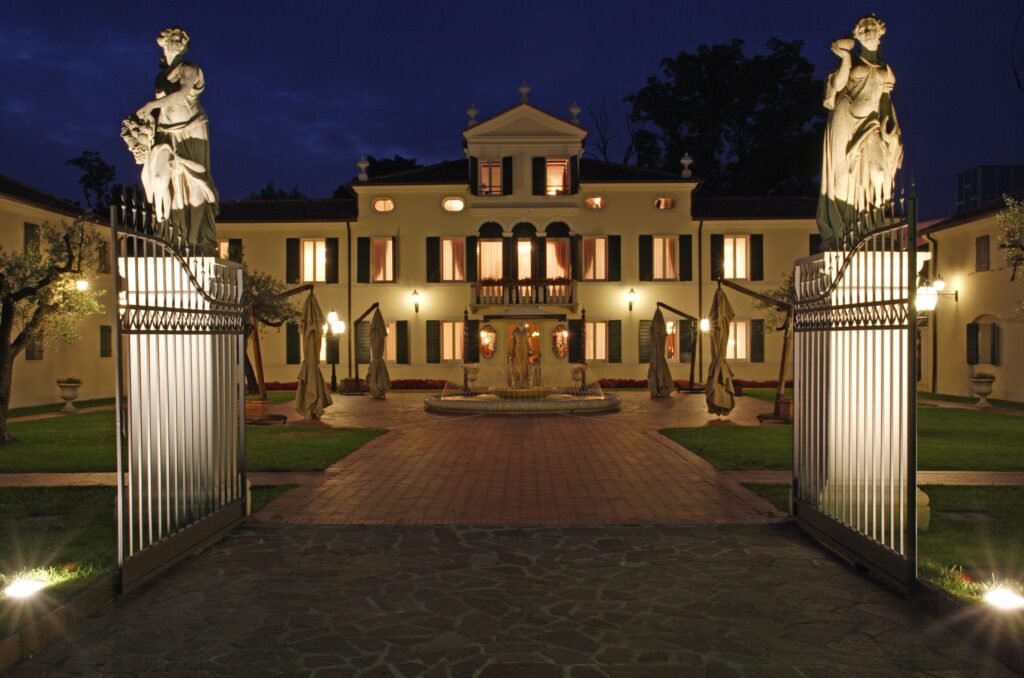
Symmetrical and vertically tripartite, the façade of the residential core features rectangular windows on both the ground floor and the first floor. The latter flank three arch-headed French windows opening onto a white balcony. Above the keystone of the arch, a refined frame separates the triple-arched window from the pedimented volume above. The mezzanine is punctuated by four oval openings, aligned with the openings below.
The entrance, flanked by two windows with a curvilinear profile and sinuous ironwork, is preceded by an elegant canopy whose supports recall the Venetian “da Casada” poles. Decorated with a red spiral, these end in a golden sphere-shaped pinnacle, adorned with a leaf motif and topped by a finial.
The central building continues symmetrically into the two-storey side wings that extend through the full depth of the central block, giving the complex a compact volume.
The Oratory and the barchesse of Villa Fiorita
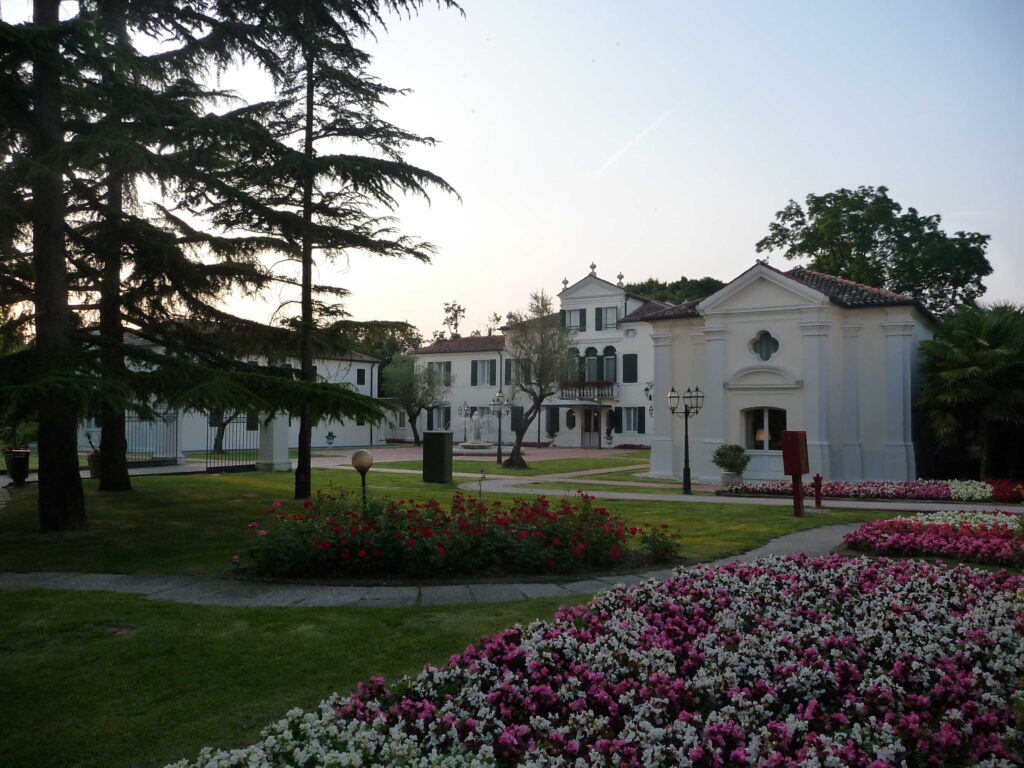
Orthogonal to the villa’s layout, two rectangular buildings project southwards, framing a large area paved with herringbone-laid terracotta strips. The warm tones of the courtyard are echoed by the grassy covering that surrounds its perimeter, shaded at the corners by four twisted olive trees with leafy canopies.
The Oratory dedicated to St. Francis of Paola, built in one of the barchesse without abbey permission, obtained indulgence on July 4, 1736.
The side buildings have on the southern side a projecting section in which a bright low-arched entrance opens. This is enhanced by a curved pediment above which a quadrilobate opening appears. Bringing the vertical development of the structure to a close is a triangular gable that connects to the hipped roof of the barchessa.
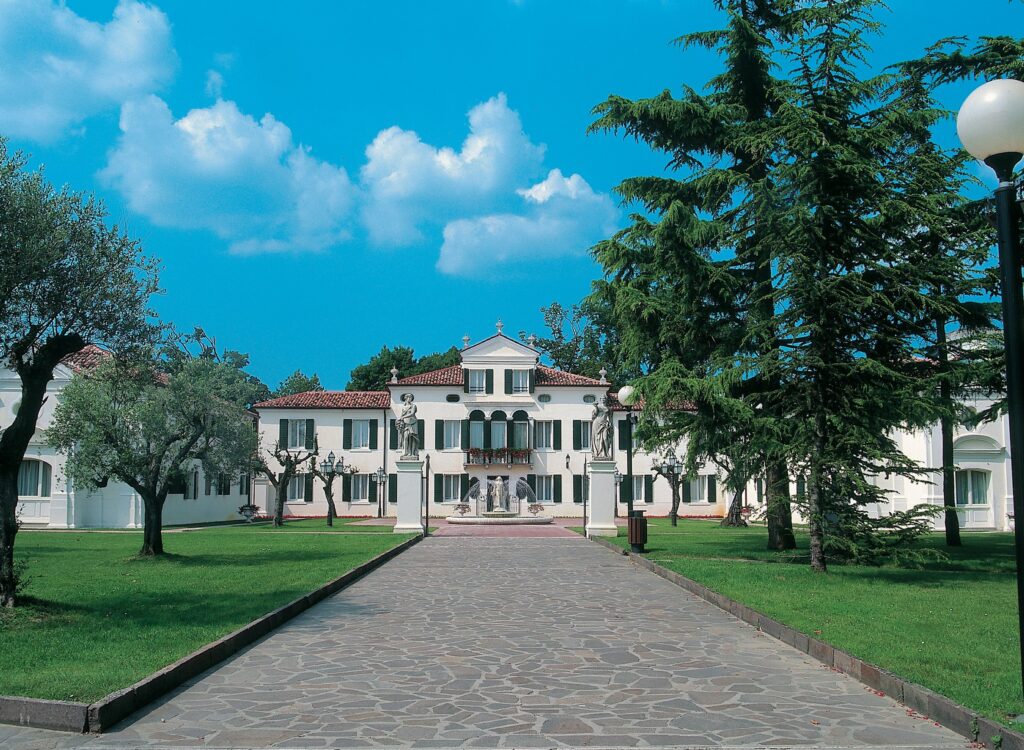
The entrance gate and fountain of Villa Fiorita
Two female statues draped in refined folds, one of them holding a cornucopia, surmount the pillars to which the gate giving access to the villa is anchored.
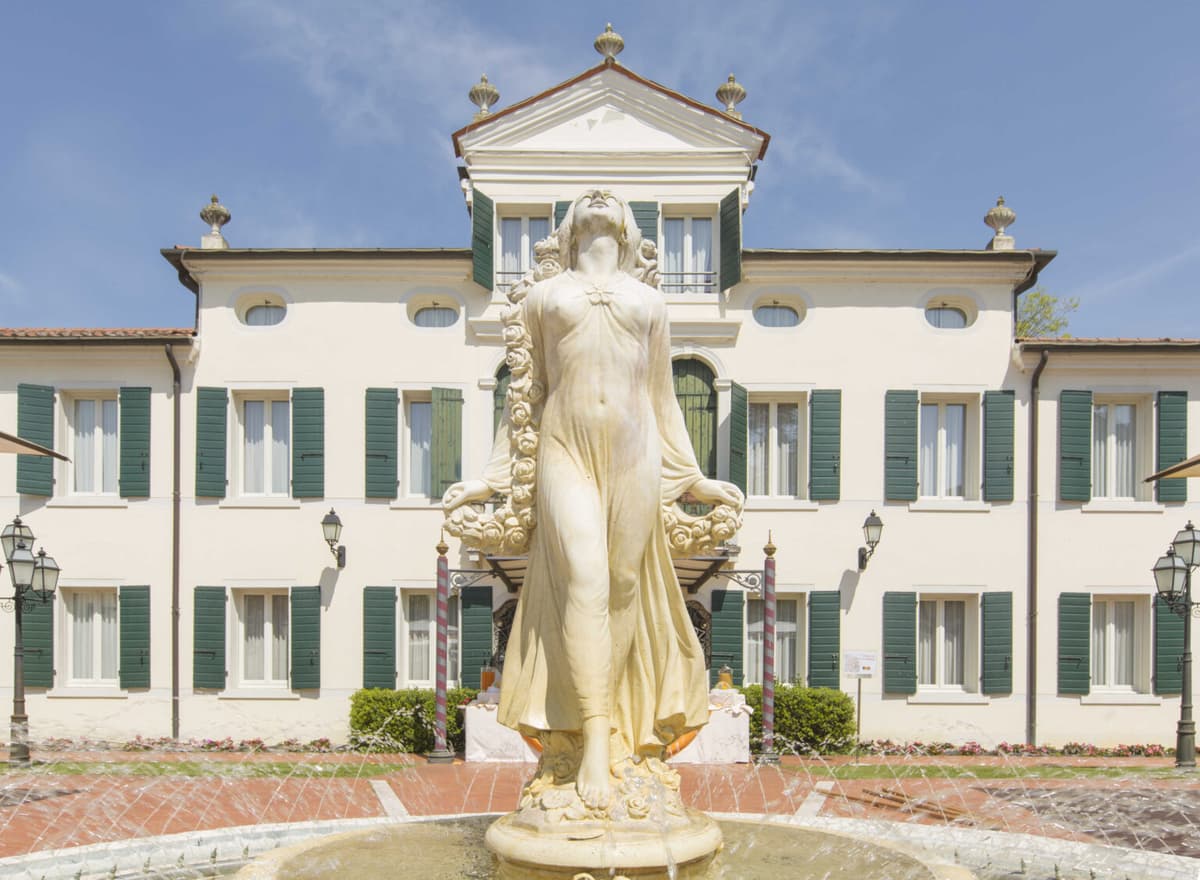
Set between the elegant gate and the main entrance, at the center of the courtyard stands a fountain made up of two concentric basins, whose spurting water features converge in the sculpture of a young lady wrapped in elegant drapery.
With her gaze turned to the sky, the female figure is portrayed in a solemn and graceful pose, with her arms resting at her sides while she delicately holds a garland of flowers that adorns her long wavy hair and falls over her shoulders.
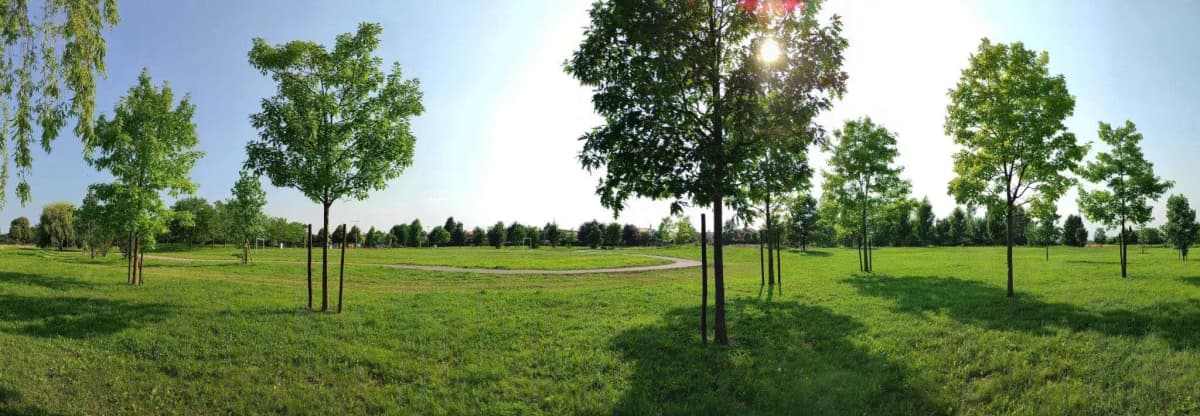
Harmonious synthesis between villa culture and garden culture, Villa Fiorita opens onto a lush park dotted with cedars, olive trees, magnolias, maples, palms, black locusts, maritime pines and many other flourishing tall trees framed by well-kept hedges.
A symbol of the glorious past of the Republic of Venice, the historic residence embodies the founding principles of the Venetian villa concept, understood as a pleasant place of otium and at the same time the hub of an efficient agricultural production system. This model is reflected in Villa Fiorita in the balance between the magnificence of the main house and the functionality of the majestic rustic outbuildings.
Villa Fiorita is a landmark for those wishing to discover the extraordinary landscape and architectural heritage of the lower Treviso plain, as well as to explore the events that struck Monastier during the Great War through the life of one of the greatest writers of the 20th century, author of some of the most famous literary masterpieces on the First World War.