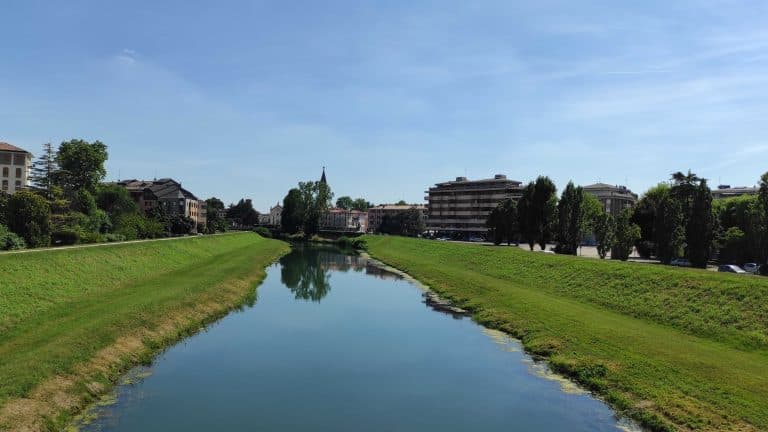


Discover what to do in Possagno, the small town in the Treviso area nestled among lush wooded hills on the border with the Belluno area, whose territory houses the temple and works of Antonio Canova, the greatest exponent of neoclassical sculpture.
Where is Possagno?
The municipality of Possagno in the province of Treviso borders to the north with Alano di Piave and Seren del Grappa, to the south with Castelcucco and Paderno del Grappa (a hamlet of Pieve del Grappa), to the east with Cavaso del Tomba, to the west with Paderno del Grappa.
The festival of San Rocco?
When and where does the festival of San Rocco take place?
The festival of San Rocco, patron saint of Possagno, takes place on the hill of San Rocco from August 15 to 18.
The event promotes values of sharing and gratitude both through moments of spiritual reflection during the Holy Mass in honor of San Rocco, and through moments of carefree fun at the traditional village festival.
To enliven the already splendid natural scenery, live music, rivers of beer to quench your thirst on warm summer evenings, as well as mouth-watering gastronomic specialties and wine excellences that attest to the uniqueness and richness of the territory await you.
Itinerary to discover Canova
The pleasant walk takes place in the suggestive natural setting of the Possagno area, near the slopes of the Grappa massif. The itinerary begins at the Gypsotheca at via Canova n. 74 – 31054 Possagno (TV), located a short distance from the nineteenth-century Canova Temple, recognizable by its white dome and solemn pronaos consisting of a majestic colonnade in the Doric order inspired by the Athenian Parthenon.
Taking the path to the left of the temple, along the road leading to Colle San Rocco, you will find signs for the natural itinerary inviting visitors to immerse themselves in the lush hilly landscape of the foothills where the brilliant sculptor from Possagno grew up.
The itinerary winds for about 4 km among gentle hills populated by various tree species, including acacias and oaks, near Contrada Vardanega, then leads to the charming little church of San Francesco nearby.
Following the corresponding Via San Francesco, you rejoin Viale A. Canova, along which there are refreshment points such as Caffè Canova, the Zatta bakery and pastry shop, the Hotel Ristorante Stella d’Oro, not far from the Gypsotheca and the house of Antonio Canova.
Gypsotheca and Antonio Canova Museum
Located at Via Canova, 74, 31054 Possagno (TV), the Gypsotheca of A. Canova represents a true artistic and historical gem at the national level, attracting visitors from all over the world each year to admire the works of the artist from Possagno, considered the greatest exponent of neoclassical sculpture.
The Gypsotheca, a term of Greek origin meaning collection of plasters, is the building where the collection of models and plaster casts of Canova’s original sculptures was transferred.
Among the spectacular works in the gypsotheca, it is easy to be impressed by the beauty of the sculptural group of Hercules and Lichas, whose protagonists, caught in a moment of extreme dynamism and violent drama, seem animated with their own life, while maintaining the perfect balance and geometric precision of forms. The young man’s face reveals his despair as he grabs the altar in a vain attempt to resist the brutal and unstoppable force of Hercules.
Hercules’ furious face accentuates the irrepressible power of his body, captured in the moment of maximum torsion and covered by a very thin and delicate drapery that enhances his muscular vigor.
The sculptural complex depicting Theseus fighting the Centaur captures the decisive climax of the conflict between the young demigod and the centaur Eurytion, who, with his right hand resting on the ground, is portrayed in his last moment of life as he desperately tries to free himself from Theseus’ hand gripping his throat.
The hero of Thessaly, in a dominant position, is ready to deliver the coup de grâce to the defeated enemy with the heavy club grasped in his right hand raised in the air.
These are just a few examples of the masterpieces of the absolute genius of neoclassical sculpture, born right here in Possagno, in the province of Treviso.
For more information about the museum’s opening hours and to book guided tours to discover the birthplace of Antonio Canova, we recommend visiting the official website of the Canova Museum.
The Canova Temple
Located at Via Stradone del Tempio, 31054 Possagno (TV), the Canova Temple dominates the top of a radiant hill with its white mass a short distance from the town center.
The monumental temple, which has housed the master’s ashes since 1830, is both the sepulcher and the place of self-celebration of the artist. From a structural perspective, the sacred building reconciles typical elements of Roman architecture, recognizable in the large dome reminiscent of the monumental Pantheon, with the layout of the ancient columned temple of classical Greece, as evidenced by the clear reference to the Parthenon.
The inspiration that led to combining elements of Roman and Greek architecture is reflected throughout the church through the precise placement of the altarpiece depicting the Deposition of Christ at the exact point where sunlight, filtering from the top of the dome at noon every day, illuminates the altar and the biblical scene, thus combining the sacredness of the Christian work with the pagan concept of God is Sun.
If you are passionate about art and architecture and wonder what to do in Possagno, you will be pleased to know that entry to the Antonio Canova Temple is free.