

Discover what to do in Camposampiero: the medieval days, the sanctuaries of the Vision and the Noce, Palazzo Tiso, the St. Anthony trail. the clock tower. Want to know more? First of all…
Where is Camposampiero located?
The municipality of Camposampiero borders Loreggia to the north, Borgoricco to the southeast, San Giorgio delle Pertiche to the southwest, Trebaseleghe and Massanzago to the east, and Santa Giustina in Colle to the west.
The medieval days
The 2023 edition of the festive historical reenactment will take place on Saturday 3 and Sunday 4 June. For the occasion, the historic heart of this town in the upper Padova area comes alive with dazzling parades in period costume, musicians, acrobats and flag-throwers, blacksmiths, weavers, carpenters and cooks preparing ancient and exquisite recipes. There will also be thrilling jousts in which knights in 13th-century armour will duel one another in single combat.
If you’re wondering what to do in Camposampiero and want to take a journey back in time to discover the celebrations and customs that marked daily life in the 13th century, the event The Medieval Days shows that the Middle Ages were anything but dark!
For more information about this traditional event, you can visit the Facebook page Proloco camposampiero and the website prolococamposampiero.com.
The Sanctuary of the Vision
Located in Via Sant’Antonio, 6, the place of worship stands alongside the convent of Santi Giovanni Battista e Antonio, a splendid architectural complex arranged around an elegant porticoed cloister.
The church has a gabled facade vertically divided into three by four pilasters connected by blind arches. Divided into three naves marked by wide round arches, the church is accessible through an elaborate wooden portal framed by Corinthian columns and topped by a lunette depicting Sant’Antonio with the Child Jesus.
Above the door is a triple-light window, while two single-light windows open in the side sections of the front facade.
If you’re wondering what to do in Camposampiero, the Sanctuary of the Vision houses priceless paintings and a spectacular pipe organ.
The St. Anthony Trail
Starting from the Sanctuary of the Vision, head south along Via Sant’Antonio. At the junction, turn left and continue to the next intersection. Turn left again and follow Via Monte Grappa for 500 metres. At the roundabout, take the first exit onto Via Guizze Basse and continue for 350 metres until you reach the bridge.
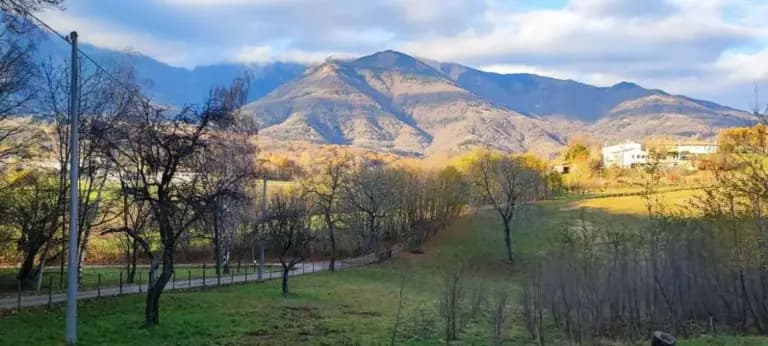
This pleasant nature trail offers fabulous panoramic views of the vast Camposampiero countryside, marked by flourishing cultivated fields bordered by clear canals and lush hedges of poplars, acacias, willows and maples, above whose canopies the bell towers of ancient country churches rise up.
The Sanctuary of the Noce
To reach the Sanctuary of the Noce, you can leave your car in the large car park in Via Sant’Antonio, 6. This 15th-century place of worship is located at the end of a long tree-lined avenue called Il sentiero Antonio. Shaded by flourishing, neatly aligned lime trees, the short route offers a striking view of several bronze sculptures symbolising the sacraments, forgiveness, prayer, and the appearance of Jesus to Sant’Antonio.
Enclosed between the railway and the winding course of the Muson Vecchio, this lovely red-brick sanctuary is accessed through a graceful porch and is decorated inside with enchanting 14th- and 15th-century frescoes.
Palazzo Tiso
One of the municipality’s most representative monuments, Palazzo Tiso is an elegant medieval castle built at the behest of the Camposampiero family.
Dating back to the 11th century, the sumptuous town hall is adorned at the base with a rusticated ornamental motif and crowned by a series of pointed blind arches topped by a refined Gothic-style battlement.
Standing beside the palace, the thousand-year-old tower dominates the city centre, wrapped in a stern and solemn aura. Made more graceful by a refined sundial, the military fortification features a mullioned window at the top and two single-light windows on each side.
The clock tower
About 200 metres away, in contrà Rialto, the clock tower rises above the rooftops. Recognisable by the two clock faces standing out on the north and south sides, this imposing 24-metre-high structure has four mullioned windows at the level of the bell chamber.