
Where is Villa Zuccareda Binetti located?
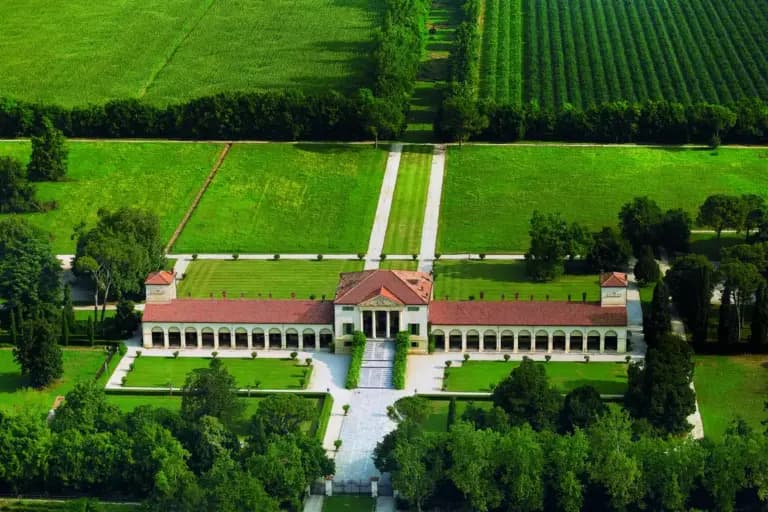
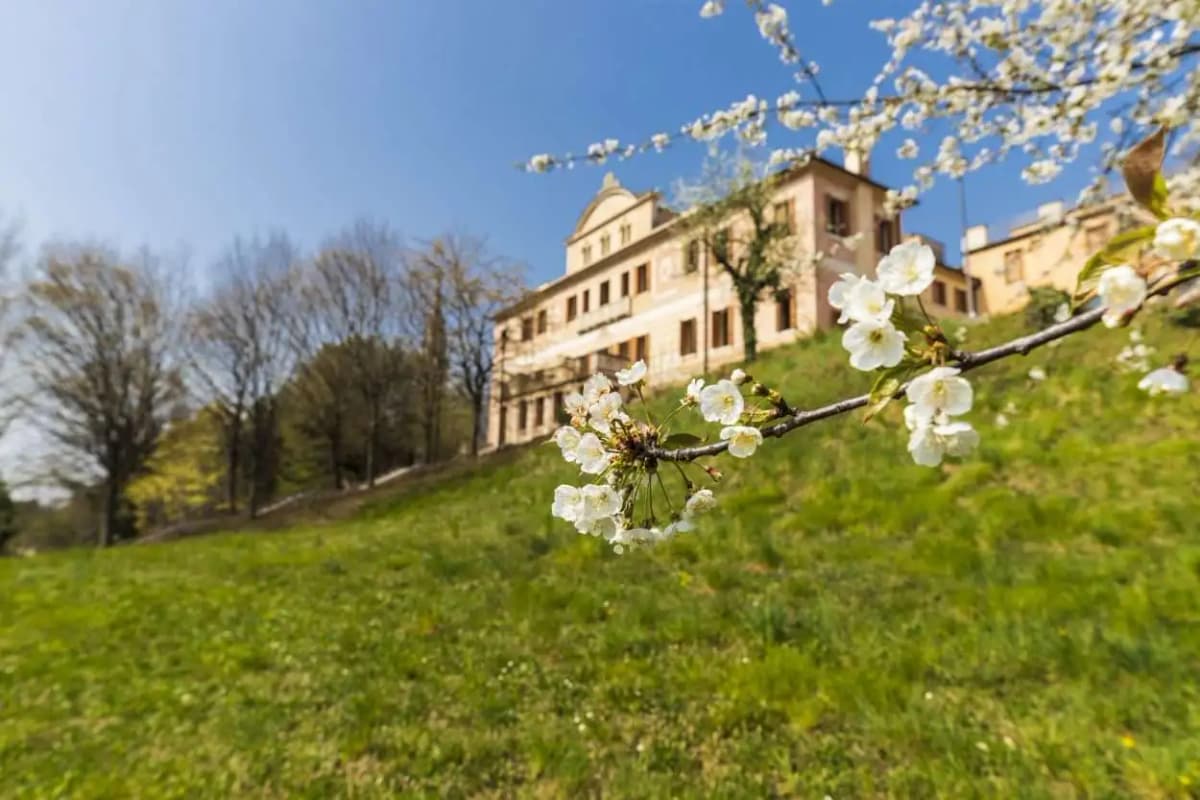
Located in Vicolo Zuccareda 5, Montebelluna (TV), Villa Zuccareda Binetti stands on the summit of a radiant hill covered with wild cherry trees, elms, magnolias, walnuts, lindens, firs, cedars, black locusts, alders, elderberries and brambles, offering peaceful and evocative natural views, especially in spring.
Architecture of Villa Zuccareda Binetti
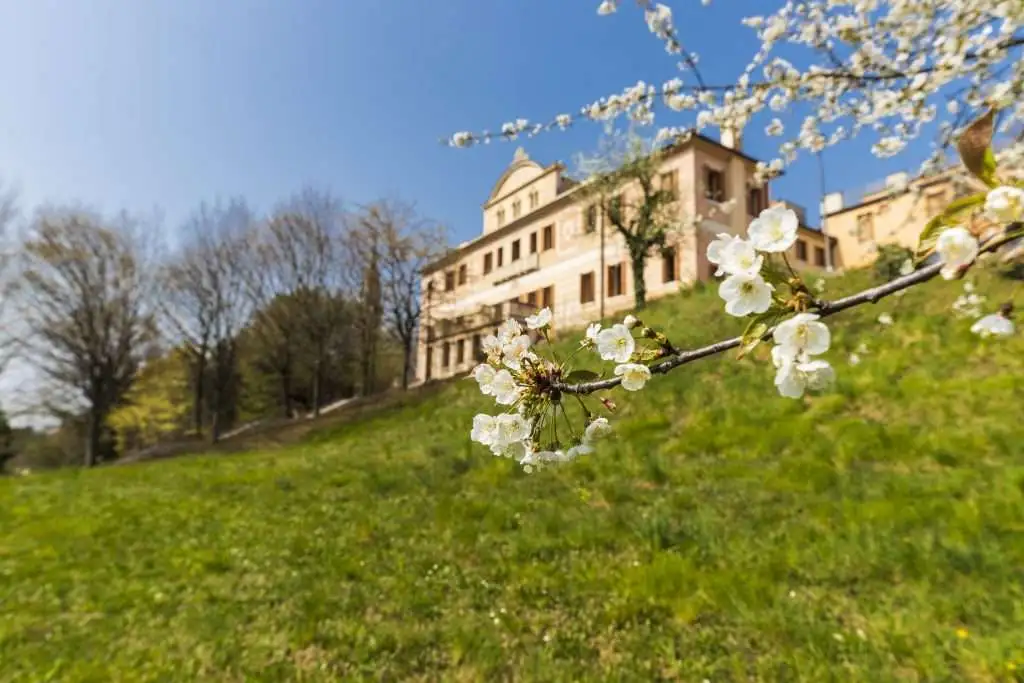
Resting on the sloping grassy hillside in the shade of lush beech trees, an elegant stone staircase leads to the entrance of the majestic architectural complex.
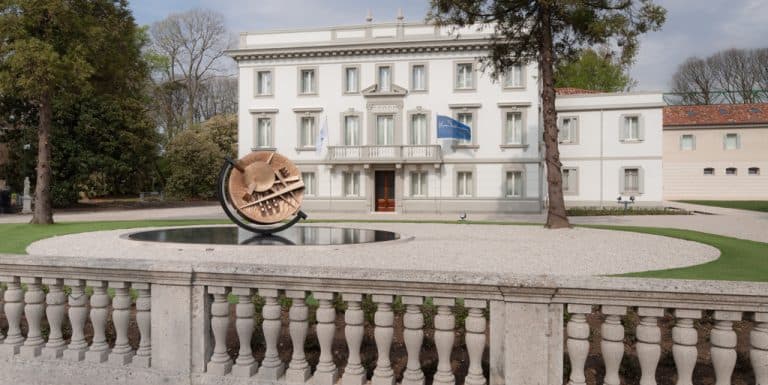
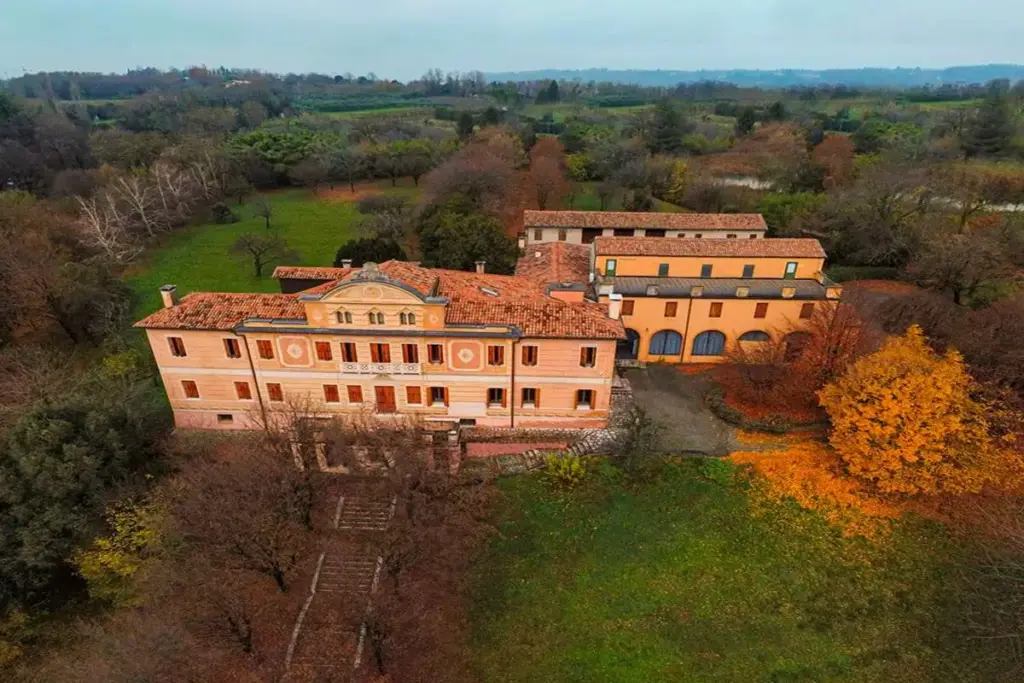
Symmetrical and vertically tripartite, the southern facade of the villa features a projecting central body at the base, where three rectangular windows open. The three single-light windows are flanked by massive pillars softened by Doric pilasters.
On the upper floor, in a central position, a door and two side windows overlook a terrace bordered by a sinuous iron balustrade. From this vantage point, the white staircase directs the gaze toward the ancient palaces, houses and apartment buildings in the urban heart of Montebelluna, which from this distance resemble tiny mosaic pieces fading into the horizon.
Turning west, you can see the neoclassical church of Santa Maria in Colle and its bell tower with a soaring pointed spire, framed by the cedars and cypresses of the nearby historic cemetery, with some burial sites of prominent figures from 19th-century Montebelluna, and by a high retaining wall in cobblestones and exposed brick that follows the difference in level of the hill on which the church complex stands.
In line with the openings below, the three central single-light windows on the second floor overlook a stone parapet decorated with sinuous geometric motifs, some of which resemble eight-petaled flowers. Crowning the vertical development of the structure is a central upper body, placed above the cornice, lit by three mullioned windows topped by a curved pediment.
The history of Villa Zuccareda Binetti
Commissioned by the historian and man of letters Bartolomeo Burchelati (Treviso, 13 June 1548; 29 September 1632) as a holiday residence, the Renaissance home was designed and built between the 16th and 17th centuries. After several centuries of neglect, the property was carefully renovated in the first half of the 19th century at the request of the new owner, lawyer Giovanni Ferro.
The enchanting manor house then passed to the Zuccareda family and later, through marriage, to the Binetti family.
A refuge and meeting place for Italian patriots during the Risorgimento, the villa became the headquarters of several military commands of the Royal Army during the First World War. During the Nazi-Fascist occupation, the sumptuous palace was used as an arms depot.
From the postwar period until the early 1980s, the complex was used as a boarding school for deaf-mute people by the wish of the Binetti sisters, the last heirs of the family. Purchased by the municipality of Montebelluna in 1982, the building became home to the Museo dello Scarpone in 1984.
The Sportsystem Foundation
The spacious and bright rooms of Villa Zuccareda Binetti now host the headquarters of the Sportsystem Foundation, whose aim is “to enhance and innovate the industrial culture of the Sportsystem District”. The Foundation’s initiatives and activities include:
- specialized technical training courses in the sports footwear sector
- meetings and events aimed at promoting innovation, research and sustainability
- the economic observatory that periodically collects and shares the district’s statistical and economic data with local companies
- The Sportsystem Foundation Museum, set up on the first and second floors of the villa
The Sportsystem Foundation Museum
Originally known as Museo dello Scarpone, the Sportsystem Foundation Museum came to life in 1984 thanks to the synergistic collaboration between eighteen local companies and footwear manufacturers. Guardians of an ancient heritage of craft knowledge passed down through generations, these businesses joined forces to create an institution intended to enhance and preserve the tradition and art of shoemaking.
The Museum houses around 1,400 patents, over 4,000 catalogues from local companies and major international competitors as well as a specialized library with more than 3,000 historical magazines, specialist books and a thesis archive.
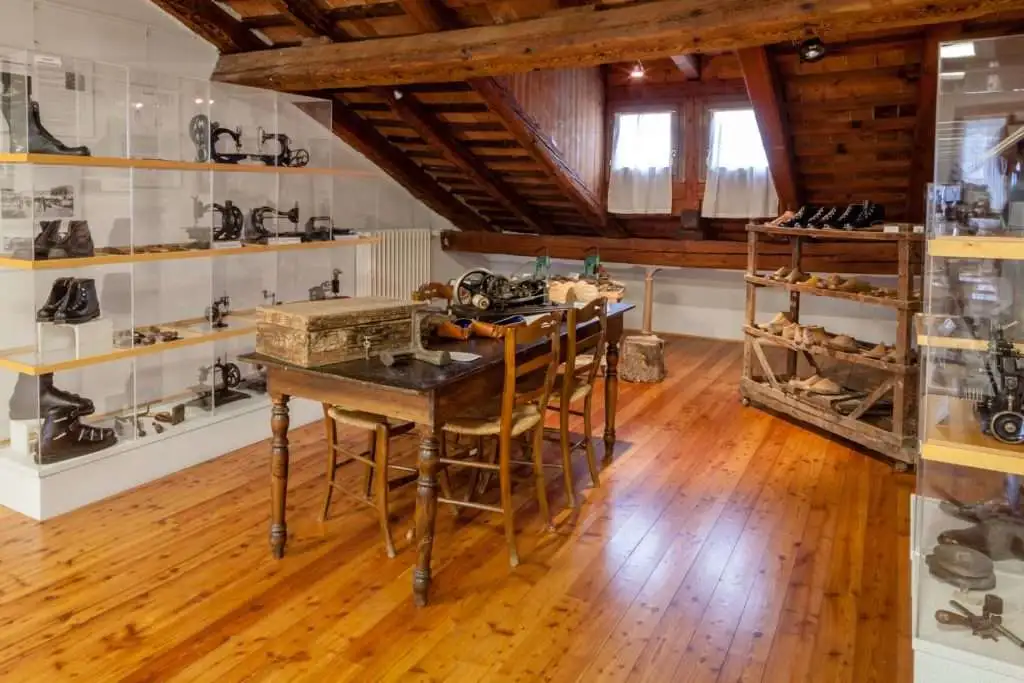
The museum route is divided into eight rooms, from the second to the first floor, with a total surface area of 200 m². The 2,500 preserved relics include tools, machinery and boot models that trace the evolution of shoemaking in the Montebelluna area from the early years of the 19th century.
Testimony to the roots of this ancient craft activity in the area is the 19th-century room, which houses a workbench with the tools used at the time and an 1808 register titled “Quinternetto delle Arti e dei Mestieri del Comune di Montebelluna” in which the presence of as many as 10 shoemakers in a community of about 5,000 inhabitants is documented.
Proceeding in chronological order, the lower floor displays several mountain boots from the 1930s, 1940s and 1950s, including some models designed for downhill skiing. Notable among them are the mountaineering boots used by climbers Achille Compagnoni and Lino Lacedelli, who made history in 1954 by becoming the first to conquer K2, one of the most challenging peaks in the Himalayan range, which with its height of 8,611 m is the highest mountain in the world after Everest.
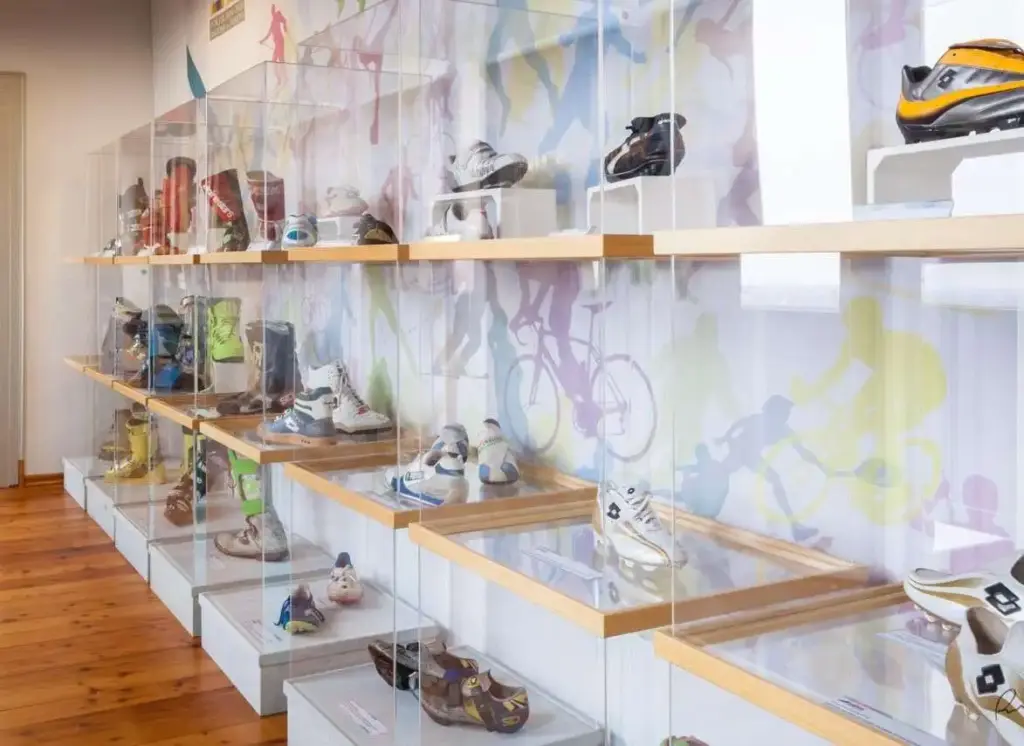
The next room illustrates the technical evolution of boots in the 1950s and 1960s. The stars of the room are the boots worn by Zeno Colò and those worn by Anton (Toni) Sadler, winner of all the alpine skiing events at the Cortina Winter Olympic Games in 1956.
The next section explores the innovation of sports shoes through the use of synthetic materials, the so-called “plastic revolution”. The route continues with an exhibition of mosaics, leather and plaster samples, moulds and models essential for the production of ski boots from the late 1970s to the 1980s.
Among the most representative footwear of this period, the Moon Boot should certainly be mentioned, with several models on display.
One of the museum’s highlights is the Gallery of Champions, where original signed shoes worn by great athletes are on display, from Bjorn Borg, Boris Becker, Gabriella Dorio, Manuela di Centa and Zico to Alain Prost, Roberto Baggio, Ronaldo, Filippo Inzaghi and Mauro Icardi, to name just a few.
The Sportsystem Foundation makes its spaces available for organizing both public and private events. It also collaborates with the Associazione CombinaAzioni Festival, which organizes the annual CombinAzioni Festival in Villa Zuccareda Binetti, one of the most interesting cultural events in the area.
If you’re wondering what to do in Montebelluna, Villa Zuccareda Binetti is an ideal destination for those who want to admire spectacular natural landscapes, visit the spacious and bright rooms of a majestic historic residence and embark on a fascinating journey aimed at promoting the value of sport and the ancient craft traditions that underpin the success of the Sportsystem District of Asolo and Montebelluna.
The park of Villa Zuccareda Binetti
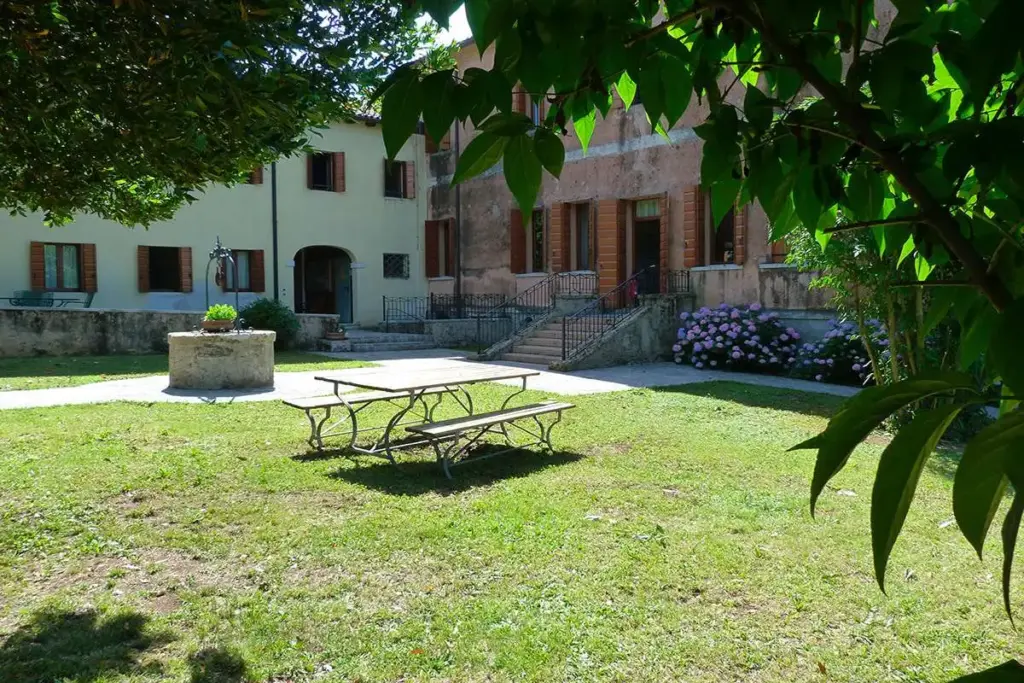
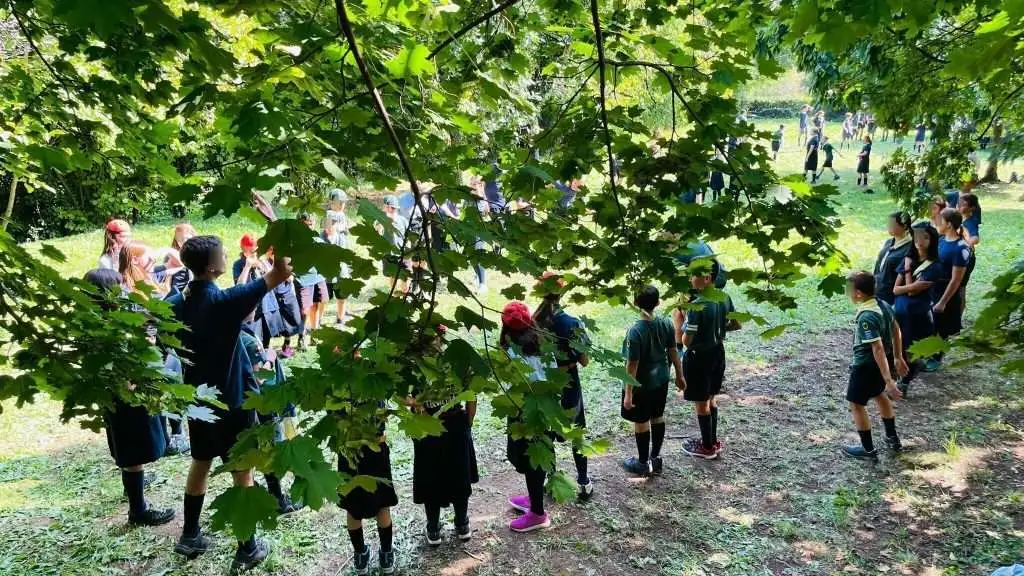
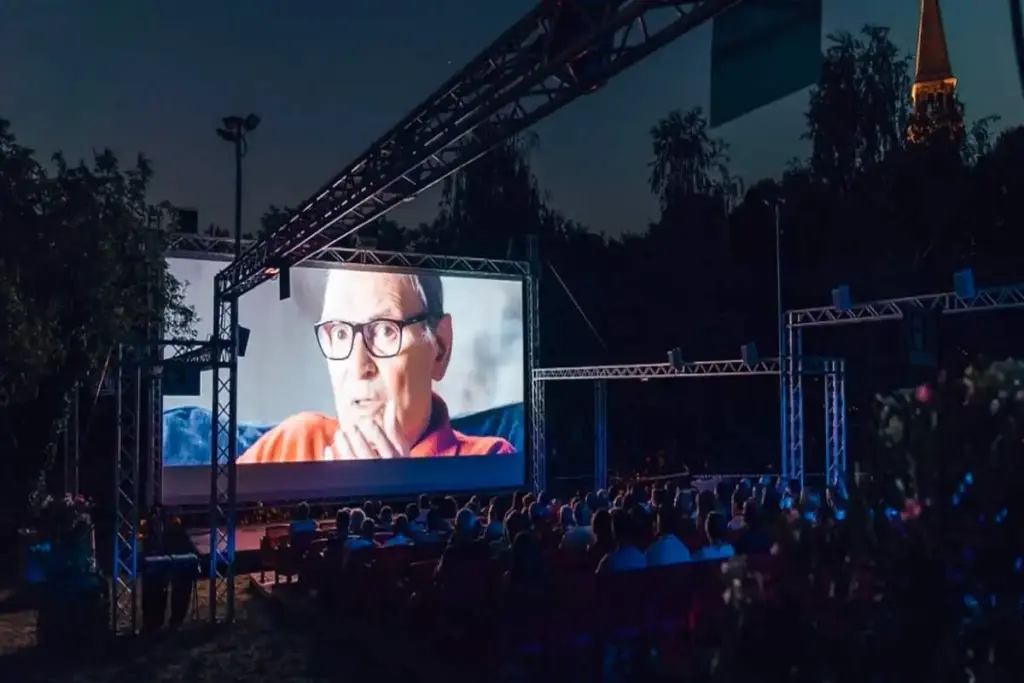
The huge park of Villa Zuccareda Binetti is also a true green lung for the city. Framed by fruit trees and flowers, it is the ideal place for picnics, sporting events and outdoor games from spring onwards. In summer the park hosts numerous theatre and reading events as part of the cultural programme of the Montebelluna Library. For some years now it has also hosted CineLuna, the open-air film series of Cinema Italia in Montebelluna.