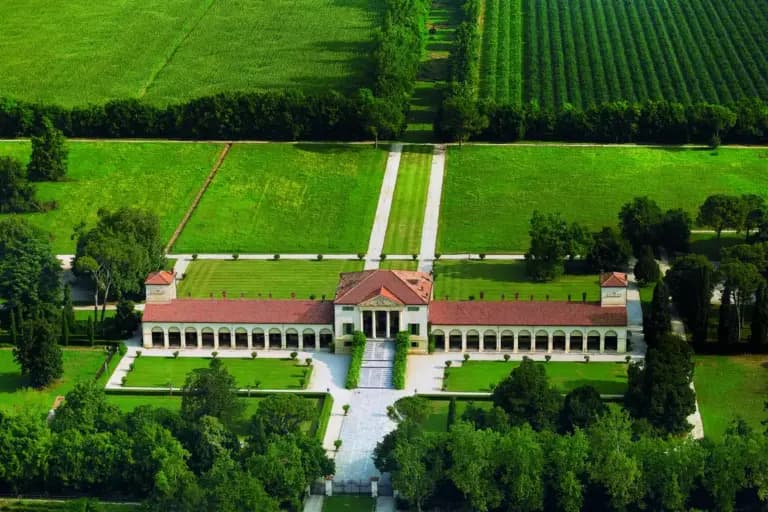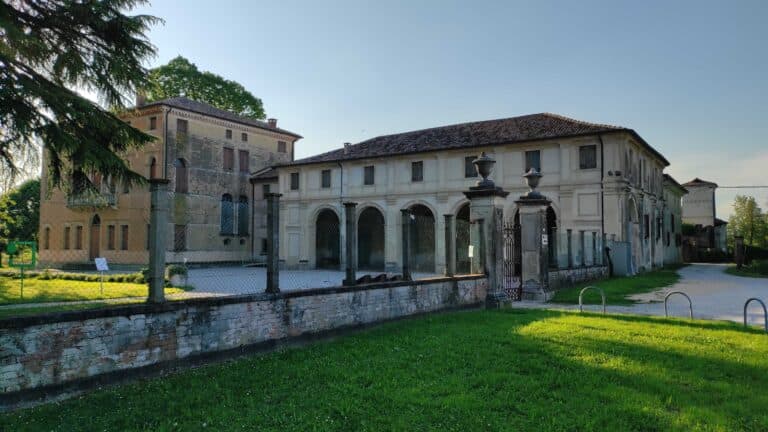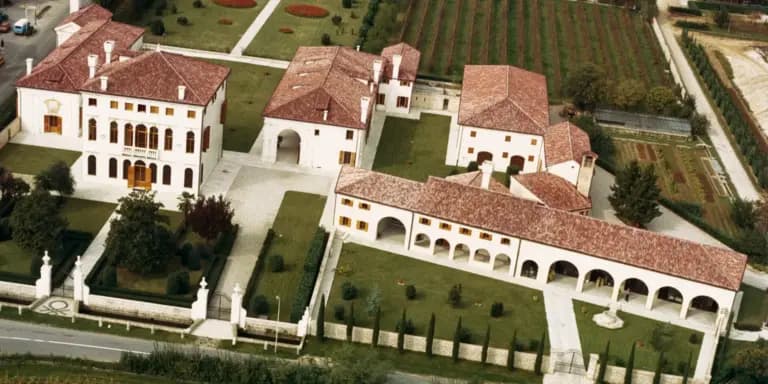

One of the most significant cultural and architectural landmarks of Caerano di San Marco, Villa Benzi Zecchini is an enchanting 17th-century residence set in the peaceful landscape of the upper Treviso plain, bordered to the northeast by the wooded slopes of the Montello and to the northwest by the bright Asolo hills dotted with medieval castles.
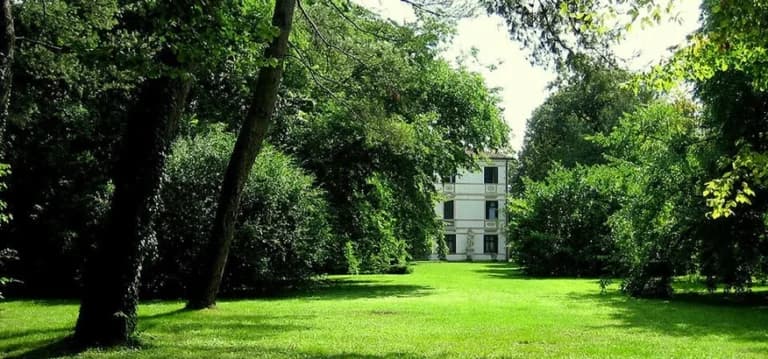
Located at Via Montello, 61, the sumptuous palazzo blends harmoniously into a lush garden adorned with cedars and magnolias, wrapped in well-kept flowerbeds and many other luxuriant tall trees.
The origins of Villa Benzi Zecchini
The history of the noble complex is linked to the investments that the Venetian Girardi family, originally from Bergamo, had made in Caerano di San Marco starting from the mid-16th century.
Documented in notarial records of 1555, the initial purchase of “campi dusentonovantatrè” in the Caerano area expanded over the course of a century to include two-thirds of the municipality’s land.
At the owners’ behest, the vast estate was cleared of woods, the dry and stony land reclaimed and brought under cultivation. At the same time, the porticoed farmhouses and the courtyard framed by the barchessa, the stable, the oven and a series of rustic outbuildings were rebuilt.
The conversion of the uncultivated land into a thriving agricultural estate was followed by the design and construction of the gentilitial residence that can be admired today.
Kept in the Marciana Library, an 18th-century manuscript describes the white palace as “no less magnificent than the one (they owned) in Venice, with a brollo of one hundred fields all enclosed by walls“.
Architecture of Villa Benzi Zecchini
Designed as a summer residence, the majestic villa consists of a square-plan residential core flanked by two towers. Taller than the central body, the soaring side turrets are lit by three superimposed single-lancet windows, topped by an oval opening in the attic.
Accessible by an elegant six-step staircase, the southern entrance is crowned by a lunette window, above which stands a noble coat of arms. The wooden portal is flanked by six windows, three on each side.
The same solution, with a central single-lancet window and six side windows, is repeated on the first floor. The three central openings on the piano nobile look out onto a balcony supported by stone corbels and softened by a sinuous iron balustrade. In the attic, seven rectangular windows open, aligned with those below.
Two square-based pyramidal spires, ending in a sphere, accentuate the building’s vertical development.
In addition to the stable, the cellars, the granaries and the houses for the gastaldi, the agricultural complex included a lovely pond, now filled in.
The 17th-century oratory of Villa Benzi Zecchini
The white oratory of 1610 is certainly worth noting. Located to the east of the palazzo, the place of worship stands out for a double-pitched façade ending in two pinnacles crowned with shaped stone elements.
Accessible through a wooden door decorated externally with the family coat of arms, the small church houses a fine altar on whose mensa, made of wood decorated to imitate marble, once stood an altarpiece from the Veronese school.
Villa Benzi Zecchini from the 19th century to the present day
Later, the complex passed to the Benzi-Zecchini family, who retained ownership until 27 January 1837, the day of the death of the last heir of the noble house, Caterina Casser wid. Benzi Zecchini. As laid down in the latter’s testamentary provisions, the Benzi Zecchini holdings were left to the Pia Casa di Riposo of Venice, on the condition that one third of its beneficiaries be chosen from among the poor of Caerano.
The Pia Casa di Riposo, however, limited the right of use to legitimate beneficiaries, which led to a legal dispute that lasted until 1863, when the Pia Casa di Riposo agreed “to pay in perpetuity to the Municipality of Caerano the annual sum of 700 florins, with which it would provide for the needs of its own poor…“. Consequently, “in return for this perpetual allowance, the Municipality of Caerano renounced every and any claim it had previously believed to have” regarding the will.
Following the acquisition of the Villa by the Municipality of Caerano di San Marco in 1982, careful restoration work began and was completed at the end of the 1980s, bringing the stately complex back to its former splendor.
The Villa Benzi-Zecchini Foundation
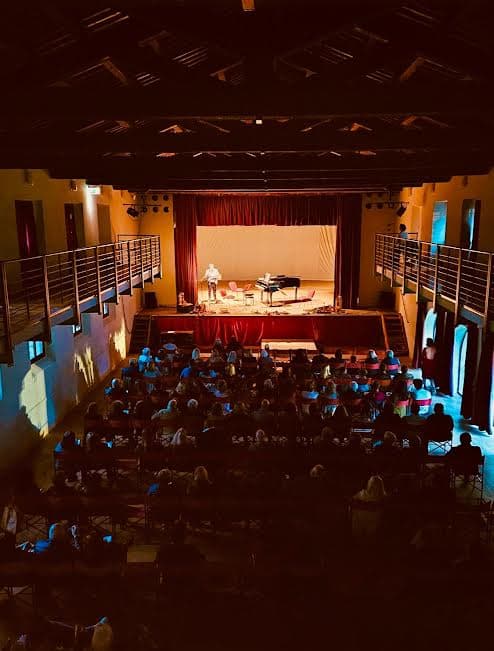
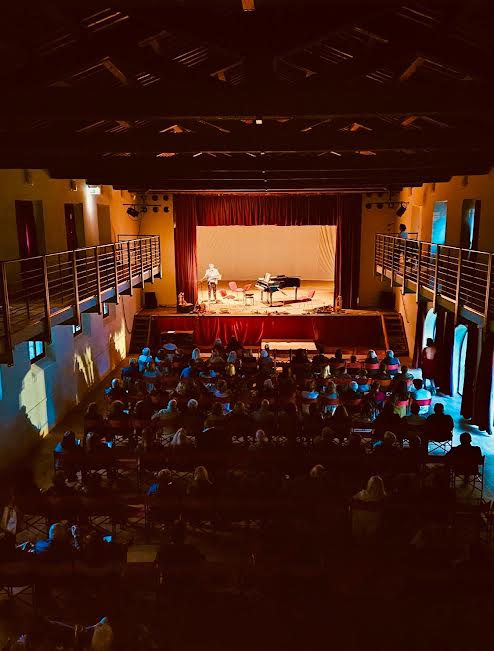
At the meeting of 20 March 1990, the Municipal Council “resolves to establish the “Foundation” called “Villa Benzi – Zecchini” with the purpose of encouraging public participation in and enjoyment of the historic real estate complex consisting of Villa Benzi – Zecchini with adjoining Auditorium and park.
The current theatre has a capacity of three hundred seats and is equipped with a 110 m² stage with fly tower, a proscenium of 8.5 m in length, 4.8 m in height and 10.5 m in depth.