

Discover the origin of the imposing walls and the civic tower of this extraordinary medieval city.
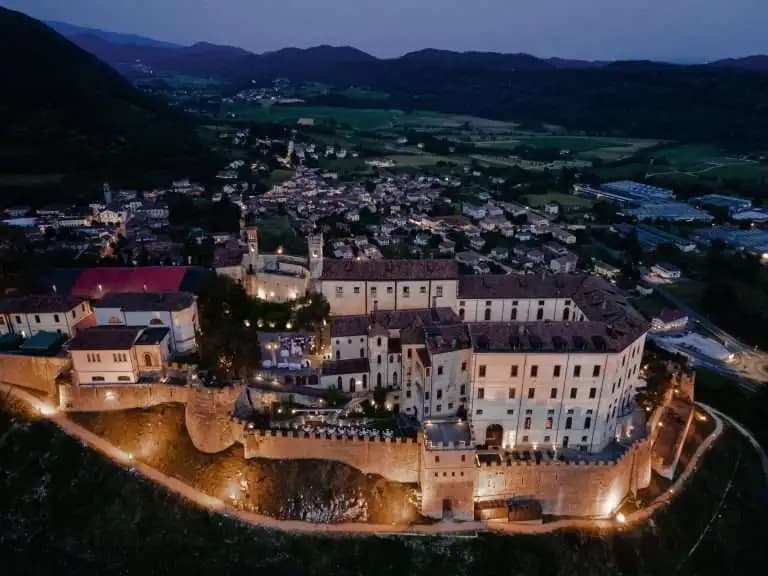
The history of Castelfranco, one of the most fascinating and best-preserved fortified cities in the region, is firmly tied to its strategic position in the heart of Veneto. Located a few kilometres from Venezia, Padova, Vicenza and Treviso, the medieval stronghold was a thriving commercial crossroads linking western and eastern Europe, the Republic of Venice and the Holy Roman Empire.
Once equipped with drawbridges and portcullises (replaced during the 16th century by masonry bridges), the main entrances to the town centre open to the east (the Treviso Gate or porta franca) and to the west (the Cittadella Gate), while the pedestrian entrances are located to the north and south.
The toponym of Castelfranco Veneto
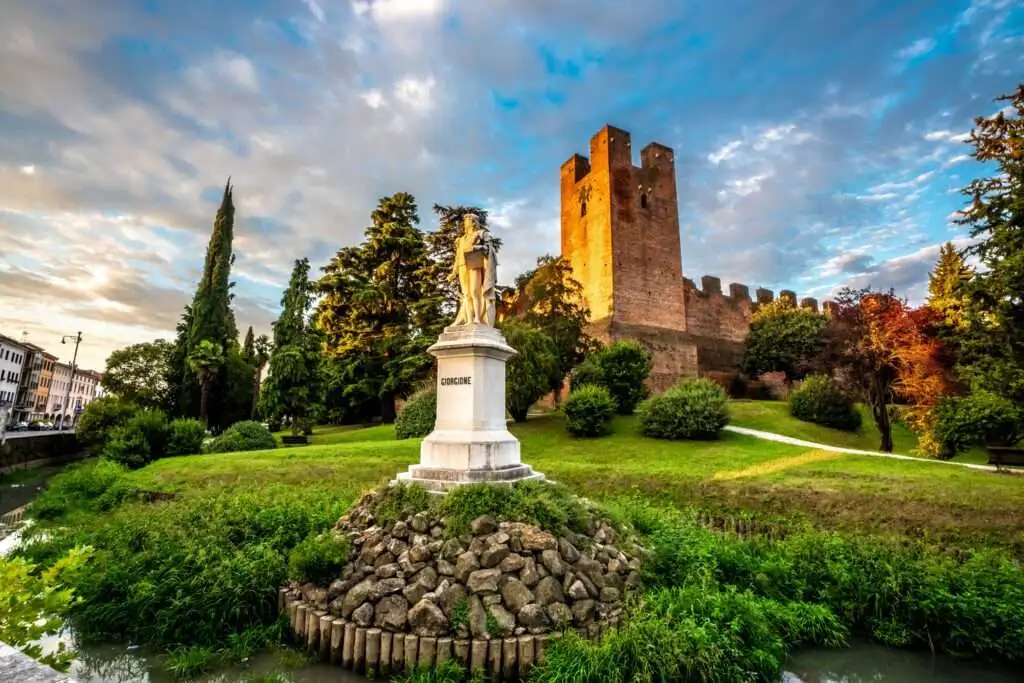
The name of the municipality comes from the combination of the words “castello” and “franco”. The latter refers to the exemption from paying taxes that the municipality of Treviso granted to the inhabitants of the stronghold in recognition of their commitment to defending it from the neighbouring people of Padova and Vicenza.
The walls of Castelfranco Veneto
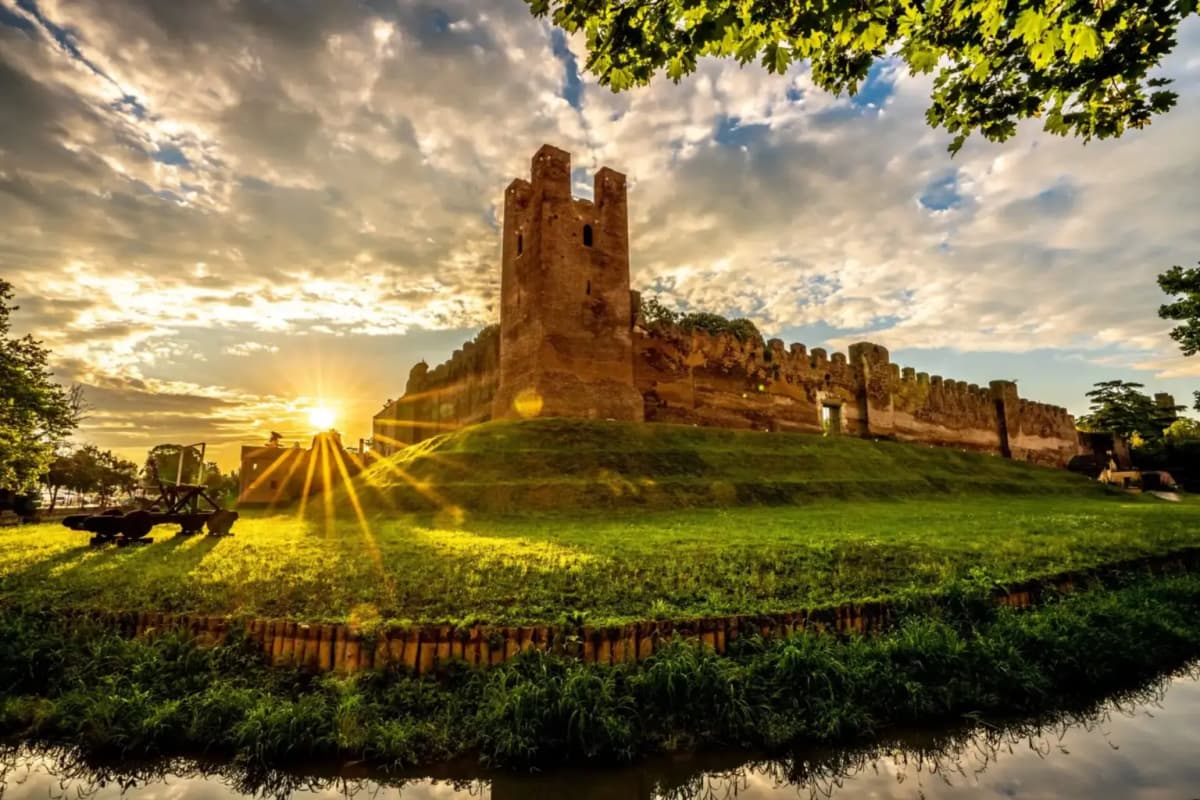
Founded in the last years of the 12th century, the military settlement rises on top of a grassy embankment bordered by the Avenale and the Musonello, whose waters are channelled into a deep moat that follows the castle wall perimeter.
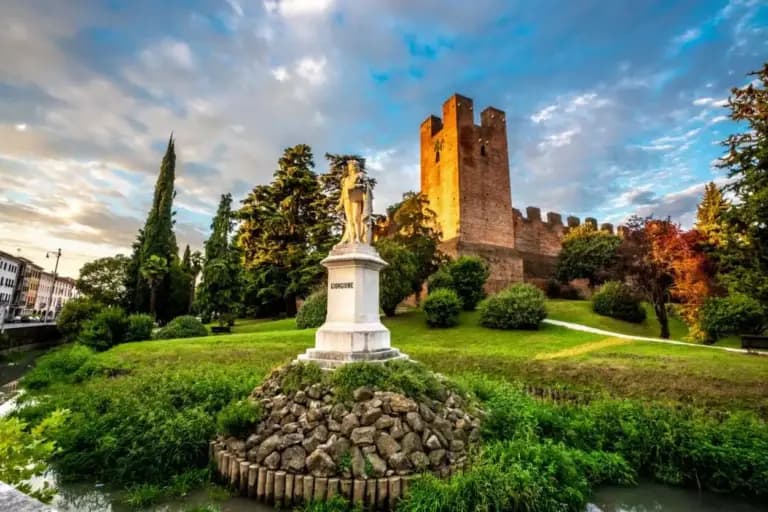
With a thickness of 1.7 metres, the exposed-brick walls of the architectural complex rest on a massive base made of river pebbles and masonry rubble bound with hydrated lime. Standing guard over the medieval citadel for eight centuries, the imposing 17-metre-high walls form a striking square of red brick, 230 metres on each side, marked at the corners by soaring corner towers and equipped with two mid-wall towers.
The civic tower
Built in 1246, the year in which Ezzelino da Romano had decided to strengthen the defences of the citadel, the tower of the dead stands out in the centre of the southern curtain wall, while the civic tower rises 43 metres along the eastern walls, dominating the porta franca with its spectacular bulk.
The magnificent work of military architecture tells, like an ancient book, some of the most significant chapters in the history of Castelfranco Veneto.
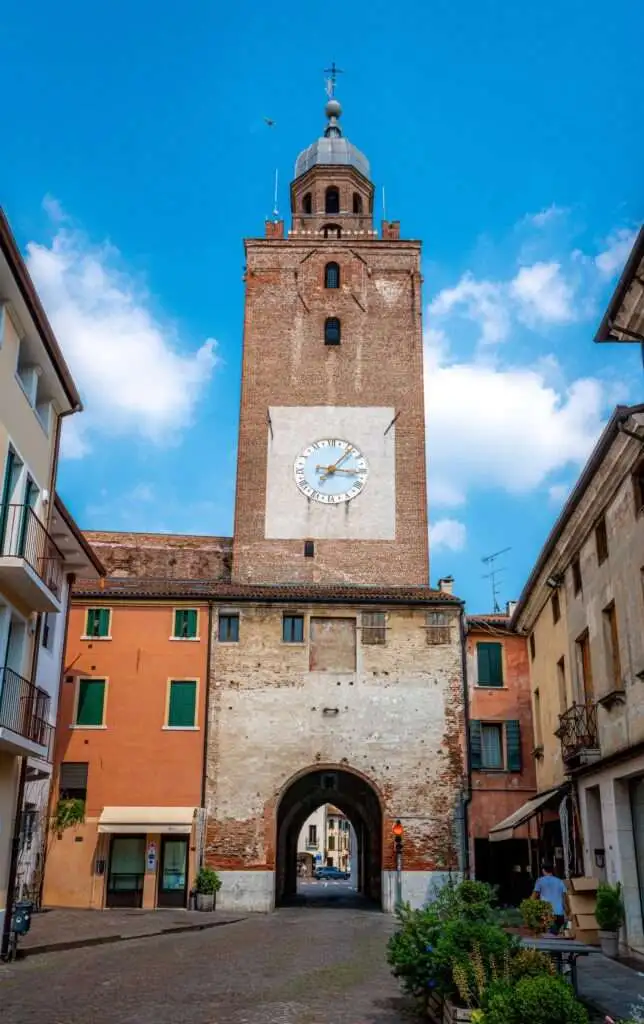
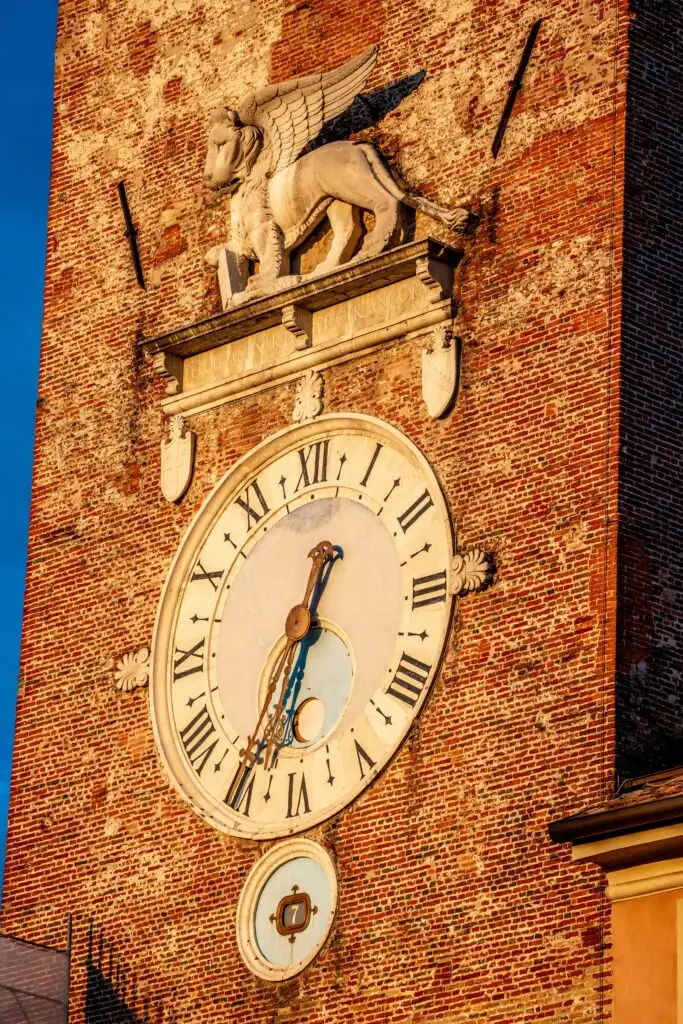
On the east wall of the civic tower stands out a clock with Roman numerals topped by a splendid Lion of San Marco in Istrian stone, whose whiteness stands out against the uniform red-brick surface of the imposing structure. Installed in 1499, both the Lion of San Marco and the enchanting clock symbolise the glorious rule of the Republic of Venice over the city of Castelfranco Veneto from 24 January 1339 to 12 May 1797.
The brief period of Carraresi rule, between 1380 and 1388, is recalled by the red carriage on a white field painted on the vault of the Treviso Gate.
During the War of Cambrai, fought from 1509 to 1517, the curtain wall proved unable to withstand the impact of Renaissance-era artillery, as shown by the collapse of part of the town walls.
By then having entirely lost its defensive function, in the 19th century the fortress became the city’s most emblematic symbol, a jewel of medieval urban planning that gave birth to the famous Giorgione, a leading interpreter of the Veneto colourism of the second half of the 15th century.