
Casa Marta-Pellizzari
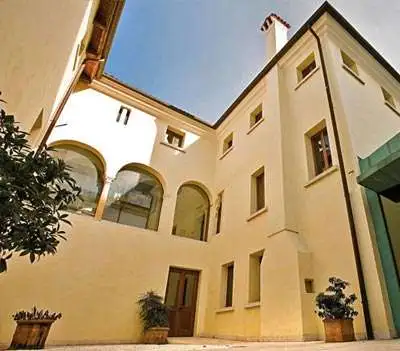
Located in the historic heart of Castelfranco in Piazza San Liberale, the original 14th-century dwelling features a charming lobed window on the first floor, a clear reference to Gothic architecture.
The loggia, also on the first floor, dates back to the 15th and 16th centuries, with its small column in soft stone reminiscent of those in the loggia of the Barco della Regina Corner in Altivole.
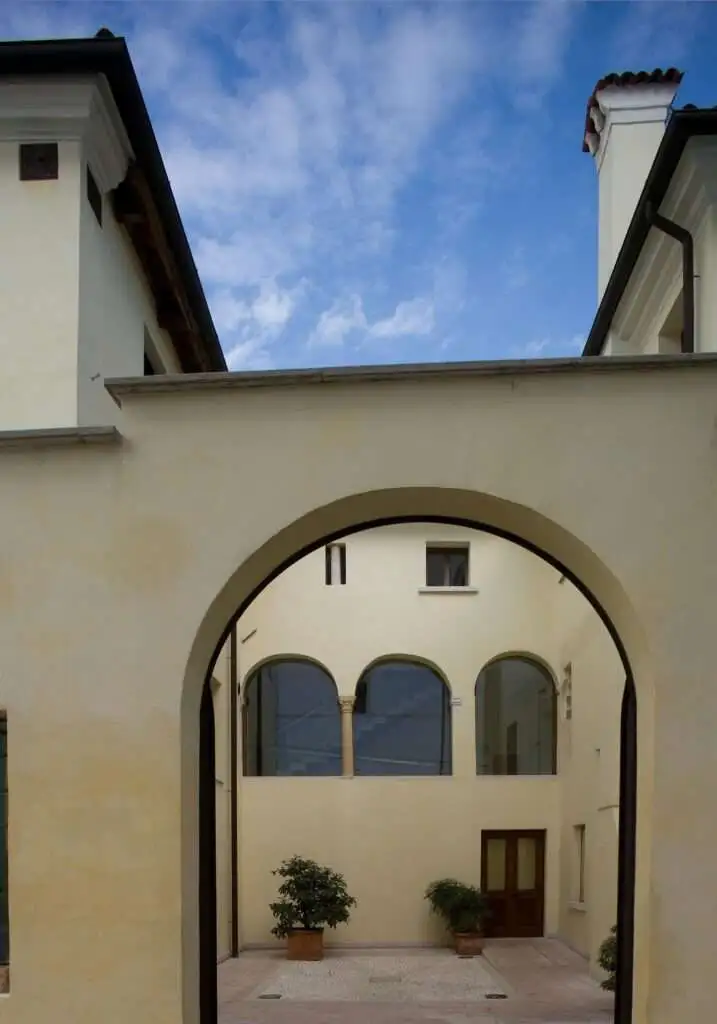
In the second half of the 17th century, the Marta family purchased the building from the Barbarella family. The residence then passed to the Zabottini family, who lived there from 1700 to 1810. In 1831, the house was renovated at the behest of the then-owner Francesco Trevisan, who ordered the demolition of the section facing the east side of the Duomo. Dating back to the 19th-century intervention, an elegant boundary wall stands where the demolished area once was. The house later passed to the Pellizzari family.
Restoration and renovation of Casa Marta-Pellizzari
In 1973 and 1974, thanks to municipal support, a careful restoration project designed by the Bellavitis & Valle Architecture Studio of Venice restored Giorgione’s House to its former splendor.
From 2002 to 2003, Casa Marta-Pellizzari underwent a renovation and restoration project curated and funded by the Cassamarca Foundation. The design was entrusted to the Carli-Moschino studio of Padua, with guidance and supervision from the Superintendence for Environmental and Architectural Heritage of Veneto and the Superintendence for Historical, Artistic, and Demoethnoanthropological Heritage of Veneto.
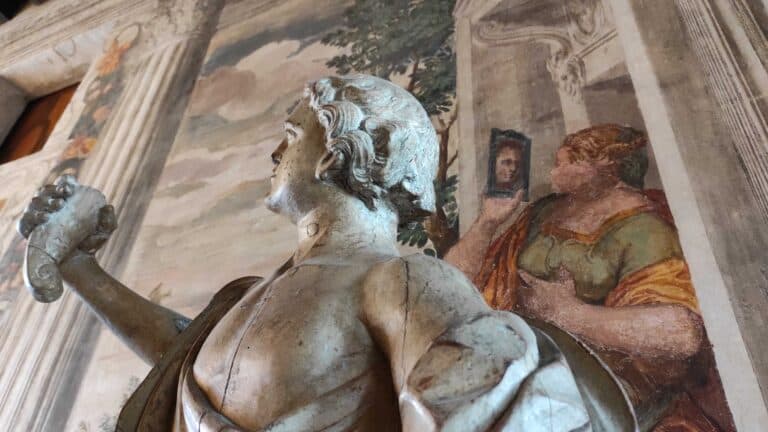
The most recent restoration work has restored luster to a frieze and a cycle of 16th-century frescoes with biblical and landscape scenes, created by Venetian fresco painters.
Giorgione’s House Museum
Inaugurated on May 9, 2009, on the 500th anniversary of Giorgione’s death (c. 1477-1478; c. 1509-1510), the museum is set up in the fascinating rooms of Casa Marta-Pellizzari, a charming medieval residence where the Master of Castelfranco, one of the greatest exponents of Venetian tonal painting, worked.
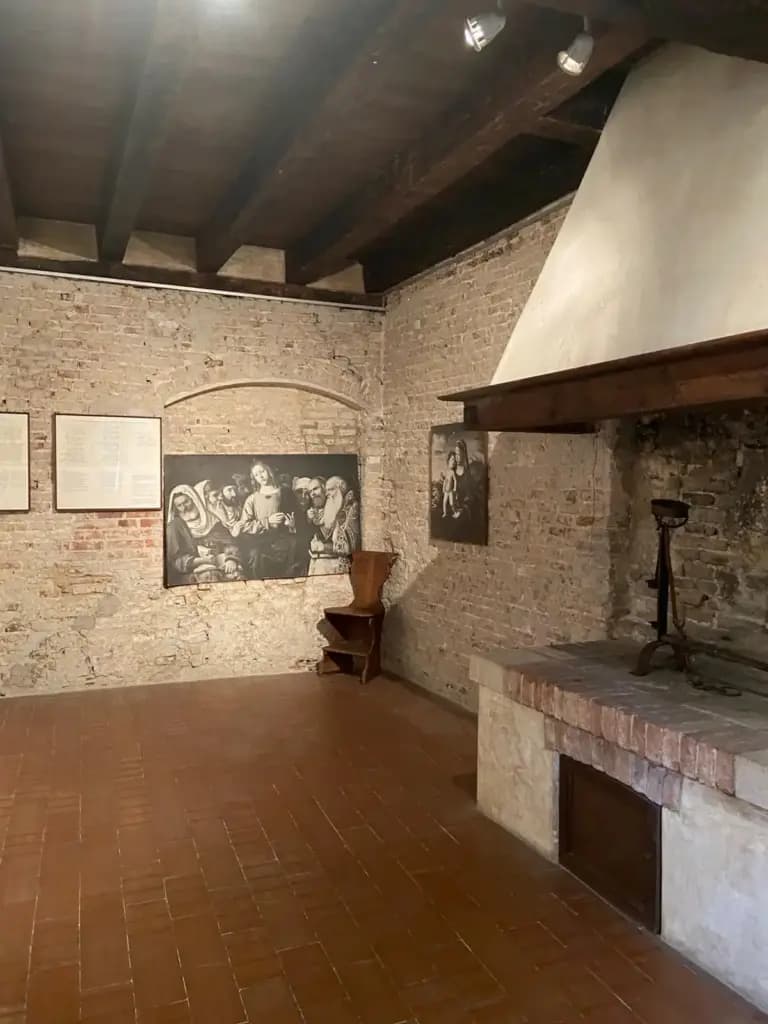
Key elements of the museum itinerary are Giorgione’s Altarpiece, housed in the Costanzo chapel inside the Duomo, the Frieze of the Liberal and Mechanical Arts, located on the first floor of Casa Marta-Pellizzari, and the house itself, whose sumptuous rooms provide the ideal historical and architectural setting for the hundred original pieces of the exhibition path.
Giorgione’s Altarpiece
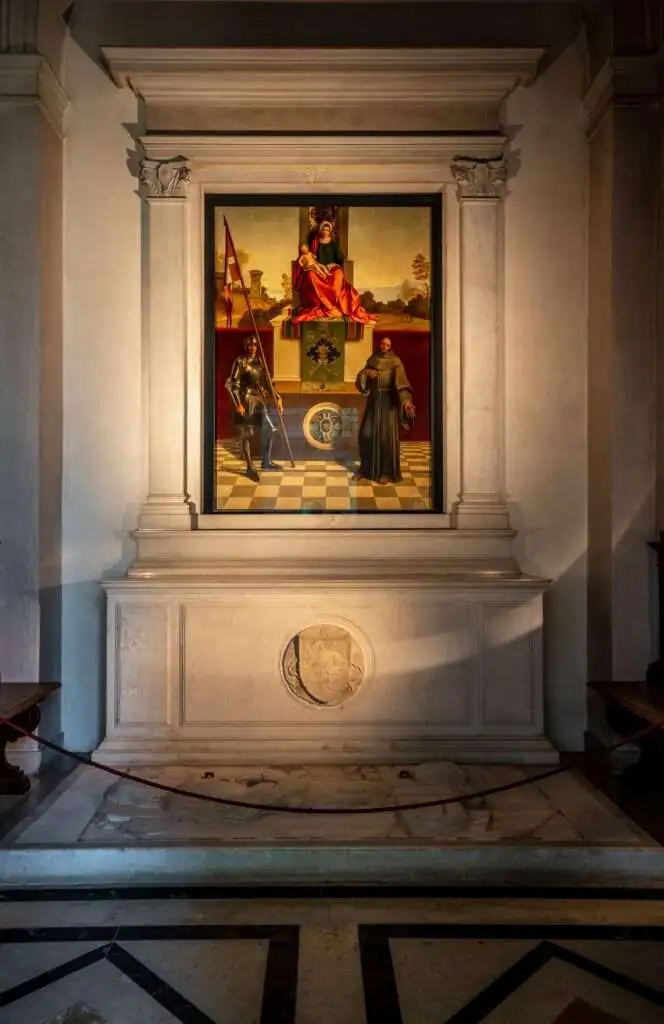
Located in the Duomo of Santa Maria Assunta and San Liberale at Vicolo del Cristo, 14, the altarpiece was commissioned from Giorgione by Tuzio Costanzo, a Messinese condottiero in the service of the Republic of Venice, to commemorate the death of his son Matteo, who died of fever in Ravenna during a military campaign of the Serenissima between 1503 and 1504. Other dating hypotheses place the work around the year 1500.
Muzio Costanzo, Tuzio’s father, had obtained the title of Viceroy of Cyprus in recognition of his help to the Cypriot king James II of Lusignan in driving the Genoese from the island of Famagusta in 1464.
Located to the right of the presbytery, the altarpiece depicts the Madonna enthroned with the Child in the center of the composition. Below the throne stands the massive porphyry sarcophagus, embellished with the coat of arms of the patron.
The choice of this precious material, used in the tombs of Roman emperors and Norman and Swabian kings in Sicily, underscores the nobility and military prestige of the Costanzo family.
The sarcophagus is flanked on the right by Saint Francis and on the left by Saint Nicasius, an armed saint depicted holding the banner of the Order of the Hospital in his left hand, the same religious and chivalric order to which Tuzio and other family members belonged.
The two saints turn their gaze to the viewer and devotee, inviting them to participate in an intimate and contemplative dimension, while the Virgin and Child direct their heartfelt gazes downward toward the sarcophagus.
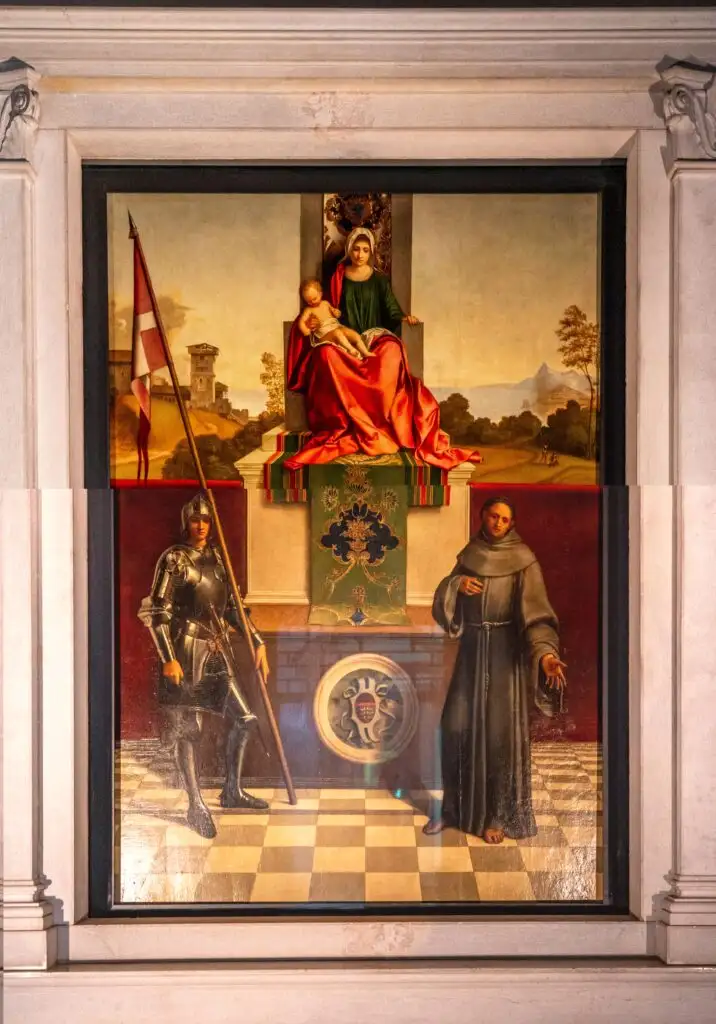
Photo by Francisco Marques.
The work introduces significant innovations compared to the stylistic conventions of horizontal altarpieces, where the Sacred Conversation traditionally took place outdoors, and vertical ones, where the courtly and ecclesiastical setting of the conversation was separated from the external space.
In Giorgione’s Altarpiece, the elevated position of the throne relative to the red velvet curtain creates a harmonious visual connection between the paved floor, marked by a rigorous black-and-white checkerboard pattern, and the boundless rural landscape that gently fades into delicate vibrations on the horizon.
The ruined turreted village nestled among wooded hills and the two armed figures immersed in greenery depict the theme of war, bringer of death and mourning.
Created through the masterful layering of chromatic glazes, the atmosphere pervading the radiant hilly landscape floods the throne of the Virgin and Child with light and color, enveloping the pictorial architecture in the foreground and accentuating its depth.
The placement of the two saints on either side of the tomb forms the base of an isosceles triangle at whose apex stands the throne with the Virgin. The pyramidal verticality characterizing the composition is emphasized by the pronounced and almost unnatural height of the throne, whose backrest’s end is not visible, an aspect interpretable as a symbolic passage from the physical world to the otherworldly.
Opening hours
From September to June: Monday, Wednesday, Thursday, and Saturday from 8:00 AM to 11:45 AM and from 3:00 PM to 5:45 PM
Tuesday and Friday from 9:00 AM to 11:45 AM and from 3:00 PM to 5:45 PM
Sunday: from 3:00 PM to 5:45 PM
From July to August: Monday, Wednesday, and Thursday from 8:00 AM to 11:45 AM and from 3:00 PM to 5:45 PM
Tuesday and Friday from 9:00 AM to 11:45 AM and from 3:00 PM to 5:45 PM
Saturday from 9:00 AM to 11:45 AM and from 3:00 PM to 6:45 PM
Sunday from 3:00 PM to 6:45 PM
The altarpiece is not visitable during services nor on Sunday mornings and holidays: Tuesday and Friday at 8:15 AM / every evening at 7:00 PM / Sunday at 7:00 AM – 8:30 AM – 10:00 AM – 11:15 AM
Frieze of the Liberal and Mechanical Arts (1502-1503)

Extending over fifteen meters, the frieze of the liberal and mechanical arts is a cycle of frescoes that adorns the top band of the east and west walls on the first floor of Casa Marta-Pellizzari. The monochrome fresco in yellow earth features delicate chiaroscuro effects achieved with the use of white lead and bistre.
One of the most well-known interpretations of the work identifies in the enigmatic frieze of the east wall a reflection on the transitory nature of human existence and in the learning of the liberal arts a means to give meaning to one’s life through the pursuit of Virtus and Fame.
Divided into the arts of the trivium (grammar, rhetoric, and dialectic) and the quadrivium (arithmetic, geometry, music, and astronomy), the liberal arts constitute a corpus of disciplines related to linguistic expression and numerical and conceptual abstraction. In contrast to the practical and manual nature of the mechanical arts, the liberal arts allow the refinement of critical thinking and discernment, essential for understanding the message of salvation in the Bible and overcoming one’s condition as a material being.

According to the astrological interpretation by Manlio Pastore Stocchi, Silvio D’Amicone, and Augusto Gentili, the allegorical frieze is linked to the presence in Castelfranco Veneto of Giovan Battista Abioso, a mathematician, physician, astronomer, and astrologer from Campania who found in Giorgione an excellent interlocutor to compare his thoughts.
According to this reading, the frieze depicts the severe cosmic and earthly imbalances announced by a forecast based on the study of celestial bodies. In Giorgione’s time, astronomy was functional to astrological predictions, which in turn served to formulate forecasts on events and human affairs.
The arrangement of books, inkwells, and glasses in the first section of the frieze indicates the profound theoretical and scientific study on which astrology was based, a discipline theorized by Giovanni Battista Abioso in his Dialogus in Astrologiae defensionem of 1494 and by Giovanni da Monteregio in the work Epytoma in Almagestum Ptolomei of 1496.
The presence of an hourglass and two cartouches bearing the Latin phrases “Umbre transitus est tempus nostrum,” meaning “our life is the passing of a shadow” (Wisdom of Solomon, II, 5) and “Sola virtus clara aeternaque habetur,” i.e., “virtue alone is considered illustrious and eternal” (Sallust, De Catilinae coniuratione, I.), emphasize the rapid and inexorable passage of time and the transience of human life. Between the two inscriptions is depicted the face of an elderly sage, perhaps Averroes.
Following the numerous instruments for measuring celestial motions, among which a sextant, an armillary sphere, squares, compasses, an astrolabe, and a set square can be identified, is the depiction of the great conjunction of Saturn, Jupiter, and Mars in Cancer announced for 1503-1504, the solar eclipse of 1502, and the total lunar eclipse of 1504, considered harbingers of cosmic disorder.
The two subsequent cartouches, between which is a medallion with the image of a bearded old man, bear Latin phrases exalting reason and wisdom: “Qui in suis actibus ratione duce diriguntur iram celi effugere possunt” and “Fortuna nemini plus quam consilium valet” (Publilius Syrus).

The dramatic situation predicted by the astronomical events illustrated in the first section of the east frieze materializes in the theme of war, depicted in a central position.
In the last part of the frieze, Giorgione elevates painting and medicine, traditionally classified as mechanical arts, to the level of music, included in the arts of the quadrivium for its mathematical nature. Testifying to a world now devoid of balance, the depicted musical instruments lie abandoned, silent, and stringless.
The inscription readable in the penultimate cartouche reads: “Si prudens esse cupis in futura prospectum intende,” meaning: “if you wish to be wise, look to the future.” This warning sees in wisdom and foresight the only way to ensure a positive future for humanity and the arts.
The frieze on the west wall is most likely a mirror imitation of the frieze on the east wall, but not particularly profound in content. In the west frieze, the space is occupied by cluttered objects related to the world of war, music, funerary rites, time measurement, equestrianism, navigation, and art.