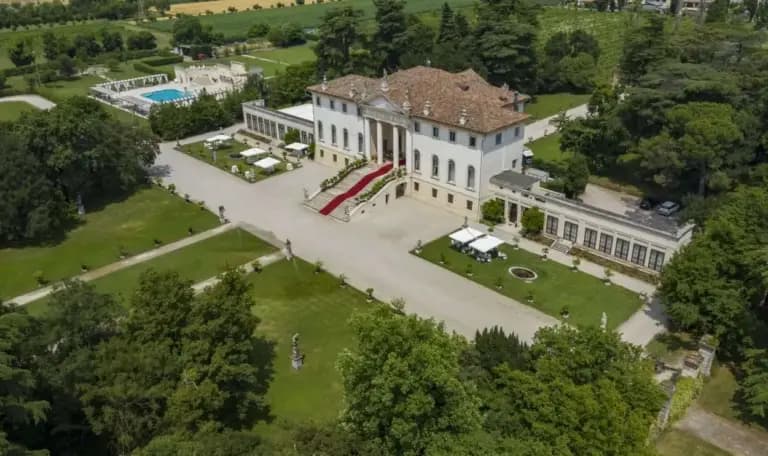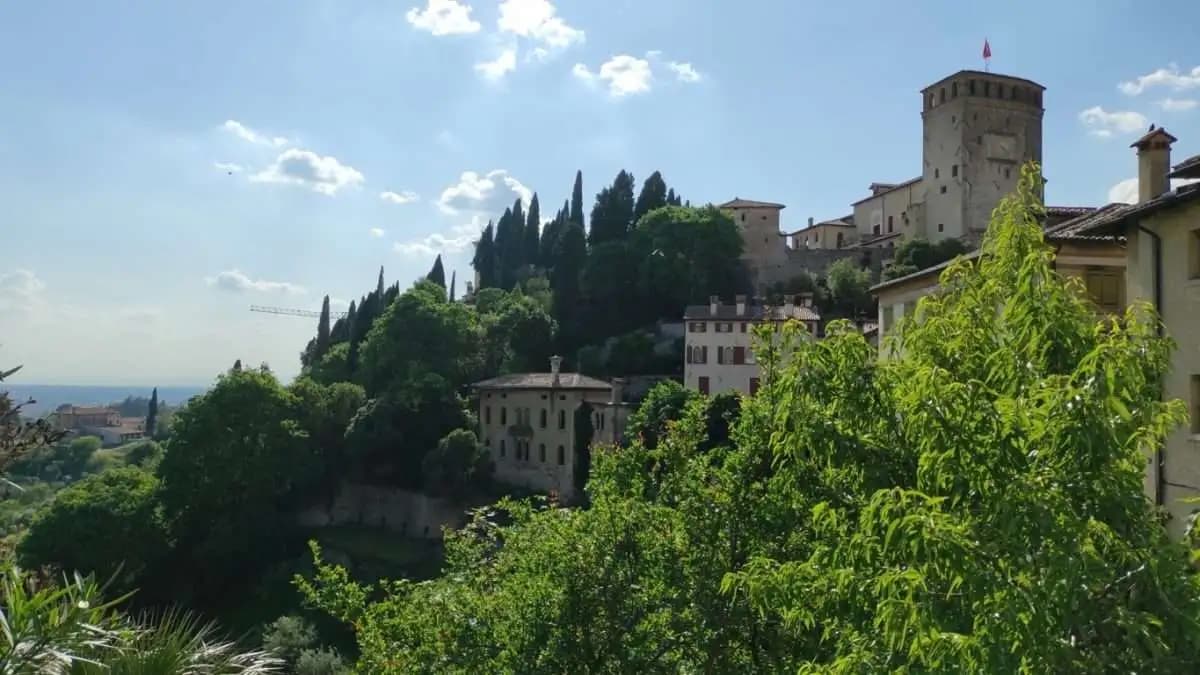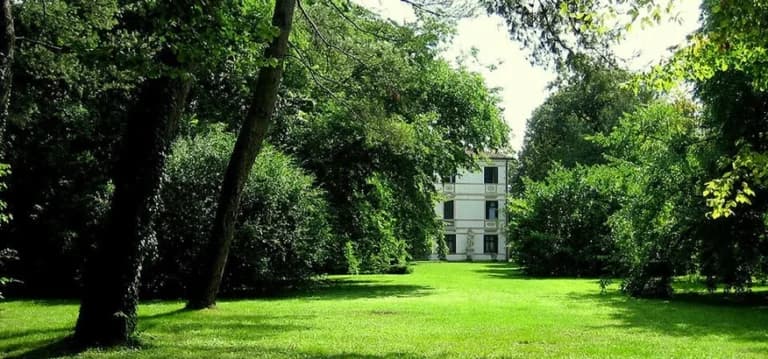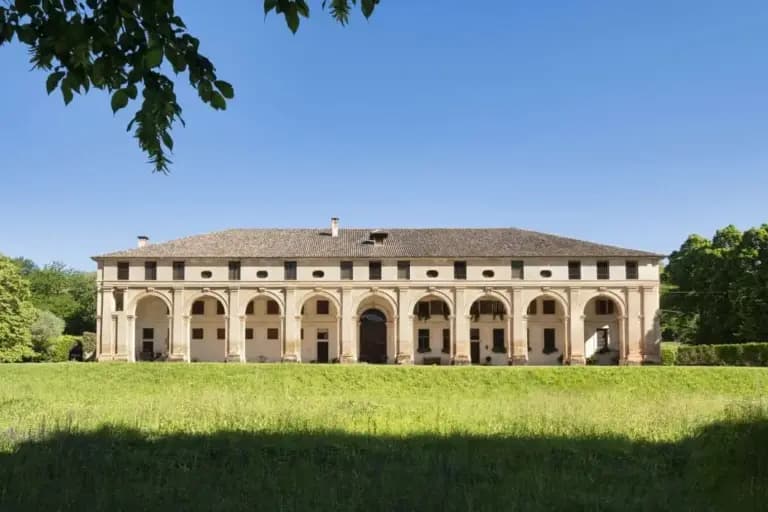

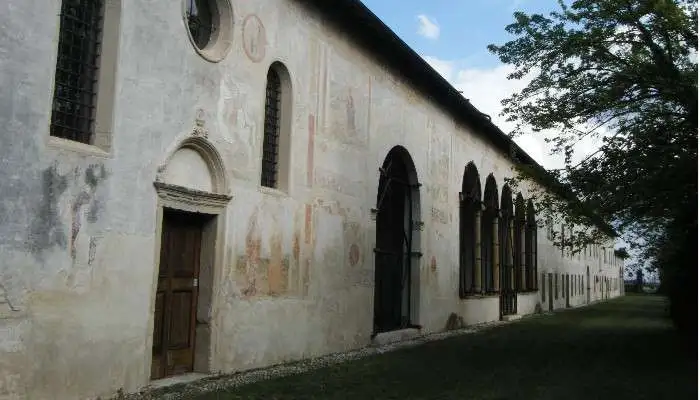
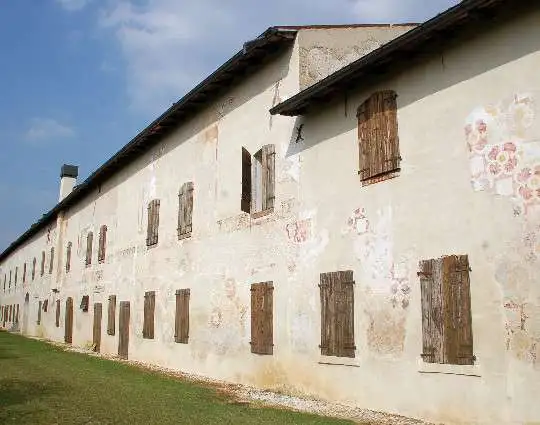
Harmoniously set in the peaceful countryside of Altivole, framed to the north by the Asolani hills, to the east by the gentle wooded slopes of Montello, the Barco of Queen Cornér is the surviving element of a larger building complex built between the 15th and 16th centuries. The Barco is not open to the public.
Extending for 119 meters, the section of the Barco that has survived the test of time consists of a linear arrangement of buildings of a religious, agricultural, residential, and administrative nature, connected both architecturally and artistically through a pictorial apparatus that embellishes the interiors and exteriors of the structure.
The frescoes that ennoble the Barco create a balanced synthesis between nature and architecture, revealing centuries later the spiritual values, political power, and cultural sensitivity of one of the most important figures of the Venetian Renaissance, Caterina Cornér.
Caterina Cornér
Childhood and Education
Caterina Cornér was born on 25 November 1454 in the palace of Ca’ Corner di San Cassiano, a jewel of Gothic architecture overlooking the Grand Canal. This majestic palace was rebuilt in the 18th century by the architect Domenico Rossi.
Caterina Cornér was the daughter of Marco Cornér, a Venetian nobleman whose paternal great-grandfather (1286-1368), also named Marco, had been the LIX (59°) Doge of the Republic of Venice.
Daughter of Nicolò Crispo, Duke of Naxos and the Cyclades archipelago, Fiorenza Crispo, Caterina’s mother, was the maternal granddaughter of John IV Komnenos, Emperor of Trebizond from 1429 until his death on 22 April 1459.
Caterina spent her early years in her father’s palace. Starting in 1464, the young girl studied at the medieval monastery of San Benedetto Vecchio, a charming architectural complex nestled in the heart of Padua along the Bacchiglione River.
Marriage by Proxy and Rise to Power
In 1468, at the age of fourteen, Caterina married by proxy James II of Lusignan, who had proclaimed himself King of Cyprus after deposing his half-sister Charlotte, the rightful heir to the throne, in 1464.
On the occasion of the wedding, celebrated in 1472 in Famagusta, Caterina was declared “Daughter of the Republic” by the Venetian Senate and received a dowry of 100,000 ducats from her uncle Andrea.
In addition to favoring the economic interests of the Cornaro family on the Cypriot island, the arranged marriage proposed by Andrea Cornér aimed to legitimize the expansionist ambitions of the Republic of Venice on the island of Cyprus, a strategic, commercial, and military reference point also claimed by the Sultan of Egypt, the Turks, the King of Naples, and the Genoese, from whom James II had taken the island of Famagusta.
The Death of James II of Lusignan
The death of Lusignan, which occurred under mysterious circumstances between 6 and 7 July 1473, led to a series of intrigues and disputes that culminated between 13 and 14 November 1473 in a conspiracy aimed at ousting the sovereign and eliminating her collaborators. Among the victims were also her uncle Andrea (1419-1473) and his nephew Marco Bembo. In February 1474, the Republic of Venice intervened militarily to end the sedition and banished from the island all Catalans, Sicilians, and Neapolitans, the main supporters of the opposition to Caterina, after confiscating their property.
To ensure direct control over the Cypriot island, the Signoria decided to assign a provveditore and advisors to the Queen of Cyprus. Aggravating the humiliating isolation to which Caterina Cornér was subjected was the tragic death of her first and only child, who died of malarial fever on 26 August of that same year.
The Abdication of Caterina Cornér
In 1487, the disputes between the Sultan of Constantinople and the Sultan of Cairo, combined with the plots hatched by Ferdinand, King of Naples (who had attempted to arrange a marriage between his illegitimate son and Caterina), intensified to the point that the Republic of Venice forced Caterina Cornér to abdicate.
On 5 June 1489, Caterina Cornér was triumphantly welcomed in Venice. In addition to retaining the title of Queen of Cyprus, Jerusalem, and Armenia, Caterina received a life tenure over the land and castle of Asolo and an annual income of 8,000 ducats.
Caterina Cornér, Queen of Asolo
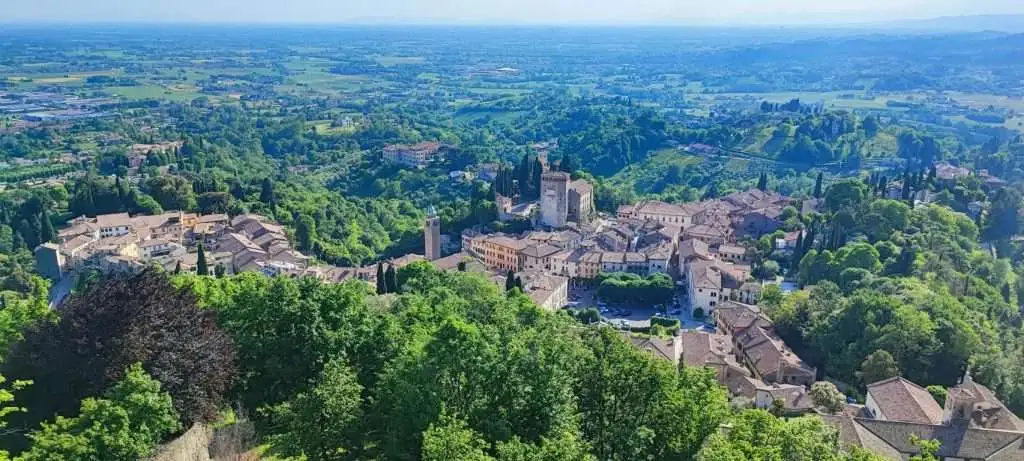
On 11 October 1489, Caterina Cornér arrived in Asolo, where she spent most of her life between the castle and the village. The queen did not neglect the city of Venice, where she stayed in the family palace, nor Murano, where she owned a sumptuous villa. During the summer season, Caterina favored the splendid rural setting of the Barco of Altivole, a tangible expression of Queen Cornér’s sensitivity to the arts, culture, and nature.
The sovereign welcomed in her Murano and Venetian residences some of the most illustrious political figures of her time, such as Isabella d’Este, Eleonora d’Aragona, Pandolfo Malatesta, and Beatrice Sforza.
At the court of Asolo, the queen surrounded herself with authoritative writers and humanists such as Pietro Bembo (Venice, 20 May 1470 – Rome, 18 January 1547), cardinal, writer, and poet author of gli Asolani. In his most famous work, published in 1505, Pietro Bembo praised the court of Caterina and the beauty of the Barco as one of the most representative symbols of the Italian Renaissance.
In 1509, during the War of the League of Cambrai, the troops of Emperor Maximilian occupied the city of Asolo. The following year, Caterina Cornér moved to Venice, where she died on the night between 9 and 10 July 1510. The queen’s remains are in the church of San Salvatore.
The History of the Barco of Queen Cornér
The Origins of the Barco of Queen Cornér
The architectural complex, whose construction began in 1491, is skillfully integrated into the centurial grid of the municipality of Asolo (1st century BC), in a fertile and well-watered territory belonging to the Cornér family since the mid-15th century.
Stratigraphic and archaeological investigations carried out under the patronage of the Benetton foundation between 1988 and 1992 identified three areas, bounded by walls, within which the elements forming the Renaissance complex were located.
The Conception and Creation of the Barco
The design and construction of the Barco are attributed to the Lombard architect Francesco Graziolo and the master builder from Asolo, Pietro Lugato.
The water supply for the vast estate and the structural components of the Barco depended on a conduit that drew water from a spring in Crespignaga and from a canal of the Brentella, a branch of the Caerano canal already active since 1493.
Architecture and Functionality of the Renaissance Complex
A 17th-century graphic representation illustrates the functions of the three main sectors of the building complex and the vast estate in which it was set.
Used as pasture and hunting ground, the largest area of the estate extended for fifty hectares enclosed by a walled perimeter of over three km, within which stood a dovecote tower. The writings of Antonio Colbertaldo reveal that during the good season, Caterina Cornér loved to hunt in this pleasant place, populated by roe deer, hares, deer, and rabbits, and covered by a lush forest, as illustrated in a 17th-century drawing.
With a surface area of two hectares, the second rectangular space was framed by two parallel buildings: the one to the east, corresponding to the still-intact structure, and the one to the west, presumably used to house warehouses and granaries. In the center of the garden stood a fountain whose water features were fed by the same sophisticated hydraulic network that also supplied the fountain of the loggia.
Above the entrance, on the south side, a soaring tower rose, as indicated in a 1716 map by Girolamo Tomasoni, while four lower towers stood at the corners of the second walled enclosure.
Accessible through three openings on the southern side of the boundary wall, the third sector, of nearly 5,000 m², was used as an orchard and was bounded to the north by a fishpond fed by the Brentella canal.
Proceeding from north to south, the still-intact surviving structure included a stable, later demolished, a place of worship, the Hall accessible through two large round arches on the east and west sides, the bright Loggia, the “Peacock Room”, the Great Hall, the Staircase, the administrative seat, called the Administration Building, and finally the Infantry Quarters, rebuilt following a fire in 1979.
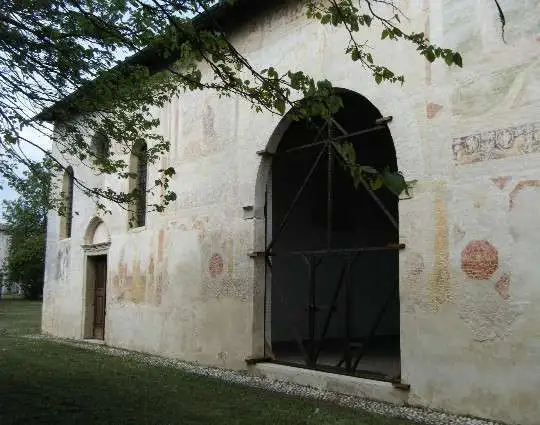
The Oratory
Restored in 1945 due to structural failures, the rectangular-shaped place of worship is accessible through an architraved door surmounted by a blind arch, flanked by two round-arched single-lancet windows. Above the portal stands a circular opening.
Dedicated since 1805 to St. Catherine of Alexandria, the rectangular-shaped oratory has a square apse containing a white altar.
The southern and western walls of the oratory are decorated with a frieze of pairs of angels holding medallions with prophets and saints, among which can be seen the face of St. George and the dragon’s head.
Above the frieze on the south wall and on the counter-façade, other lunettes feature images of Prophets, the Dove of the Holy Spirit, the Virgin Mary, and the Angel of the Annunciation.
Externally, below the right single-lancet window, the pictorial depictions of John the Evangelist and Francis of Assisi can be distinguished; the former is recognizable by the open book, long shining hair, and purple robe, the latter by the long cross and the ocher-colored monastic habit.
The Door or Hall
The simplicity and linearity of the structure harmonize with the complexity of the rich decorative apparatus that embellishes its façade and interiors.
Set within a fine painted architectural frame, the large entrance arch is surmounted by an illusory triumphal arch crowned at its apex by a putto holding a cartouche, at the keystone.
Externally, on either side of the entrance, a frieze with rams and plant motifs is interposed between the panels at the base of the façade, marked by polychrome octagons and triangles, and the frescoes of Saint Jerome Penitent and Apollo and Daphne, respectively top left and top right, enclosed by fake Corinthian columns.
At the top of the front, a frieze with pairs of winged horses, whose tails reproduce phytomorphic motifs, facing medallions with profile faces. The background alternates shades of purple, green, and red.
The polychrome frieze running along the internal walls is ennobled by plant motifs, medallions with profile heads, and fake bas-reliefs depicting playful putti riding magical creatures. Of notable interest are the two coats of arms of the Cornér family: one cardinal’s coat of arms with two white eagles, probably referring to Giorgio Cornér, Caterina’s nephew, the other decorated with three rampant lions and five crosses, referring to Caterina Cornér.
The Loggia
The Loggia is one of the most representative and fascinating elements of the Barco of Queen Cornér. The structure is articulated on the west side by five arches resting on Corinthian columns and half-columns, while on the east side two elegant mullioned windows open.
The exteriors are embellished with fake columns, roundels, and winged figures with shields. Along the eaves runs a frieze with winged horses and plant motifs.
Past the majestic entrance, on the east wall one can admire a painted architectural frame topped by the coat of arms of the illustrious family with a double-headed imperial eagle. This decoration originally surrounded an elegant fountain.
The four walls of the room are traversed by a frieze with dolphins, legendary sea creatures, urns, vases, and phytomorphic motifs on a red background. In the center of the frieze, on the east and west walls, the comital coats of arms of the Cornér stand out. In the center of the north frieze stands a coat of arms with yellow and green bands.
Below the frieze extend a monochrome yellow band, supported by fake corbels, and a motif of plant festoons.
The Peacock Room
Divided into two levels, the Peacock Room features two enchanting frescoes on the façade, unfortunately damaged by wear and tear, flanking the cross window on the first floor. The top left panel depicts a winged figure and an archer. The top right panel shows two lions, a female figure, and a face, probably also female.
The name of the Room derives from the lively decorations in the first-floor room, depicting peacocks with dazzling plumage immersed in a floral setting.
The Great Hall
Currently inaccessible, the rectangular Great Hall had an agricultural and residential function. Lit by four cross windows, the first-floor hall included two fireplaces. The façade of the Great Hall is ennobled by two frescoes depicting two naked women, each with a child at her side. One of the two female figures seems to come from the forest visible in the background. The second fresco portrays a green, bucolic landscape with hares and rabbits.
Past the Staircase, the connection between the Great Hall and the oldest area of the structure, another painted landscape can be seen with a doe lying on a meadow crossed by a clear stream, against a backdrop of lush wooded hills, a walled enclosure, and towers.
The Administration Building
Accessible through a segmental-arched portal, the building is externally adorned with a fresco set in a maritime scene. The protagonists of the composition are the shining golden figure of a naked god, depicted standing on a wave. In the background, a page with a pole facing a fisherman and his boat can be seen.
The Infantry Quarters
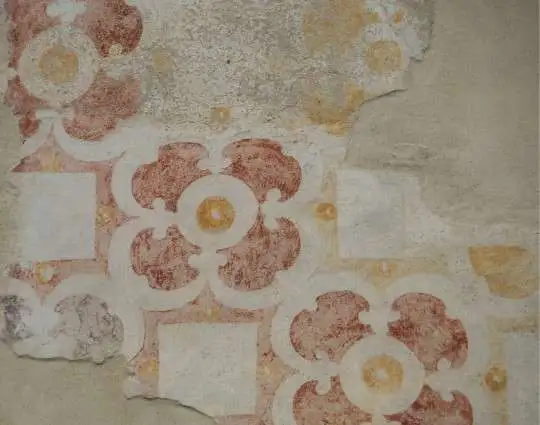
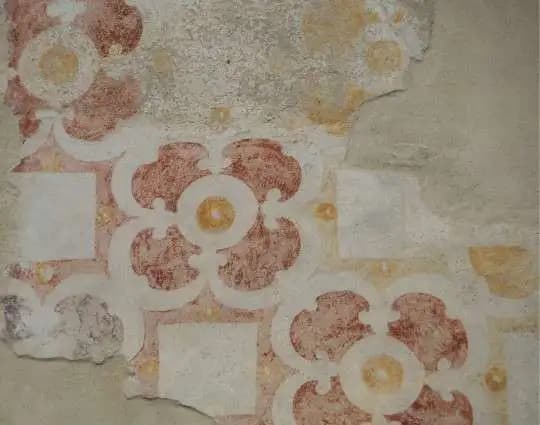
The only surviving part of this portion of the building is the east wall, of which fragments of fresco with geometric motifs remain. Irreparably damaged by a fire in 1979, the rest of the building has been completely rebuilt.
Characterized by a lower ceiling than the rest of the building complex, the infantry quarters are located at the southern end of the complex and have two large segmental-arched openings.