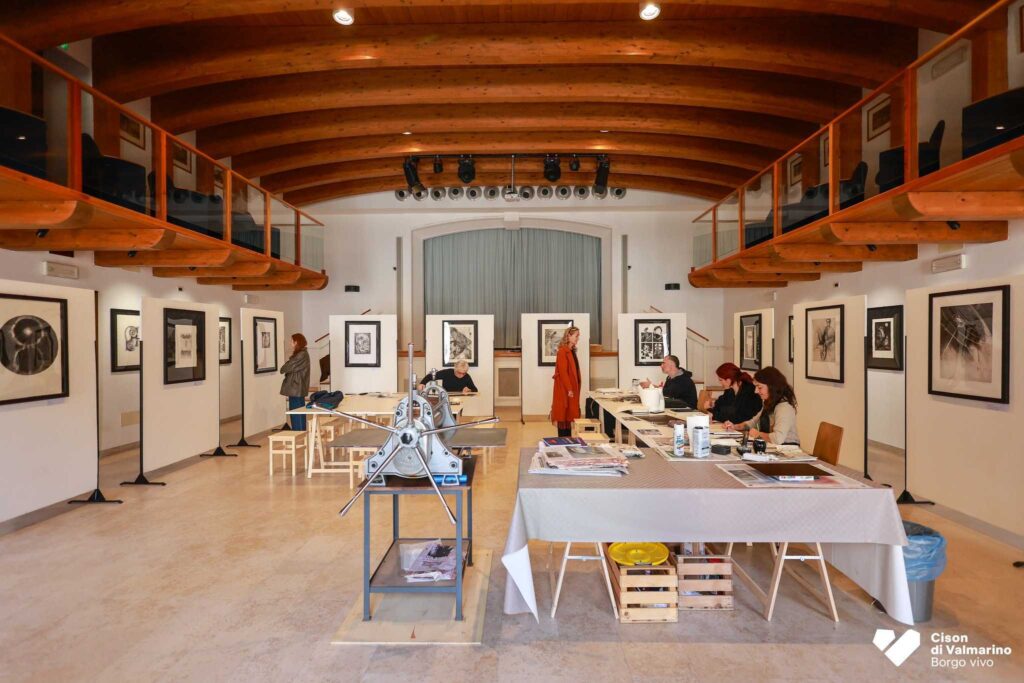

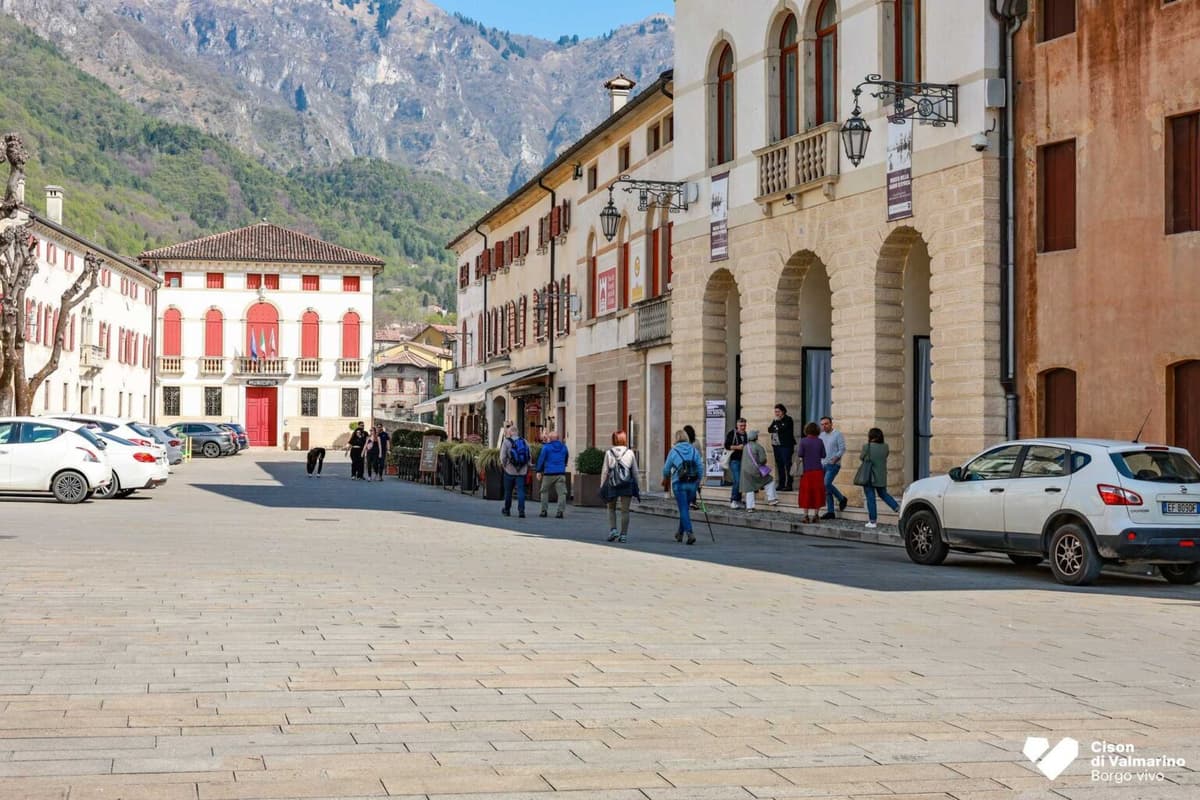
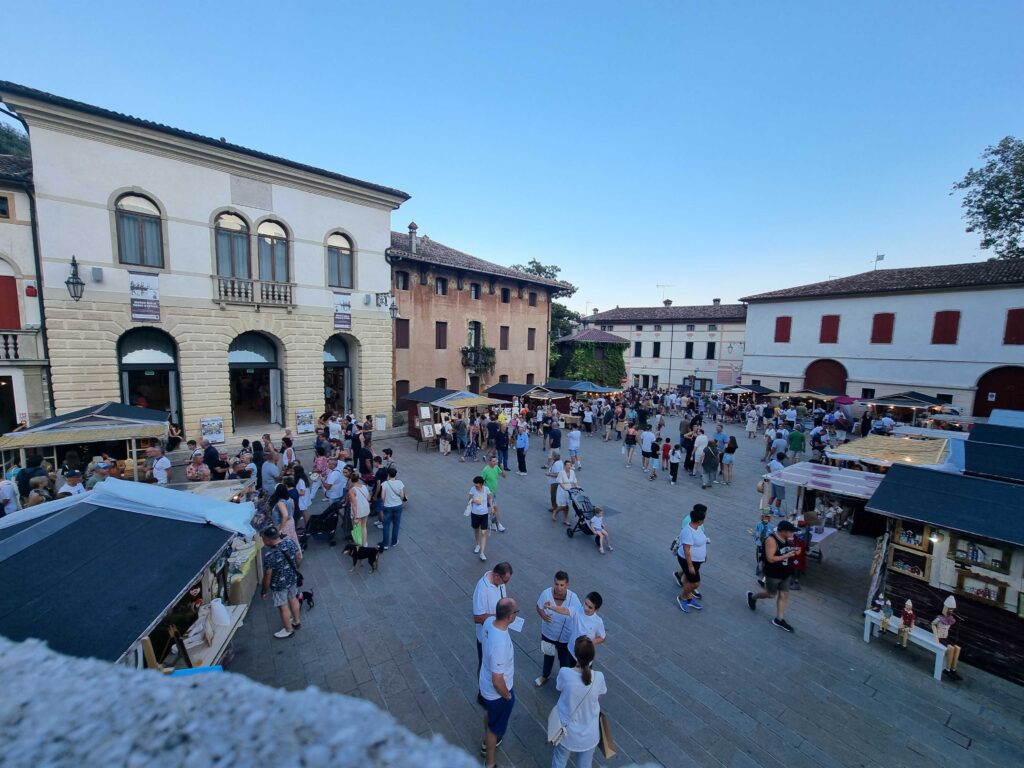
photo property of the municipal administration of Cison di Valmarino
We thank the municipality of Cison di Valmarino for its kind collaboration.
Contents
Where is the La Loggia Theatre located?
The La Loggia Theatre is located at Piazza Roma, 8, Cison di Valmarino.
The territory of Cison di Valmarino
The pleasant valley hollow that frames the historic center of Cison di Valmarino takes its name from the Rujo stream, a lively watercourse along which the Via dei Mulini winds. After crossing the charming Ponte dei Sassi, you follow the crystal-clear brook until you reach the Penne Mozze woods, a silent memorial immersed in greenery dedicated to alpine soldiers born in the province of Treviso.
Northwest of the Valle di Rujo, between Col de Moi and Cima Vallon Scuro, lies Forcella Foran. To the north stands the Crodón del Gevero, near the bivouac of the Loff. To the northeast stand out Monte Agnellezze and Croda Punta Mont. To the west rise Monte Castelaz, Crodon de Farega and Monte Schiaffet. To the east stands Monte Pallone.
The spectacular landscape of this radiant place was shaped by the gigantic glacial caps that, between 90,000 and 10,000 BC, loomed over the Alpine peaks.
During the Würm glaciation, the movement of the lapisino branch of the Piave glacier created the clear waters of Revine Lago, shaping the gentle moraine slopes that embrace the cheerful valley to the south at the foot of the Belluno Prealps.
A second glacial branch of the Piave formed the Valsana, a fertile green ribbon stretching from Vittorio Veneto to Follina.
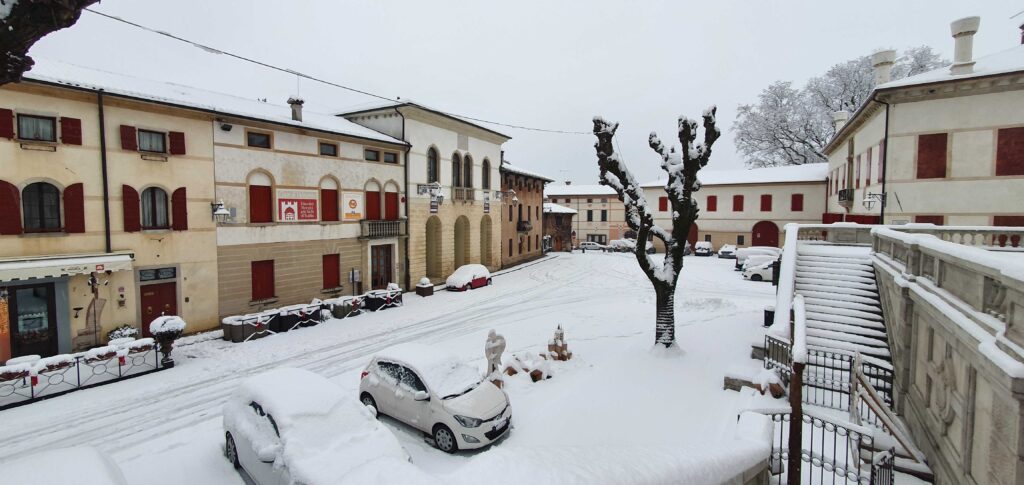
photo property of the municipal administration of Cison di Valmarino
The historic center of Cison di Valmarino: an ancient village at the foot of the Prealps
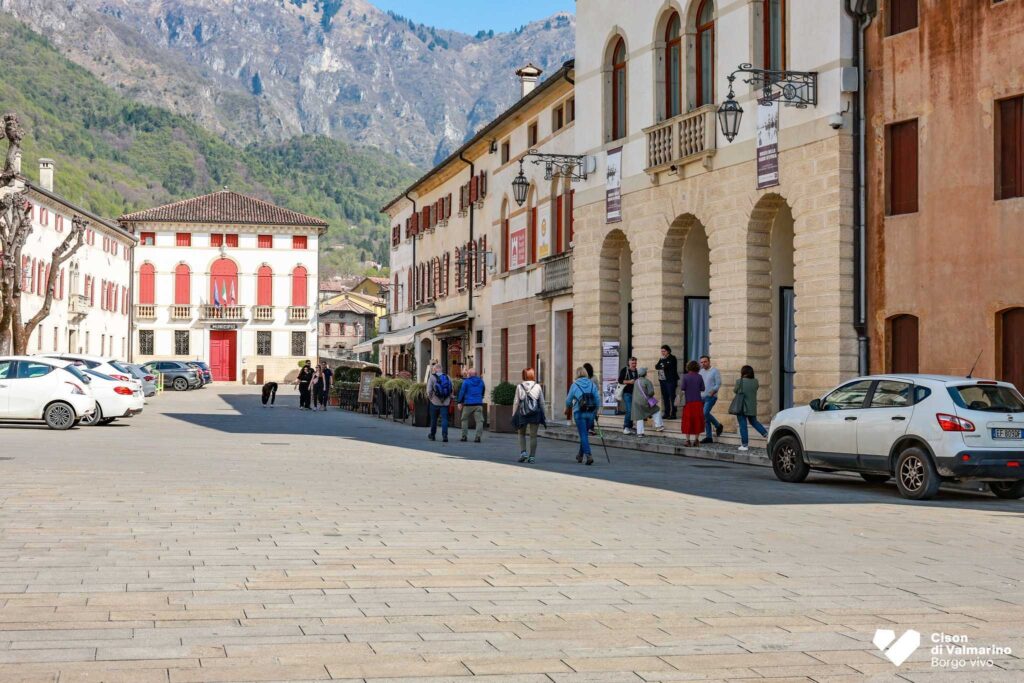
Wrapped in conifer forests, steep hills with sunlit ridgelines encircle the welcoming urban heart of Cison di Valmarino, gathered around Piazza Roma. The latter is bordered to the west by the archpriest church of Santa Maria Assunta and by Villa Marcello Marinelli, a centuries-old complex of which the current municipal headquarters is an extension.
A monumental double-flight staircase connects the square to the place of worship, whose eastern façade, flanked by a soaring stone bell tower, is softened in the center by a statue of Saint John the Baptist, recognizable by the symbols of the lamb and the processional cross. The statues of the cardinal virtues are arranged in pairs at the ends of the upper register, linked to the lower one by two curved wings.
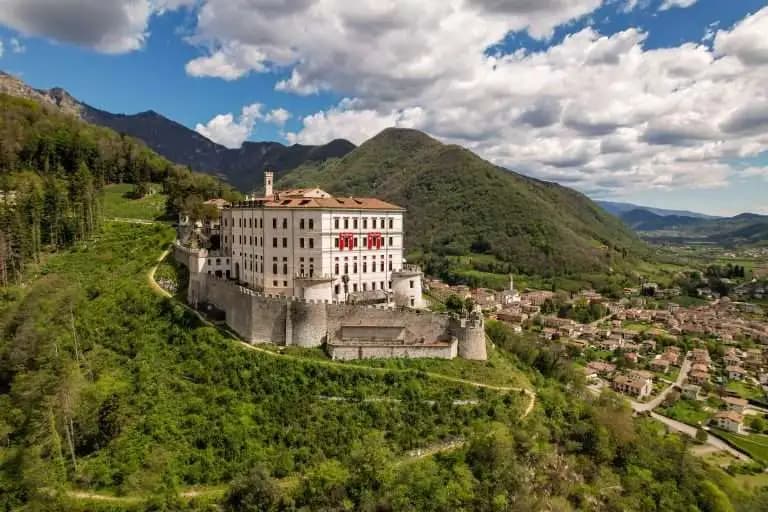
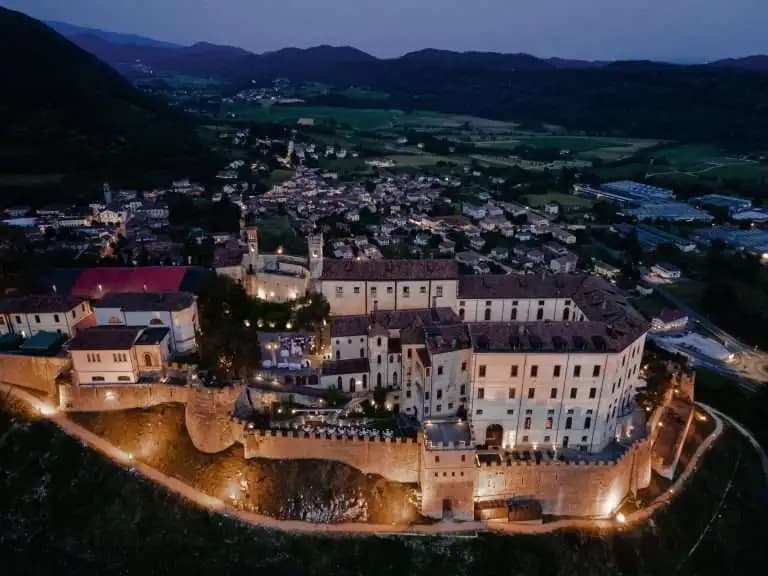
Southwest of the village, beyond the silvery olive trees dotted along the slopes of a green hill, the grand mass of Castelbrando rises on a rocky spur, wrapped in cedars, firs, cypresses, walnuts, tree-of-heaven, black locusts and many other lush tall trees. Built on the foundations of a castrum, the sumptuous palace is surrounded by towers and battlemented walls, from whose privileged position there is a spectacular view of Valmareno.
Architecture of the La Loggia Theatre
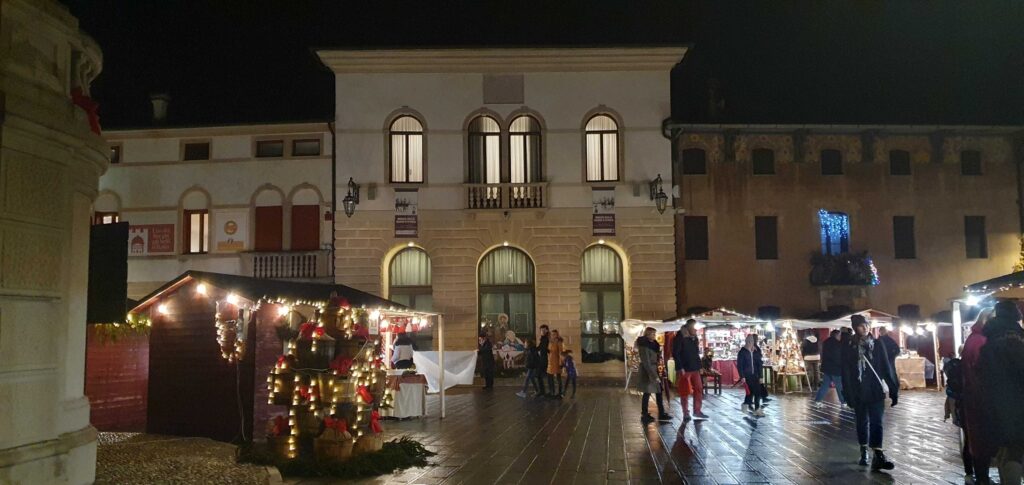
photo property of the municipal administration of Cison di Valmarino
Designed by architect Zambianco, the La Loggia Theatre stands out for a façade horizontally divided into two sections. Decorated on the outside with rustication, the ground floor is marked by three large openings finished with round arches, the central one being larger.
In line with the large arches below, two single-light windows with archivolts flank an elegant mullioned window, also with round arches, opening onto a slightly projecting stone balcony supported by three small brackets.
The latter is surmounted by a plaque depicting, at the upper left, the coat of arms of the Brandolini family, and at the right the cross of Saint Andrew, a symbol attributed to the communities of the Feudo di Valmareno as well as the current coat of arms of the municipality of Cison di Valmarino.
Murdered in an ambush in Campea in 1652, Brandolino VIII was the driving force behind the reconstruction of the building, completed in 1648 “without sparing either money, time or workmanship”.
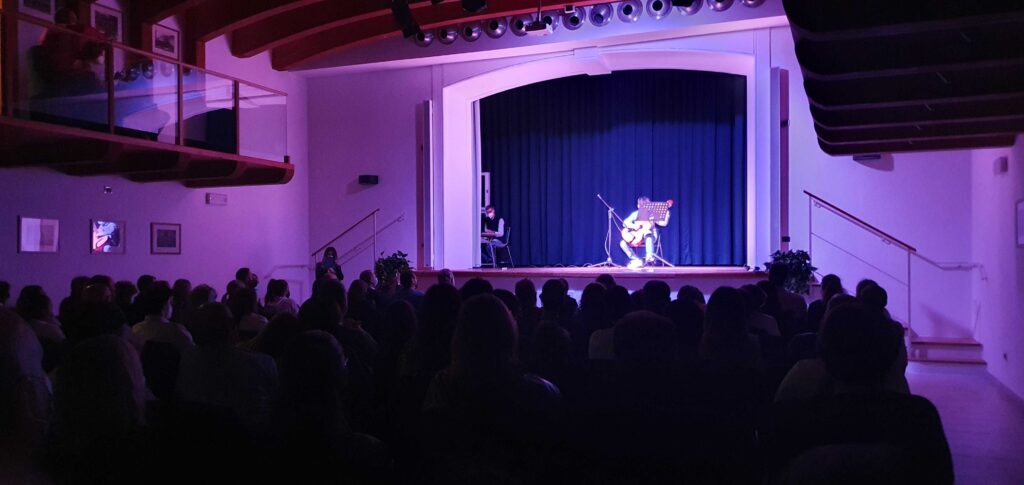
photo property of the municipal administration of Cison di Valmarino
History of the La Loggia Theatre
As early as the late 13th century, the presence of temporary structures (a tent or a wooden canopy) on one side of the square is documented for the carrying out of administrative acts, later replaced by permanent masonry structures that took the name of “Loggia”, a place set aside for the exercise of civil and criminal administration.
As the seat of the podestà, who, together with the chancellor, carried out the duties of chancellery and court in this building three days a week, the Loggia reserved the hearing room for the “dodese”, the representatives of the twelve villages of Valmareno who gathered here to discuss issues related to feudal administration.
The upper floors housed the residence of the Chancellor and the Court Knight, who from this place read his lord’s proclamations to the people. Finally, the prisons were located in the basement.
The decline of the Dominante in the 18th century led to a change in the function of the Loggia, from a place intended for legal and administrative activity to a Theatre. Home of the Opera Nazionale Dopolavoro from 1934, in the postwar years La Loggia hosted the ENAL Hall (Ente Nazionale Assistenza Lavoratori), for cinema and dancing.
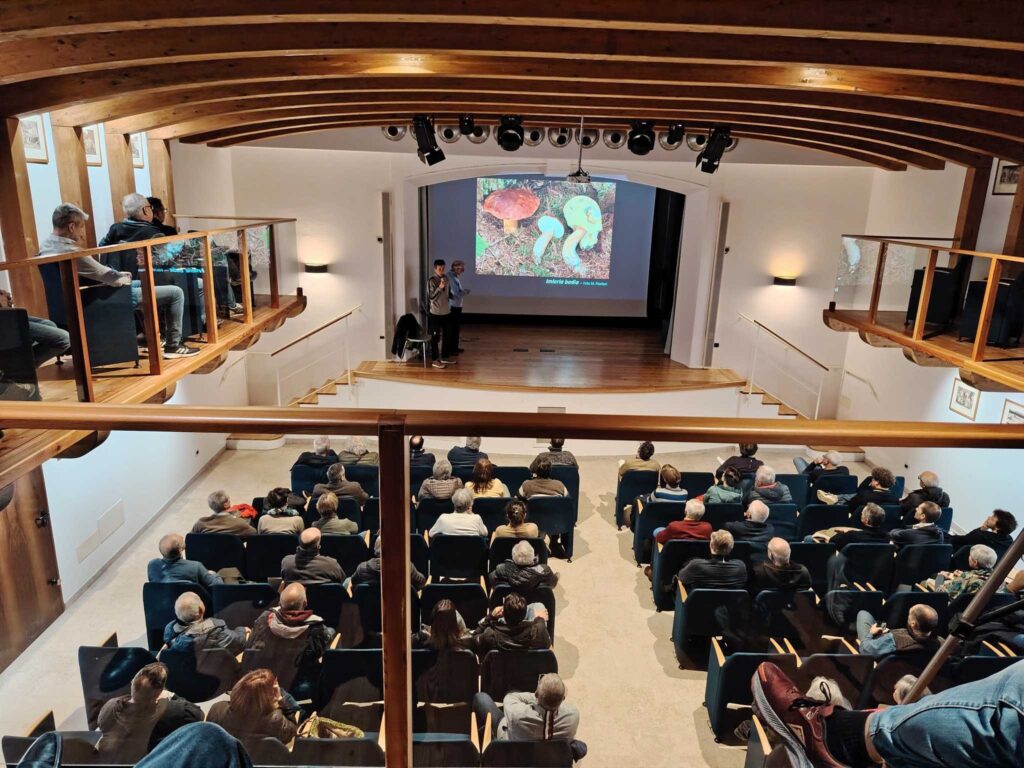
photo property of the municipal administration of Cison di Valmarino
The building fell into neglect from the 1960s onward, until it was restored between 1993 and 2002 by architects Adriano and Alberto Alpago Novello and Michela De Zorzi.
On the ground floor are the Theatre and the Pro Loco of Cison di Valmarino, while the first and second floors house the museum of Old Radios. The exhibition route includes a fine Safar radio-phonograph engraver, designed in 1938 by the Cisonese engineer Virgilio Floriani.
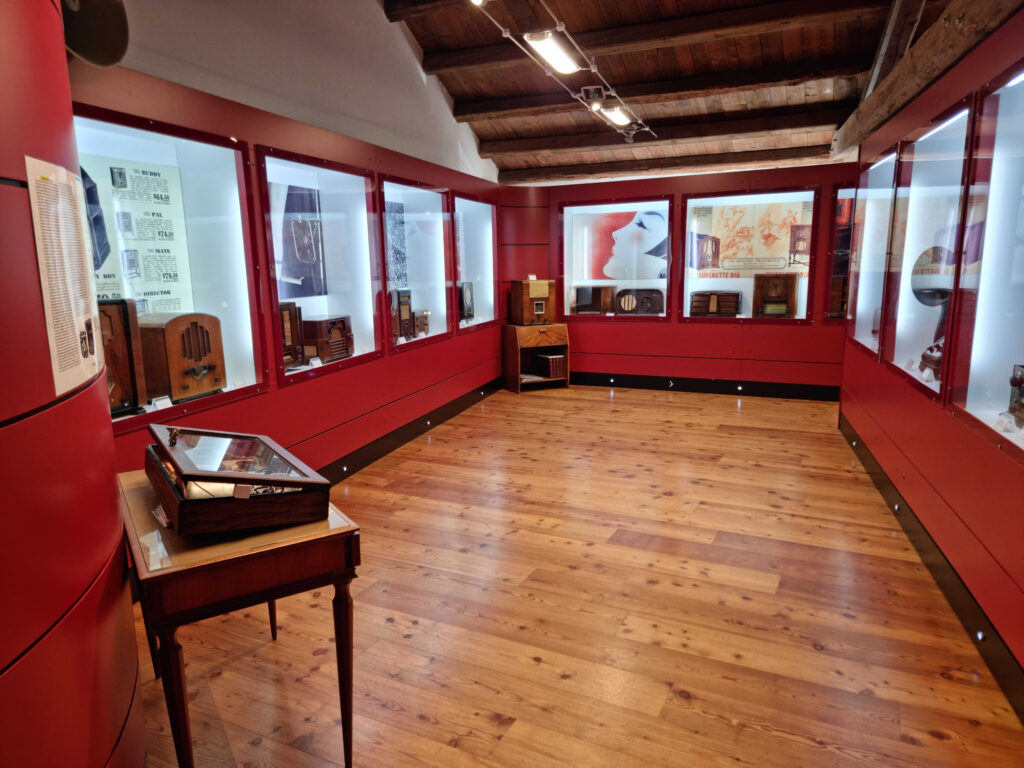
photo property of the municipal administration of Cison di Valmarino
If you are wondering what to do in Cison di Valmarino, visiting the La Loggia Theatre is an ideal opportunity to immerse yourself in the history and culture of one of Italy’s most extraordinary villages.
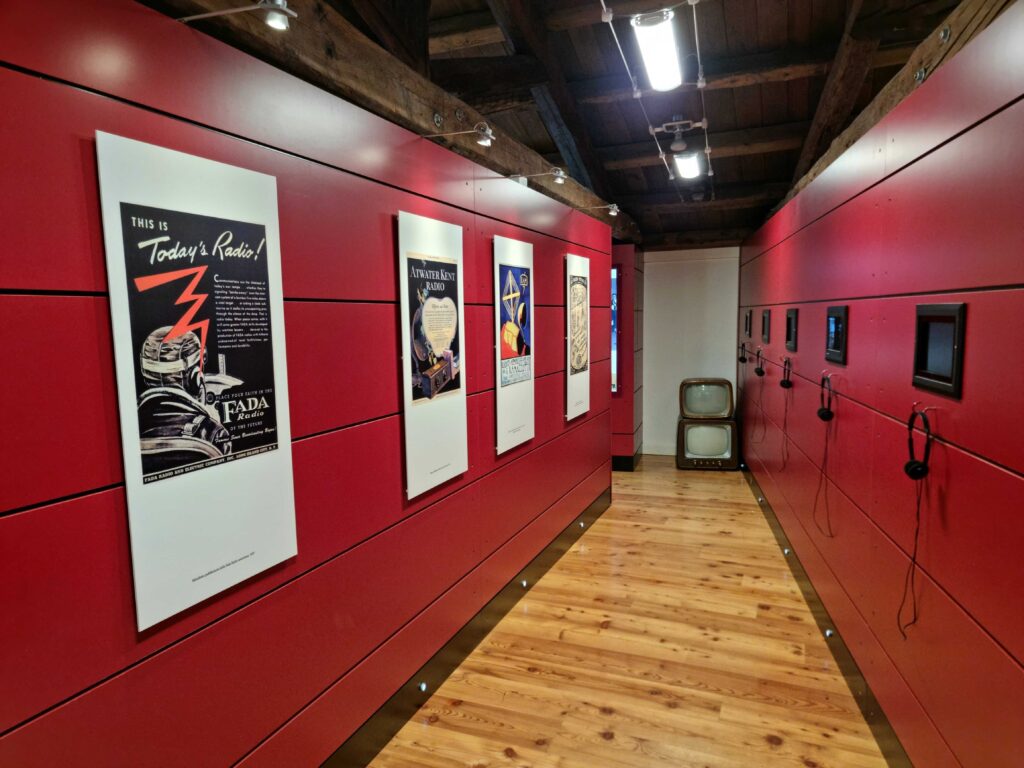
photo property of the municipal administration of Cison di Valmarino
Starting point for exciting nature itineraries, the La Loggia Theatre is a jewel of architecture of medieval origin in which art comes to life through interesting museum trails, engaging theatre seasons and fascinating cultural events.