

Discover what to do in Cordignano in the province of Treviso: from the suggestive panoramic views of the clear course of the Meschio to fascinating historic buildings and mysterious medieval fortresses immersed in greenery.
Where is Cordignano?
Located on the border between Veneto and Friuli-Venezia Giulia, Cordignano borders to the north with Sarmede and Caneva, to the east with Caneva and Sacile, to the south with Gaiarine, Orsago and Godega di Sant’Urbano, to the west with Colle Umberto, Cappella Maggiore and Sarmede.
Bike ride along the Meschio
The Meschio river, whose crystalline spring originates from the brent basin below Monte Visentin in Vittorio Veneto, winds sinuous and placid through the municipality of Colle Umberto and then reaches the municipality of Cordignano, after which it flows into the Livenza.
The name of the river, of Latin origin (misceo, misces, miscui, mixtum, miscēre) meaning to mix, to blend, indicates the confluence of numerous streams in its course.
Animated by lively ripples, the quiet course of the river has favored agriculture and crafts, leading to the growth of the dynamic and picturesque inhabited center that over the centuries has developed along its banks.
If you are passionate about cycling and are wondering what to do in Cordignano, following the cycling itinerary along the Meschio might be just for you!
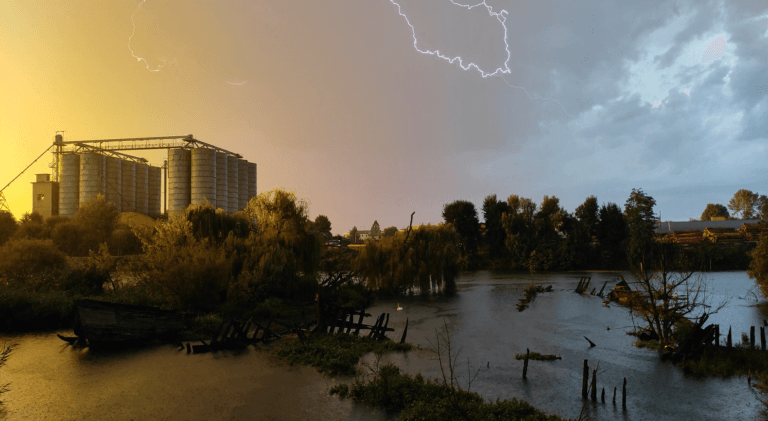
The icy waters of karst origin, combined with the mild climate and fertile soil, favor the growth of olive groves and vineyards of high quality, whose lush rows lie orderly on the gentle hillsides and take on bright red and golden colors in the clear and crisp autumn sunsets, especially when the sky clears after a storm.
Piazza Italia
The bends of the Meschio, whose silent winding is rarely interrupted by small waterfalls, delimit to the south the vast expanse of Piazza Italia, the historic heart of the town announced by the towering mass of the bell tower of the parish church, behind which the majestic profile of the mountains looms.
Il Palazzo del Dazio
Located in Via Fiume along the course of the Meschio on the border with Friuli, the Palazzo del Dazio was built in the first decade of the 16th century as accommodation for officials in charge of collecting taxes on goods.
One of the most representative architectures of the municipality of Cordignano, the Palazzo del Dazio is distinguished externally by a suggestive portico rhythmically punctuated by round arches. Inside, the portico is marked by wide cross vaults supported by pillars embellished with the noble coat of arms of the Rangoni family of Spilamberto.
Visit the Torricella
Located in Via Torricella, the fortification rises near the banks of the Meschio and was built between the 13th and 15th centuries.
Immersed in the radiant rural landscape of Cordignano, partly hidden by the foliage of lush trees, the medieval defensive structure is wrapped in an aura of charm and mystery that attracts many hiking and cycling enthusiasts.
An ideal destination for lovers of history and nature wondering what to do in Cordignano, the ancient stone structure is a reference point for anyone wishing to explore and discover the wonderful and rare vestiges of the Cordignano territory.
Parish of Santa Maria Assunta and San Cassiano
Located in Piazza Italia, 12, 31016 Cordignano TV, the parish church that dominates solemnly in Piazza Italia is one of the most significant monuments of the municipality.
The imposing double-pitched façade is vertically divided into three sections by four pairs of pilasters resting on high bases. Crowned by Corinthian capitals, the pilasters are surmounted by a dentiled pediment bearing an octagonal opening in the center of the tympanum.
Inside, the single nave of the church is flanked by two circular openings in which the side chapels are located.
Of notable interest are the refined Baroque altars, both wooden and marble, the centuries-old altarpieces, and the fresco depicting the Assumption of the Virgin that adorns the nave.
Who was San Cassiano?
Living between the 3rd and 4th centuries AD, San Cassiano of Imola was a teacher of grammar and literature in the namesake city of Emilia. Denounced for educating his students in the Christian religion, Cassiano refused to renounce his faith and was thus martyred.