
We thank the Municipality of Vittorio Veneto for allowing the publication of the photos.
Discover what to see in Vittorio Veneto: the tower of San Floriano, the springs of the Meschio, the path of the dead lake, the Blue Lakes park, Piazza Flaminio, the city in bloom, the town hall, the castle of San Martino, the secret garden, the path of the Prosecco hills. This is just a small part of the extraordinary natural, architectural and landscape heritage of the municipality of Vittorio Veneto. Want to know more? First of all…
Where is Vittorio Veneto?
The municipality of Vittorio Veneto borders to the north with Belluno, to the north east with Farra d’Alpago, to the north west with Limana, to the south east with Conegliano, to the south west with San Pietro di Feletto, to the east with Fregona, Cappella Maggiore and Colle Umberto, to the west with Revine Lago and Tarzo.
The springs of the Meschio and the tower of San Floriano
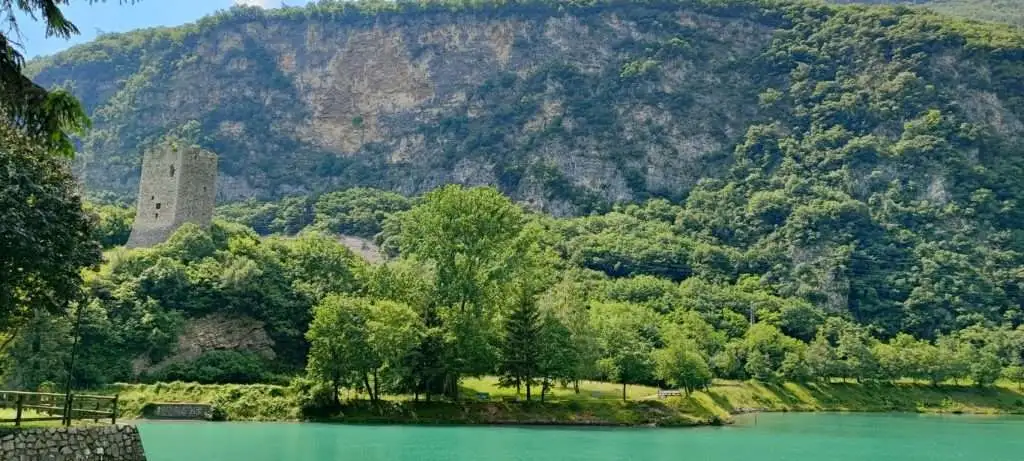
To reach the tower of San Floriano, you can leave your car at the picnic area in Via del Restello (46.031839292492315, 12.302397970398337) from where you can contemplate the mighty crenellated fortification of Roman origin standing on the summit of a grassy hill located between the steep and looming mass of Col Occett and Col Visentin and the clear mirror of water of San Floriano.
Starting from the picnic area, to reach the springs of the Meschio leave the tower to your right. Facing the fork, take the road on the left, uphill, which leads to the monument to the fallen of San Floriano.
Keep right and travel along state road 51 for 1.5 km, then you can leave your car in the parking lot on the side of the state road (46.021613171369005, 12.292242127128356) where you will find directions to the springs of the Meschio.
Take the asphalt road (access is allowed only to pedestrians) and pass the iron gate. Just before the bridge over the A27, keep left on the path that leads to a small bridge, after crossing which you will reach a clearing with a table and benches. After crossing a second wooden bridge you will find on your right the course of the Meschio with gushing waterfalls.
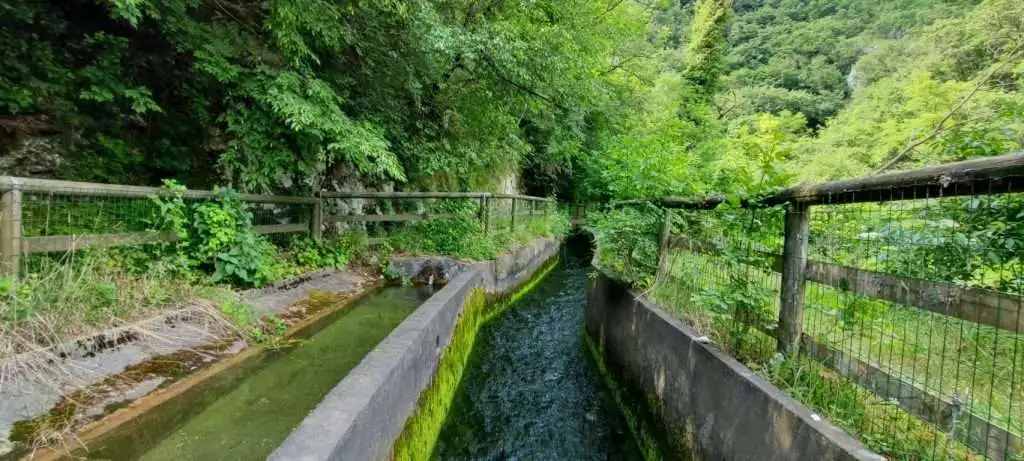
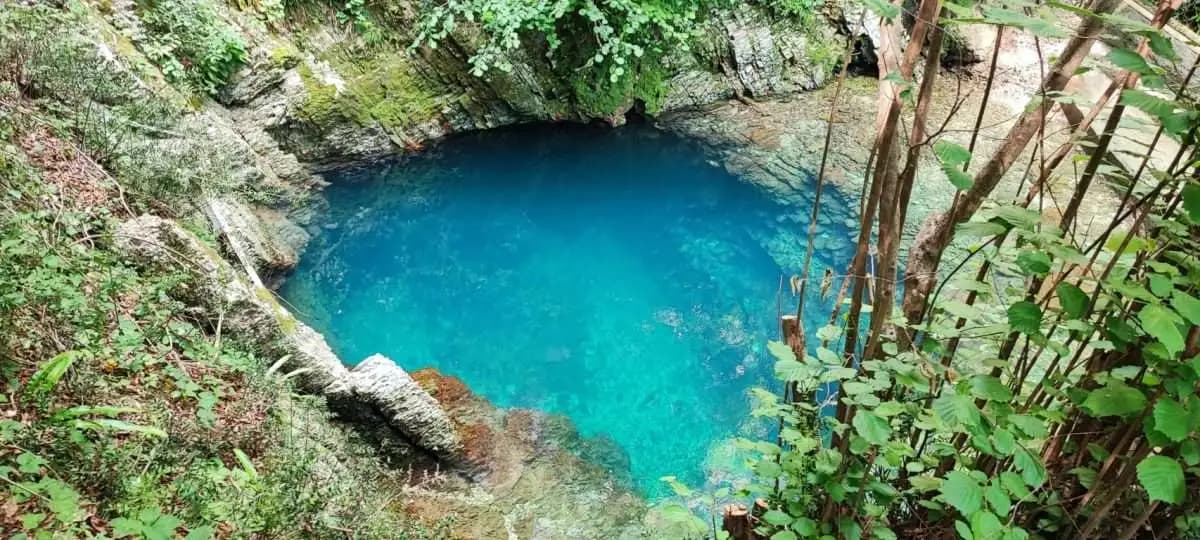
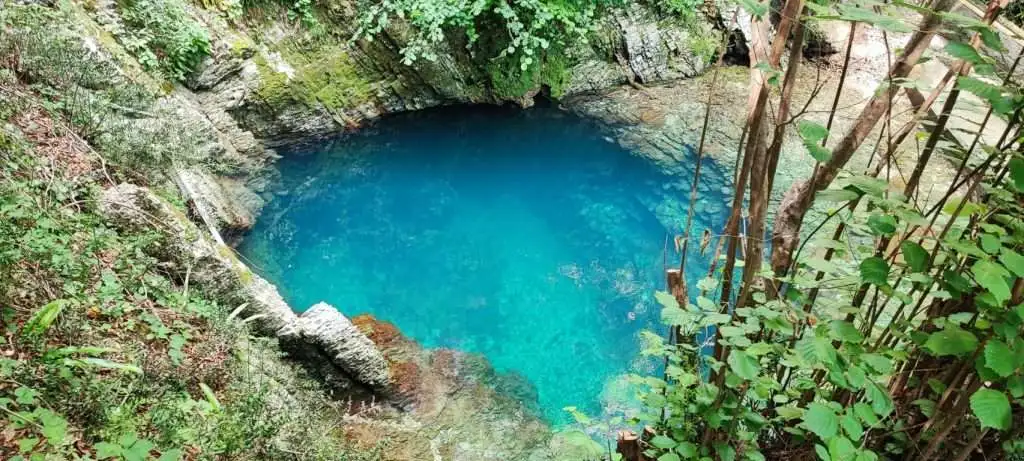
Immersed in the vegetation of acacias, ash trees, elms, beeches, dogwoods, oaks, nettles and wild ignea, a staircase of wood and beaten earth climbs up the wooded hill until it leads to a sinuous stone channel. After crossing the metal bridge keep right and follow the winding wooden walkway that follows the narrow channel. The effort of the excursion is rewarded by the suggestive view of the deep crystalline spring, a brilliant blue jewel set among the rocks, one of the most suggestive, enchanting panoramic views of the Veneto region.
The path of the dead lake and the Blue Lakes park
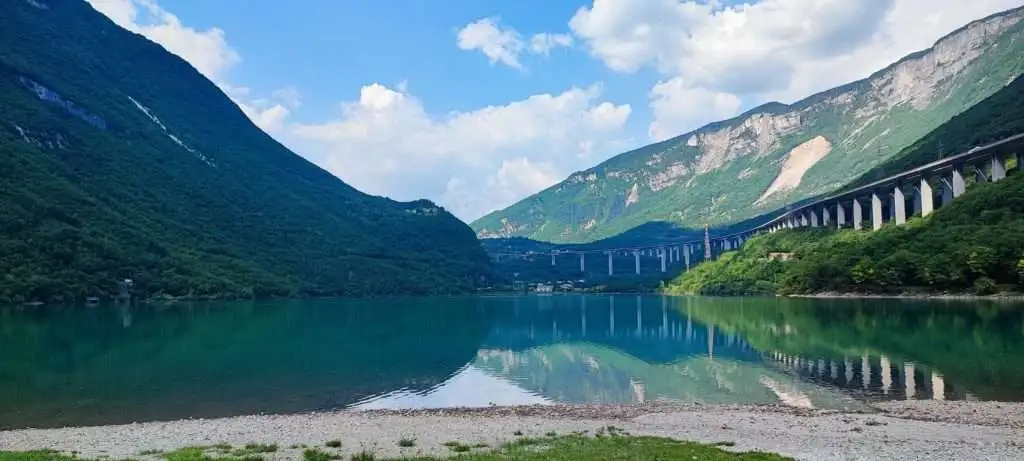
The starting point of the excursion is the parking lot on Via della Ferrovia, in the hamlet of Nove-San Floriano. A stone’s throw away you will find a white pebble beach lined with trees, lapped by the icy mirror of water, framed by the grand wooded mass of the Belluno Prealps crossed by the Fadalto Viaduct.
To undertake the loop route, take Via Borgo Piccin at the parking lot and proceed along the gravel path flanked by dry stone walls veiled with moss. The path goes into the dense vegetation of ash trees, willows, black locusts and beeches, between whose foliage spectacular views of the lake and the steep mountain slopes can be seen.
Pass a small shrine carved into the rock, then continue until you reach a fork. On the left, the panoramic path climbs the side of the mountain until it leads to the charming village of Caloniche di Sotto.
Keep right along trail no. 1044 which runs along the shores of the karst basin until it leads to a picnic area with a wooden table and benches. At this point cross the hamlet of Fadalto Basso. After crossing the bridge follow Via Fadalto Basso for about 240 meters, then turn left to reach the Blue Lakes Park nature oasis in the shade of ash trees and firs.
After visiting the park, return to Via Fadalto Basso. Proceed south along Via Fadalto Basso, then take the path on your right that winds along the lake shore until it leads back to the starting point.
Piazza Flaminio
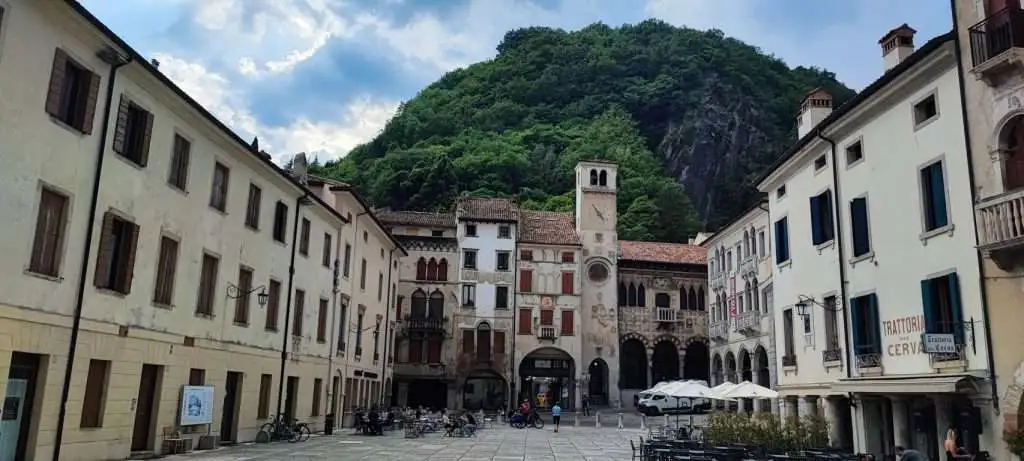
One of the most significant locations in Serravalle, Piazza Flaminio is bordered to the west by the clear course of the Meschio, to the east by a series of fifteenth-century palaces adorned with meticulous works of painting, namely Palazzo Racola, Palazzo Troyer, Casa Bernardini, the clock tower and the community palace.
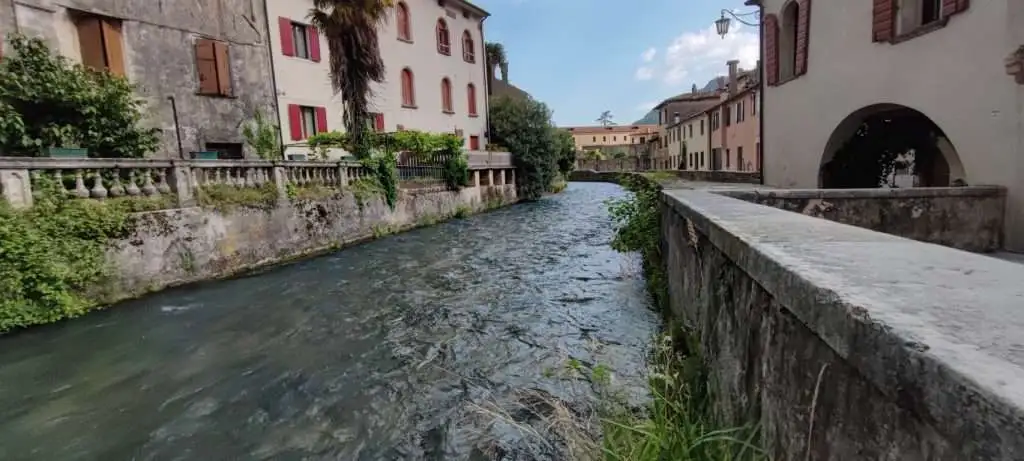
Distinguished by a marked upward thrust and verticality, the compact array of richly decorated buildings, with two-sloped roofs at different heights, is lightened on the ground floor by a slightly sloping portico rhythmically punctuated by round arches, lowered arches and pointed arches supported by pillars and columns.
Recognizable by the refined three-light and four-light windows with trilobed ogee arches, Palazzo Racola is adorned along the eaves with an elaborate pattern of hanging arches that, intersecting, form ogee arches. The same pattern continues in the adjacent building, refined on the third floor by Gothic three-light windows and on the lower floor by a balustraded round-arch two-light window.
Above the artisanal ice cream parlor, a balcony stands out surmounted by a fresco depicting the Madonna and Child, a distinctive feature of Casa Bernardini.
The clock placed on the top of the civic tower goes almost unnoticed compared to the clock below, whose wavy metal hands imitate the bright rays of a golden sun. At the center of the sun, a human face emerges from a dark blue background symbolizing the vault of heaven.
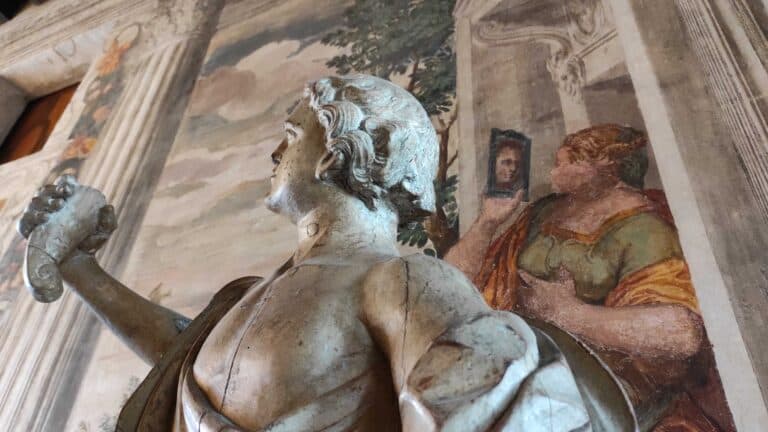
Surrounded by noble coats of arms, a fresco portrays a crowned noblewoman, with a sword in her hand, seated on a throne enclosed by a painted round arch. Below the throne appears the Latin inscription “VIDISTIS VIDETIS VIDEBITIS (you have seen, you see, you will see) IONE BAPTISTA VALERIO PRAETORE ZACHARLAEFILIO MDLXXXV (1585)”.
Currently the seat of the Museo del Cenedese, the Palazzo della Comunità features a loggia with round arches. On the upper floor, two flaming trilobed three-light windows flank a balcony punctuated by small columns, above which stands a representation of the Lion of Saint Mark.
If you are wondering what to see in Vittorio Veneto, Piazza Flaminio offers an extraordinary view of a splendid picture of ancient houses against the backdrop of the imposing wooded mass of the hill of Sant’Antonio, clothed in ash trees and beeches that envelop the remains of the Rocca del Montesel and the ruins of the small church of Sant’Antonio Abate.
The city in bloom
The lively event takes place every year in the month of April. The 2023 edition was held on Sunday 16 April in Piazza del Popolo.
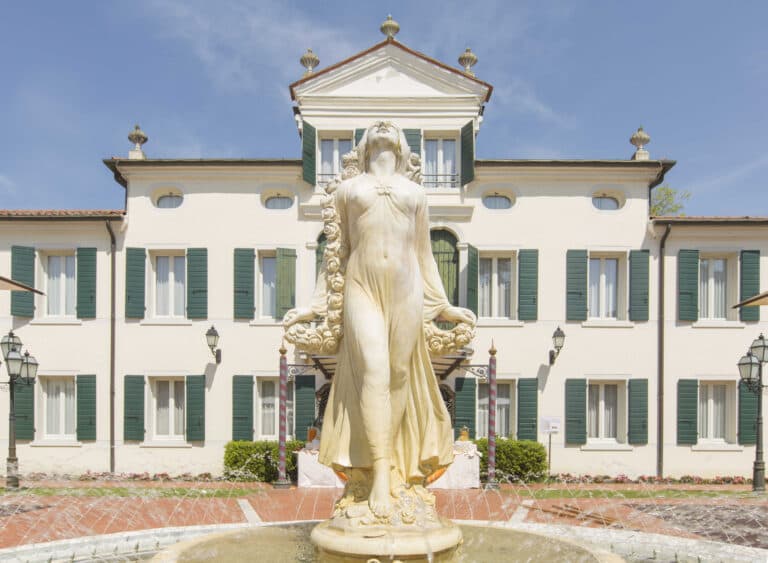
Bordered to the east by the town hall, the square is softened by a large elliptical fountain and is adorned with a stone and metal sculpture commemorating the fallen of the First World War.
On the occasion of the event, the vast square and the pleasant public garden dotted with cedars, magnolias, maritime pines and horse chestnuts will be embellished with gaudy floral compositions and numerous stalls set up by local nurserymen.
If you are wondering what to see in Vittorio Veneto and are looking for interesting initiatives to spend the spring season in a cheerful and carefree atmosphere, taking part in the city in bloom might be just what you need!
For more information about the next appointment of the festival, you can consult the Facebook page Pro Loco Vittorio Veneto APS.
The town hall
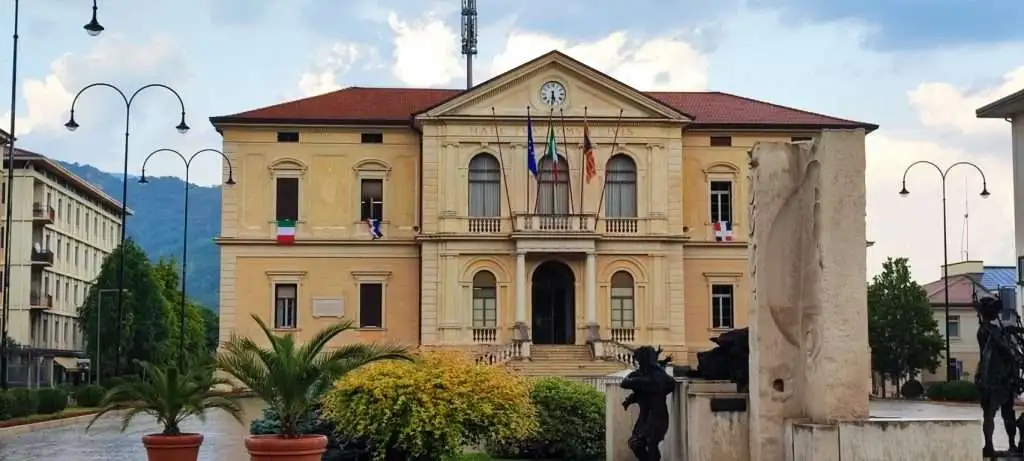
Articulated over four levels (rusticated base, noble floor, first floor and mezzanine), the sumptuous building is divided vertically into three sections.
The central avant-corps has on the ground floor two round-arched windows adorned with parapets flanked by Tuscan lesenes. Two columns of the same order support the small portico that precedes the entrance portal, accessible via an elegant staircase.
On the first floor there are three windows closed by round arches, also balustraded and framed by Ionic lesenes surmounted by the frieze, the architrave bearing the Latin inscription “Haec tua domus civis” and the triangular dentilled pediment in which a Roman numeral clock is inserted.
The castle of San Martino
Located at Via Brevia, 33, the majestic fortification was built between the 5th and 6th centuries during the reign of Theodoric, whose reign in Italy lasted from 493 to 596.
One of the most representative elements of the formidable architectural complex is the mighty tower in which several single and double lancet windows open. Wrapped in a thick mantle of climbing vegetation, the thousand-year-old fortification is articulated around a central courtyard delimited by elegant crenellated walls.
From the privileged position of the fortress, one can dominate with the gaze the boundless panorama outlined by steep hills dotted with firs, cedars, ash trees and birches and the urban heart of Ceneda.
The path of the Prosecco hills
Vittorio Veneto is the final stage of the tourist and food and wine trail that for 51 km (starting from Vidor) runs through twenty-nine municipalities including Valdobbiadene and Conegliano, whose famous hills have been considered a UNESCO World Heritage site since 2019.
The last section of the winding cycle-pedestrian itinerary runs along the ridge of Monte Baldo, whose gigantic mass dominates the picturesque location of Serravalle. The lush vegetation of the hill envelops the solemn ruins of the castle of Montesel, the church of Sant’Antonio Abbate and mysterious medieval towers.
How to access the path?
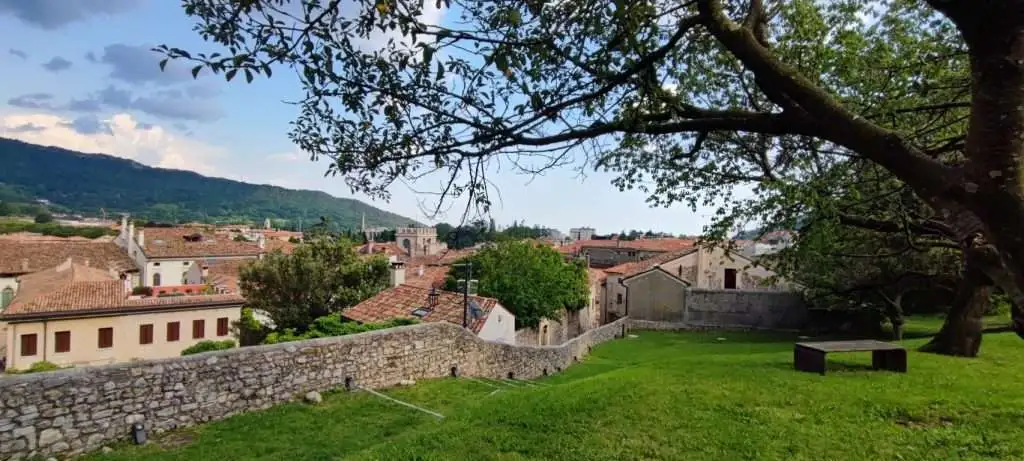
From Piazza Flaminio proceed towards the Museo del Cenedese. Turn right onto Via Roma, then immediately left onto Via Piai passing under the portico. Proceed along Via Piai until you reach the secret garden, a pleasant tree-lined park from which you can enjoy a splendid view of Serravalle. On your right, you will find signs for trail no. 1043.