

What to do in Susegana in the province of Treviso? Maggio suseganese, Nova eroica Prosecco Hills, Colle della Tombola, Castello di San Salvatore, Castello di Collalto.
Where is Susegana?
The municipality of Susegana in the province of Treviso borders to the north with Refrontolo and San Pietro di Feletto and Conegliano, to the south with Nervesa della Battaglia, to the east with Santa Lucia di Piave, to the west with Pieve di Soligo and Sernaglia della Battaglia.
NOVA eroica Prosecco Hills
A cycling, food and wine, and music event, NOVA eroica Prosecco Hills is a sporting and cultural event aimed at promoting the natural and landscape heritage of the Treviso area, made unmistakable by the enchanting sun-drenched hills on whose gentle slopes the lush rows of vines lie regularly, from which one of the rarest and most loved wine qualities in the world is obtained.
For those who wish to spend moments of fun and carefreeness discovering majestic fortresses surrounded by centuries-old woods and lush vineyards, we recommend consulting the event program on the EROICA movement website.
Maggio suseganese 2023
Where and when does Maggio suseganese take place?
The 2022 edition of Maggio suseganese took place from Friday 12 to Sunday 28 May at the “Vivaio” Recreational Center APS – NOI Association in Via della Chiesa, 4.
The rich program of the festival includes live music, grilled meat specialties to be enjoyed with cold pints of beer and top-quality local wines to brighten the spring evenings in the setting of one of the most idyllic historical and natural locations in the province of Treviso.
For those wondering what to do in Susegana, we recommend checking the Maggio Suseganese Facebook page to stay updated on upcoming event dates.
Colle della Tombola
Colle della Tombola is a hill of ancient geological formation on whose summit majestic tree varieties soar, from tall dark cypresses and splendid horse chestnuts to hornbeams, acacias, and centuries-old oaks.
Dating back to the early Middle Ages, the mighty fortress of the Counts of Collefusco towered on the top of the hill a short distance from the small church of San Daniele, (whose origins may date back to before the year 1000, although the first records of the temple date back to 1270) unfortunately almost completely destroyed during the Great War.
Accessible via a white stone stairway shrouded by thick tree and shrub vegetation, the lush hill lies between Colfosco to the northwest and San Salvatore to the southeast.
The dominant position of the suggestive hill led the Austro-Hungarian army to make it an observation point during World War I.
For those wondering what to do in Susegana and cannot resist the charm of exciting historical-naturalistic excursions, a visit to Colle della Tombola is certainly recommended!
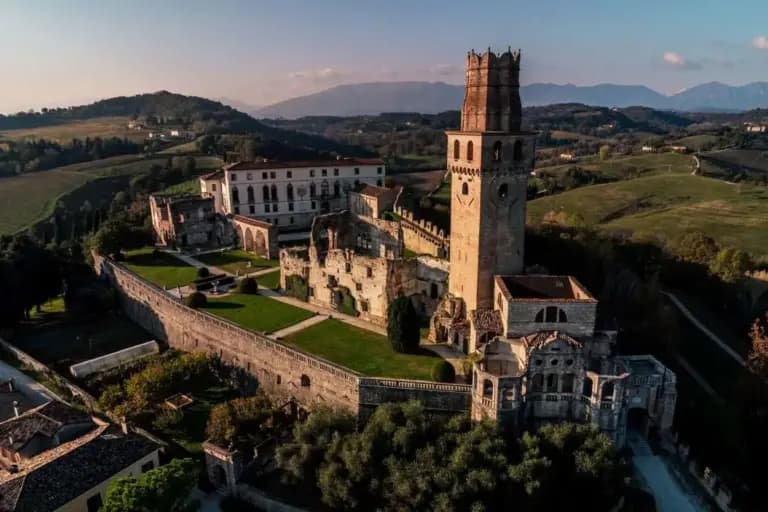
Castello di San Salvatore
Located in via Sottocroda, 31058 Susegana (TV), the ancient defensive complex is one of the monuments of greatest historical, architectural, and cultural relevance in the region.
Harmoniously set in the enchanting hilly landscape of the Marca Trevigiana countryside, the majestic fortification was built between the 12th and 13th centuries in the radiant and verdant territory of the county of Lovadina, whose administration was ceded in 958 to Rambaldo, progenitor of the illustrious Collalto family and son-in-law of Berengario II, King of Italy.
The mighty crenellated walls enclose a magnificent noble palace distinguished by the elegant architectural features of the Rococo.
The spectacular castle represents an ideal location for hosting events, shows, conferences, and weddings.
Castello di Collalto
Where is Castello di Collalto?
A recommended destination for lovers of collecting and antiques, Castello di Collalto is a formidable fortress built in the first half of the 12th century by order of Ensedisio I, feudal lord and Count of Treviso.
According to legend, the sadness that afflicted Bianca da Camino for Tolberto da Collalto’s departure to war aroused the envy of Aicha da Camino, who, to avenge her wounded pride, ordered the young woman to be walled up alive and left to agonize in the dark dungeons of the castle, destined to die of hunger and thirst.
According to ancient folk belief the ghost of Bianca da Collalto still roams the castle rooms and it is still possible to hear the spectral laments of her tormented soul.