
How to reach the Abbey of Sant’Eustachio?
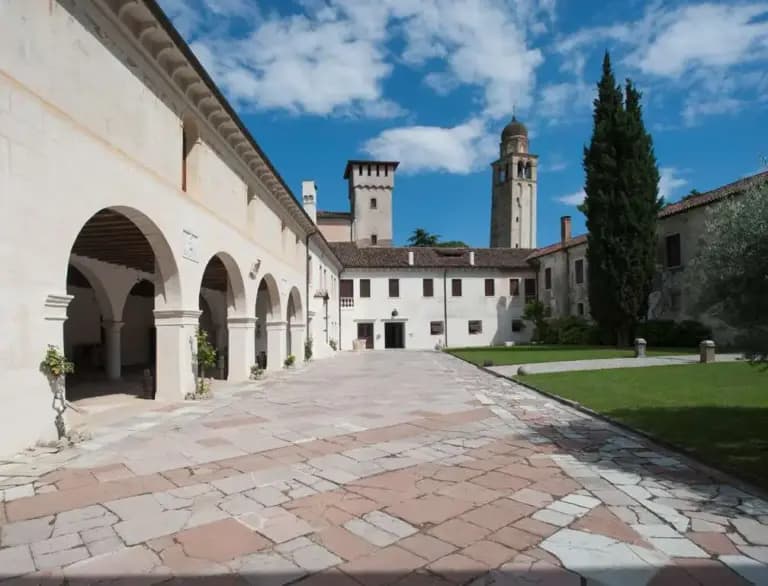
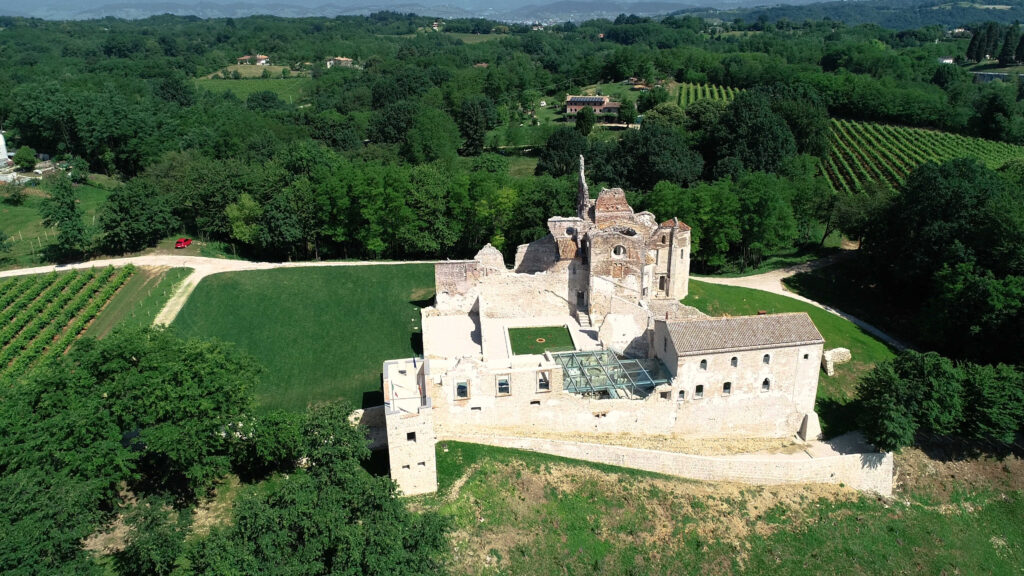
To get to the Abbey of Sant’Eustachio, you can leave your car in Piazzale della Chiesa, near the parish church of San Giovanni Battista, a late-16th-century place of worship framed by a long row of linden trees and an olive grove enclosed by a well-kept hedge.
The path of Via Collalto
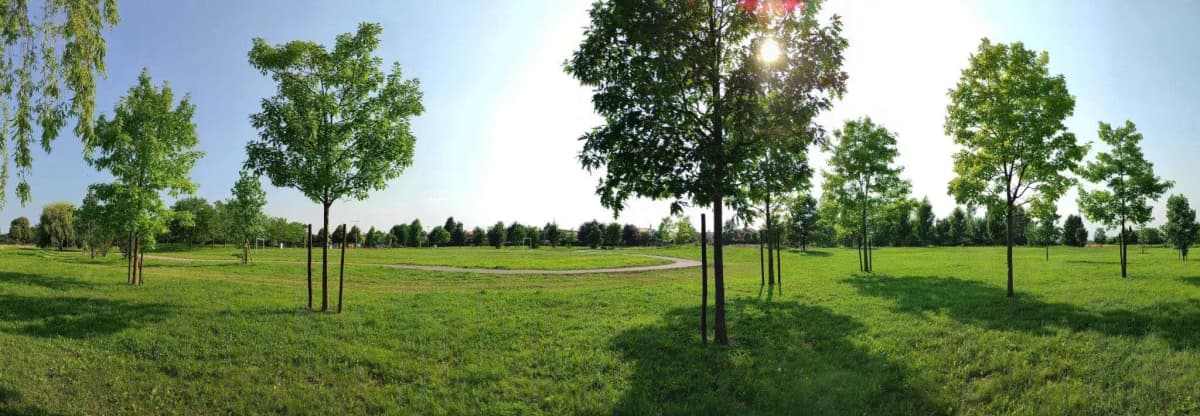
In autumn, towering lindens, elms, field maples, ash trees, hazels, black locusts, elderberries, and nettle trees drop their leaves onto the path, forming a golden and crackling carpet onto which fall the acorns of majestic oaks and the spiny husks of chestnuts.
At the start of the route, looking east, you see a lovely wooded hill whose shape resembles that of a castellieri, an earthwork built in ancient times for defensive purposes.
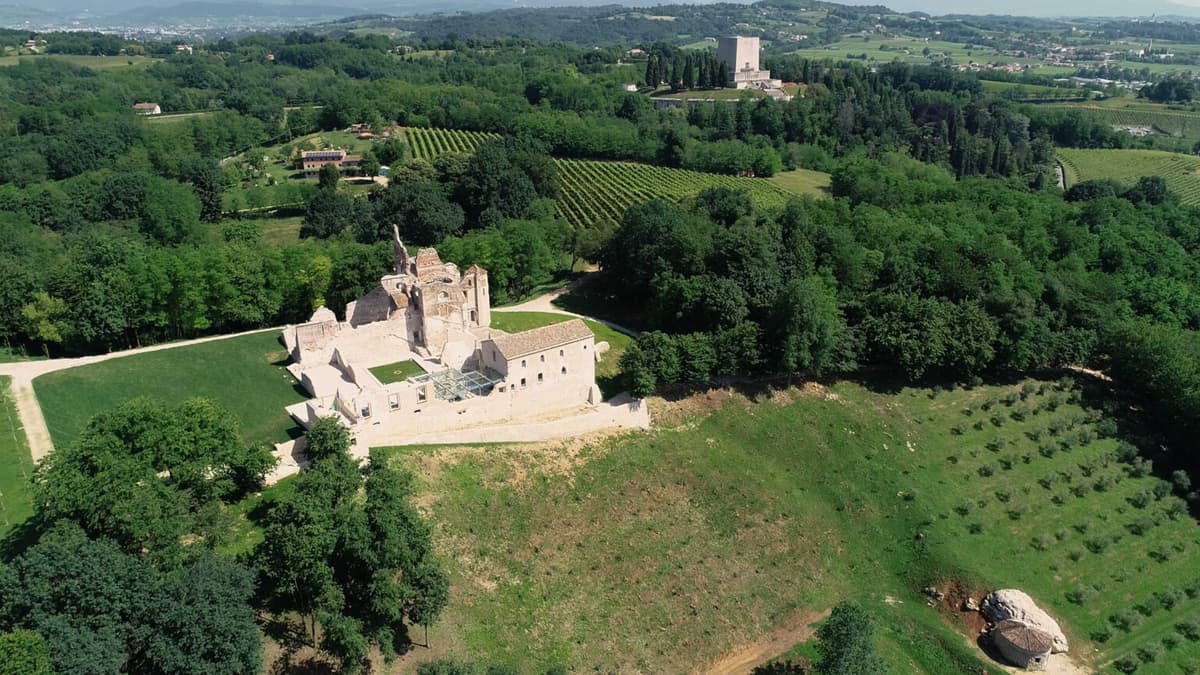
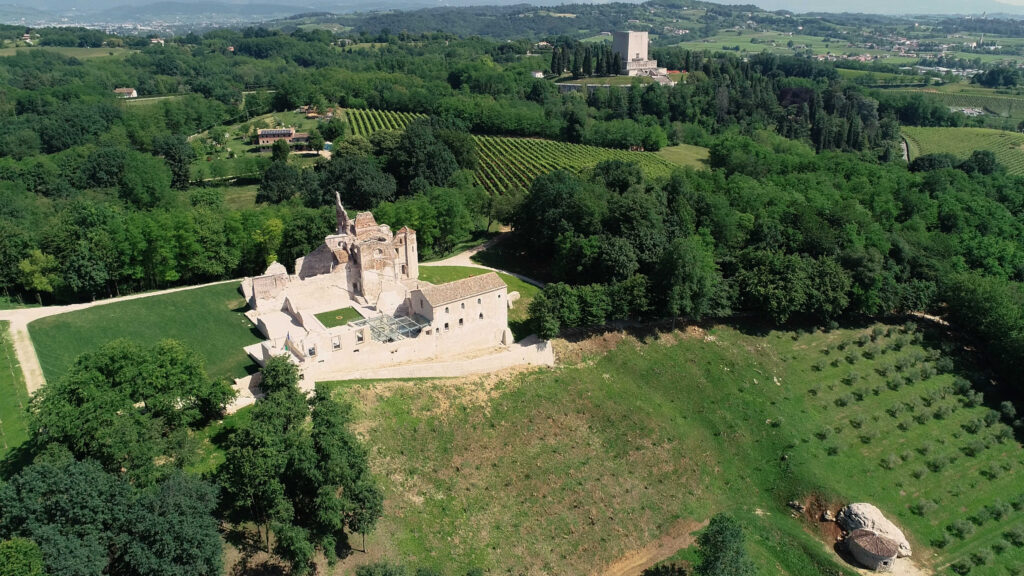
Continuing on a slight incline, the path offers a stunning view of a green slope marked by sun-drenched vineyards and dotted with twisted olive trees that surround the ancient Hermitage of San Girolamo.
A plaque above the entrance of the votive shrine indicates that the cave of San Girolamo was destroyed during the battle of June 1918 and rebuilt by the people of Nervesa in January 1922. A second stone, bearing the year 1728, is placed on the floor next to the altar, adorned with a headless statue of San Girolamo.
The vegetation that grows lush in this fertile area includes plants like bramble (Rubus ulmifolius), stinging nettle (Urtica dioica), and butterbur, whose scientific name, Petasites hybridus, recalls the wide-brimmed hat worn by peasants and travelers in ancient Greece called petasos (πέτασος), referring to the broad leaves of this plant suited to damp soils. The verb petánnymi (πετάννυμι) actually means “to spread out, to extend.”
History of the Abbey of Sant’Eustachio
As reported in a bull of Pope Alexander II from 1062, the Benedictine complex was founded in the mid-11th century on a pre-existing fortified structure, by the will of Rambaldo III of Collalto and his mother Gisla di Paoluccio, wife of Rambaldo II, Count of Treviso.
Between the 16th and 17th centuries, the Abbey of Sant’Eustachio was a cultural cenacle that saw the presence of eminent Renaissance intellectuals, including the playwright Pietro Aretino (Arezzo, April 19, 1492 – Venice, October 21, 1556), the poetess Gaspara Stampa (Padua, 1523 – Venice, April 23, 1554), and Monsignor Giovanni della Casa (Borgo San Lorenzo, June 28, 1503 – Rome, November 14, 1556), who within these walls dedicated himself to composing the famous treatise “Galateo, overo de’ costumi.”
The Abbey of Sant’Eustachio in World War I
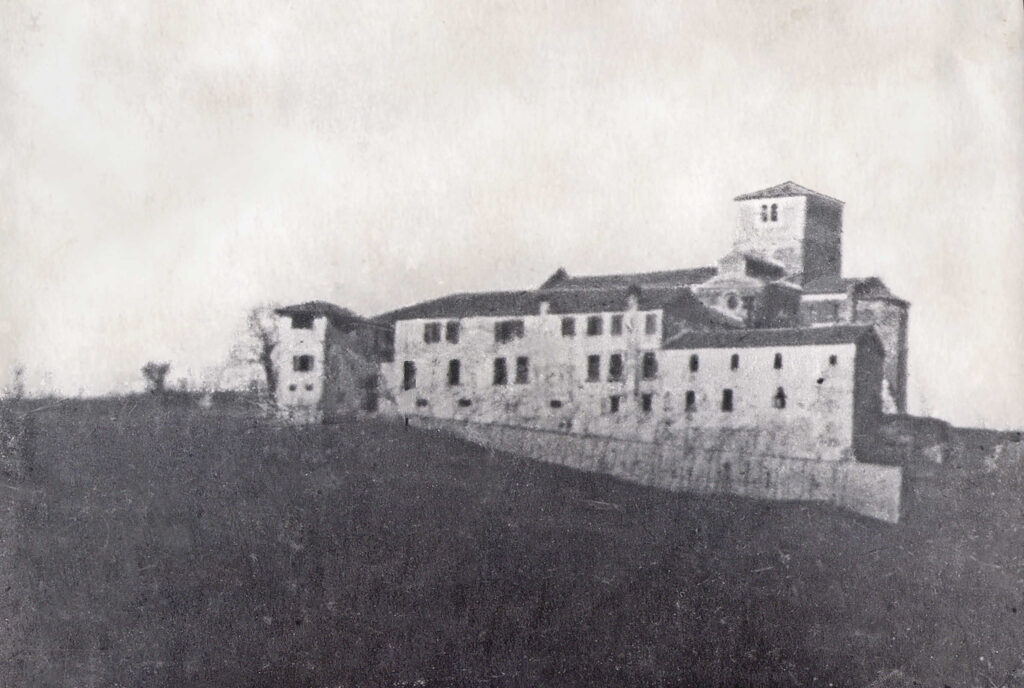
With the rout of Caporetto, announced on the night of October 24, 1917, by massive Austro-German bombardments on the Upper Isonzo front, the Italian troops retreated chaotically for about a hundred and fifty kilometers, suffering heavy losses in terms of dead, wounded, prisoners, and stragglers.
Having taken position on the right bank of the river Sacred to the Fatherland, the Royal Italian Army managed to hold the line on the Prealps and the Piave, resisting the impetus of the enemy advance, which on November 16 was repelled under the command of Chief of Staff Armando Diaz, who succeeded Luigi Cadorna on November 8 of that year.
During the Battle of the Solstice, fought from June 15 to 24, 1918, the small town of Nervesa della Battaglia, enclosed between the eastern slopes of Montello and the river Sacred to the Fatherland, was not spared by Austro-German artillery, which battered the peaceful wooded hill with its characteristic bean shape and the Benedictine complex that stood there.
The restoration of the Abbey of Sant’Eustachio
The decades of neglect suffered by the ruins of the ancient abbey came to an end thanks to the restoration project undertaken by the Agricultural Society Giusti Dal Col, to which the Ministry has granted the use of the site. Since then, careful maintenance work has been carried out, making it possible to reopen the complex to the public.
Today, within the estate, premium wine grape varieties are cultivated, including Merlot and Cabernet Sauvignon for the production of the iconic wine “Umberto I.” Also present are other varieties such as Pinot Nero, Glera, and Sauvignon Nepis, which is a resistant variety.
Why visit the Abbey of Sant’Eustachio?
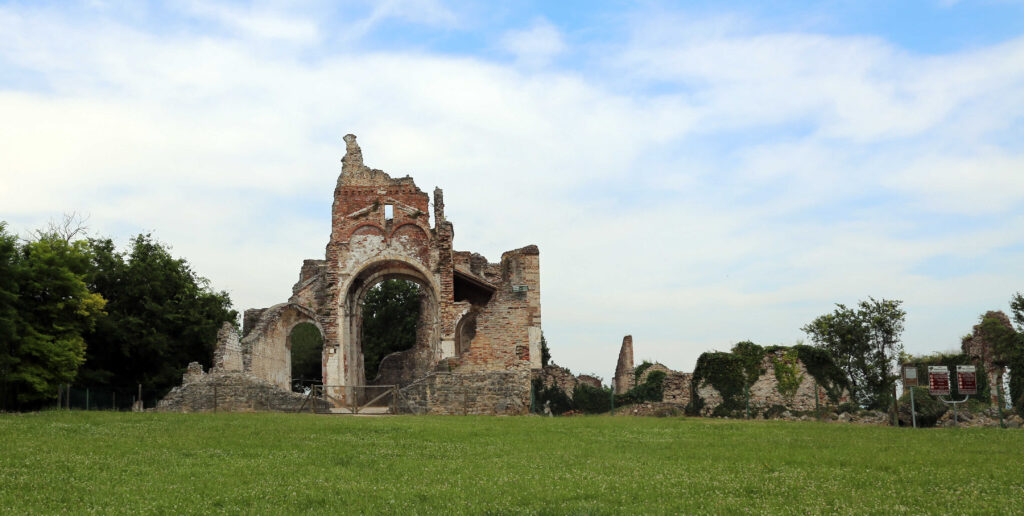
Wrapped in an aura of charm and mystery, the ruins of the Benedictine complex are one of the most significant archaeological and cultural sites in the region.
After the pleasant nature walk, you are struck by the breathtaking views of cheerful hills marked by vineyards, dotted with silver olive trees, and cloaked in woods, beyond which your gaze falls on the bell tower of the church from which we started.
From this privileged position, after contemplating the Hermitage of San Girolamo, the view stretches to the horizon over the vast Treviso plain, punctuated by the regular pattern of hedges and fields dotted with farmhouses and centuries-old rural annexes.