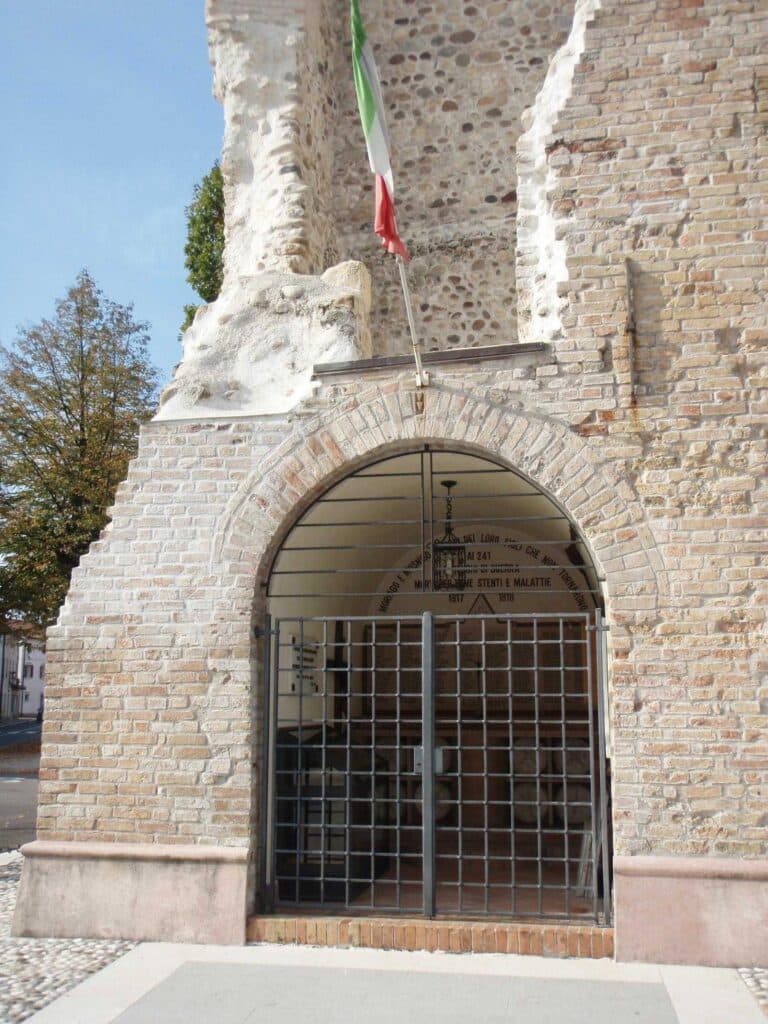

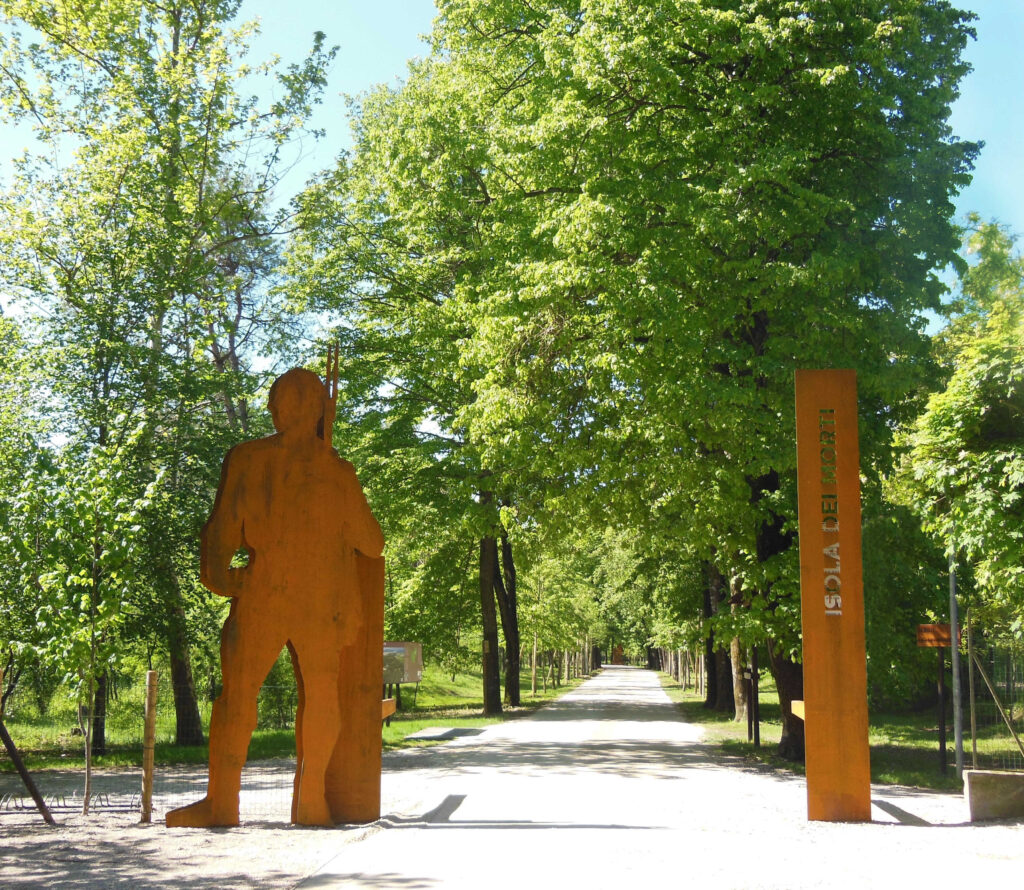
Once divided into sixteen plots, each assigned to a local family that obtained firewood and hay from them, this fertile strip of land was known as the “Green Island” before it was overwhelmed by the devastation of the First World War, particularly during the stopping battle, fought between November and December 1917 following the defeat of Caporetto, in the Battle of the Solstice, between 15 and 24 June 1918, and in the Vittorio Veneto offensive, between 24 October and 4 November 1918.
Background
From the punitive expedition to Caporetto
At the beginning of the Great War, the Italian border with Trentino was one of the sectors most exposed to Austro-Hungarian and German offensives.
On the Lavarone and Folgaria plateaus, Field Marshal Franz Conrad von Hötzendorf, the Austrian chief of staff, had built seven reinforced-concrete forts that looked impregnable.
Planned for spring 1916, the Austro-Hungarian objective, which proved unsuccessful, was to break through Valdastico and Vallarsa, occupy Thiene and Vicenza, then advance east and close in on the Italian armies deployed on the Upper Isonzo.
In this region, where the valleys of the Judrio stream and the Natisone river open out, the Italians had taken up positions on the precarious lines extending from the slopes of Monte Rombon southeastward to Tolmino, passing through the Plezzo basin and the Monte Nero salient.
The rout of Caporetto
Scheduled for the second half of October 1917, the Austro-German offensive called for striking the Ježa massif and the Kolovrat ridge, near Tolmino, in order to sweep into the Judrio valley toward Cividale. A second attack would target Plezzo and Saga, then descend into the Uccea valley and pour into Upper Friuli.
The Austro-German forces would join up at Caporetto and strike the Italians from behind, deployed on the Monte Nero salient.
Launched at two in the morning on 24 October with a targeted bombardment of shells loaded with phosgene gas, the Austro-German plan overwhelmed the Royal Army on the Upper Isonzo front.
Unprepared to withstand the impact of the enemy offensive, the Italian frontline units were outflanked. The chaotic retreat to the Tagliamento was followed, on 29 October, by a disorderly withdrawal to the Piave line.
Italian losses in the rout of Caporetto amounted to about 40,000 dead and wounded, 300,000 prisoners, 350,000 soldiers scattered in disarray and half a million refugees.
All heroes! Either the Piave or we all get killed!
Between October and November, the Third Army and what remained of the Second were deployed along the Piave. A few days later, the Fourth Army, arriving from Cadore and the Carnic Prealps, also took up position along the right bank of the river sacred to the Fatherland.
Further north, the First and Sixth Armies, defending the Asiago Plateau and Monte Grappa respectively, took up positions further back.
On 8 November 1917, the chief of staff Luigi Cadorna was replaced by General Armando Diaz.
On 16 November, tenacious Italian resistance blunted the force of the Austro-German advance, which came to a halt. During the winter, both sides suspended military operations, which would resume between spring and summer of the following year.
The Battle of the Solstice
In June 1918, the First Army of the Royal Army was deployed on the Asiago Plateau, the Sixth between the Brenta river and Monte Grappa, the Fourth between the Grappa Massif and the Montello. The Eighth Army defended the area between the Montello and the Grave di Papadopoli, while the Third Army was deployed between the Grave and the Venetian Lagoon.
At three in the morning on 15 June 1918, the Austro-Hungarians, without German support, attacked on the Grappa front and on the Asiago Plateau, but the offensive ended in a stalemate.
On the Piave line, imperial troops managed to cross the river, advancing as far as Giavera. In the area between the Grave di Papadopoli, Fossalta and San Donà di Piave, they secured the right bank of the river, but the tenacious resistance of the Royal Army, strengthened by the experience gained after the disaster of Caporetto, dashed their plan to reach Treviso.
Crucial was the skillful deployment of the Italian strongpoints along the Piave front, combined with accurate artillery fire and the intervention of the air force, which repeatedly struck the Austro-Hungarian pontoon bridges, inflicting heavy losses.
Also helping the Italian soldiers was the river flood, caused by heavy rain, which swept away the floating structures laboriously assembled by the enemy forces.
On 20 June, a general retreat of the Austro-Hungarian army was ordered.
The Battle of Vittorio Veneto
In October 1918, the political and military disintegration of the Austro-Hungarian Empire was now evident, as shown by the high number of desertions in the imperial divisions, especially among the Magyar regiments, which had begun to abandon the front before the battle even started, refusing to fight for an empire that was crumbling.
In October, the collapse of central authority was confirmed by the declaration of independence of Czechoslovakia, Hungary and Yugoslavia, which brought together the Serbian, Croatian and Slovenian peoples.
On 24 October 1918, the anniversary of the defeat at Caporetto, the Italian army attacked on Monte Grappa. Despite the many defections in the opposing ranks, the Austro-Hungarian frontline units put up fierce resistance in what was the last burst of energy of a dying empire.
Moriago della Battaglia: the Gate of Victory
Coming from the Fontana del Buoro area, the Arditi of the XXII Assault Unit and the Cuneo Brigade of the XXVII Army Corps managed, despite flooding caused by heavy downpours, to establish a bridgehead during the night between 26 and 27 October 1918 that made it possible to cross the Piave, opening the way for the brigades of the Eighth Army.
On 28 October, the headquarters under General Vaccari was established at Mulino Manente, to whom the square of the same name in the Island of the Dead is dedicated.
On 29 October, Emperor Karl I called for an armistice, while the Austrian army, now exhausted, retreated toward the frontier.
The paths of the Island of the Dead
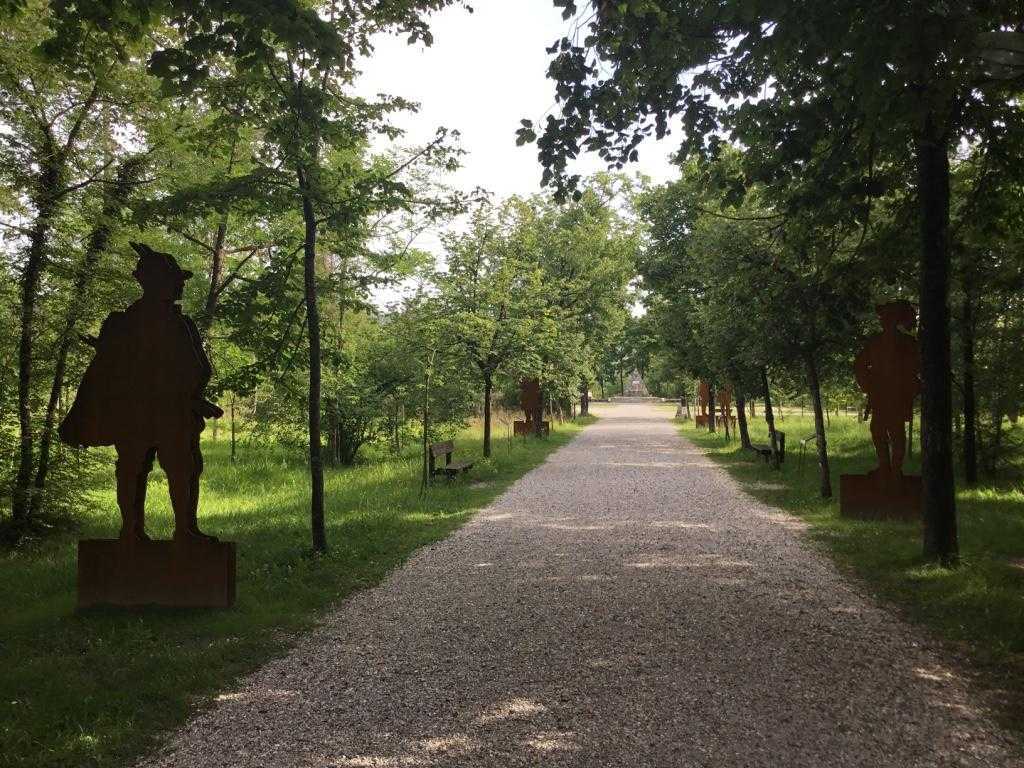
The monumental park is crossed by a network of paths and tree-lined avenues whose names recall the battlefields, armies, brigades and divisions that played a leading role in the battles fought along the Prealps and Piave front in 1917 and 1918.
To the west stretches Viale “Montegrappa”, and to the east Viale “Nervesa della Battaglia”.
From the “Ragazzi del ’99” square in the heart of the Island, the road “Prima divisione d’Assalto” winds southwest, joining the path “Fontana del Buoro”, from which you reach the Piave, the “Sentiero delle Grave” and the “Strada del Bosco”.
The avenue dedicated to the XXII Army Corps, which leads to the gates of Fontigo, runs parallel to the Montello.
Crossed by Via della Vittoria, the bright grassy expanse dedicated to General Vaccari, commander of the XXII, lies between the Fontigo entrance to the northeast and the central square to the southwest, where the Sanctuary of the Madonna and the Arditi Marker stand.
The commemorative marker on the Island of the Dead
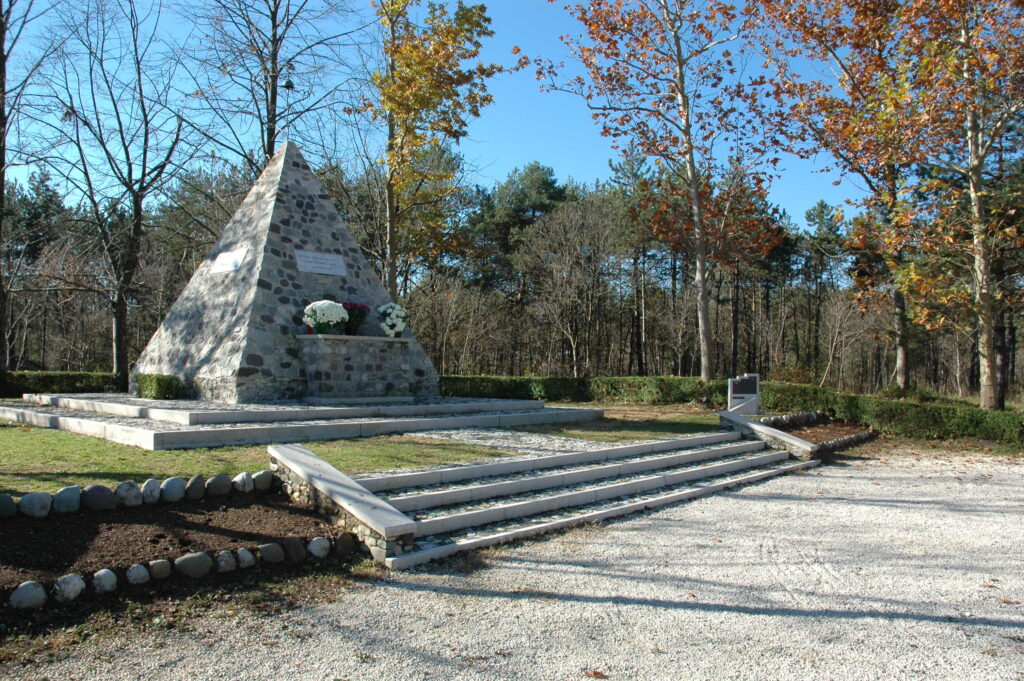
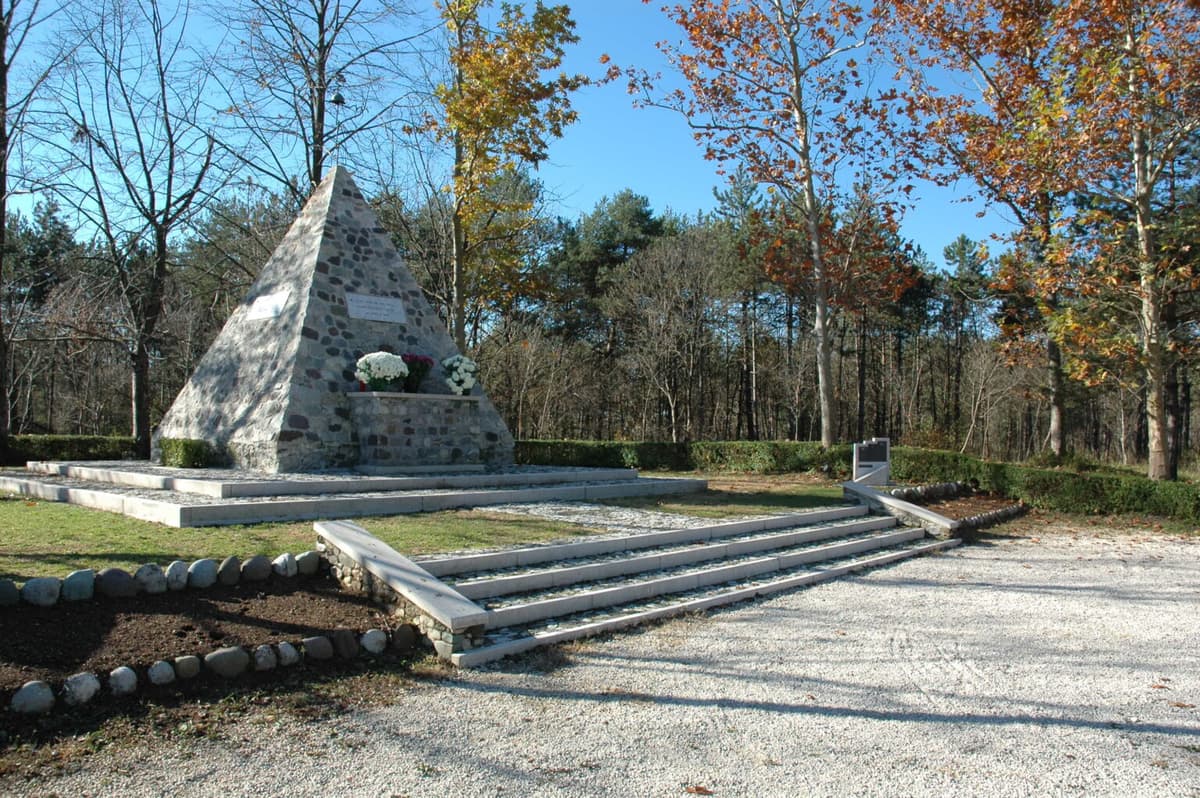
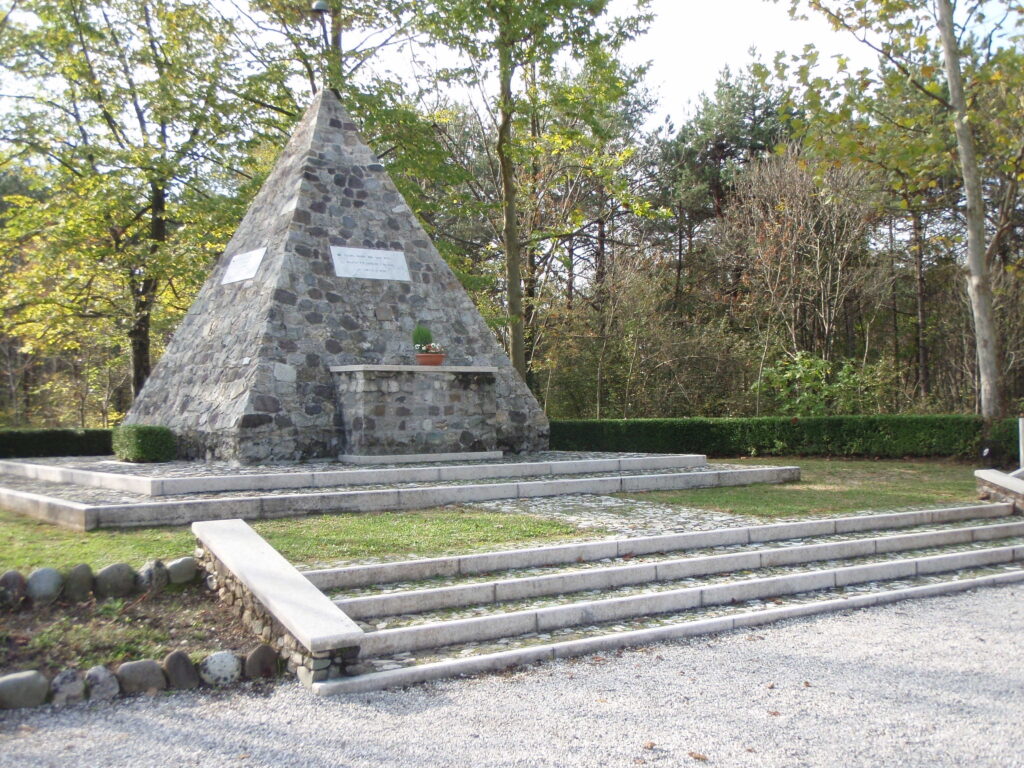
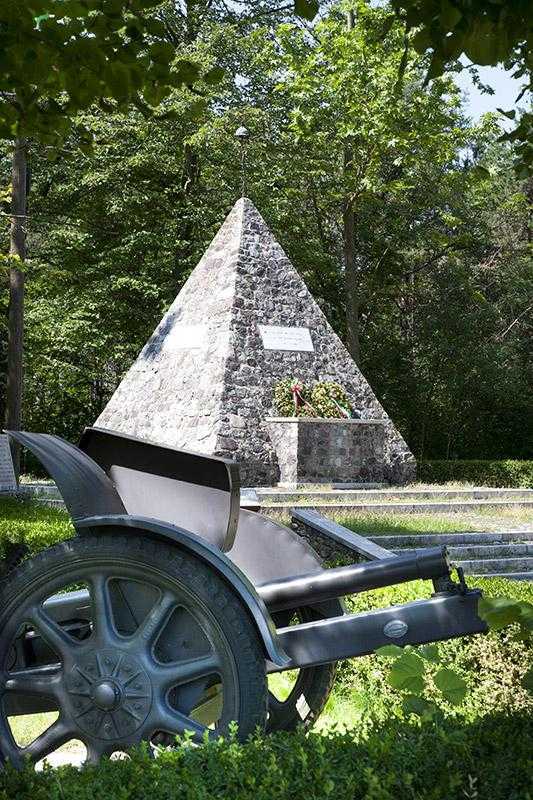
Built in 1923 with river stones and lime, the pyramidal marker erected in the heart of the island is crowned by a crucifix made from stakes of wire mesh, wrapped in barbed wire intertwined around a rusted helmet.
At the base of the monument, four plaques bear verses from La preghiera di Sernaglia (1918) by Gabriele D’Annunzio. The front plaque reads:
TO THE DEAD OF THE PIAVE
54…. O EMPTY VALLEYS WHERE SUCH PURE SWEETNESS RETURNS THAT THE DEAD SEEM TO SLEEP THERE IN THE LAP OF MARY LIKE THE SON! …
The verses are framed by the symbol of the Arditi, made up of a gladius inscribed between a laurel wreath on the left and an oak frond on the right.
The woodland of the Island of the Dead
The initial reforestation work on the Island of the Dead dates from the period between May 1929 and December 1938, carried out by the Civil Engineering Department of Treviso with the assistance of the Forestry Administration, during which the avenues leading to the central square were laid out. In this context, a hydraulic defensive work in a pincer formation was built in the riverbed in 1933.
During the Second World War and in the immediate postwar years, the construction of encampments and military structures in this area, together with the shortage of firewood, compromised the river regulation works and nullified the planting efforts of the 1930s.
Flora and fauna on the Island of the Dead
Entrusted to the Forestry Corps, the memorial area reached a surface area of around one hundred and twelve hectares in 1948, which, once restored and planted, became the extraordinary green lung that today surrounds the monuments and the small church in the central square. The Island of the Dead is currently cared for by volunteer associations, including the Alpini and the Pro Loco of Moriago della Battaglia.
That wounded soil, battered and broken by war, is now covered by a dense blanket of Scots pine, Austrian black pine, Japanese larch and false cypress.
The lovely avenues leading to the pyramidal marker are shaded by tall linden trees. Among the crowns of majestic conifers grow thriving manna ash, black and common hornbeam, alder, yew, Siberian elm, hackberry and downy oak, as well as fruit trees such as apple, cherry and plum.
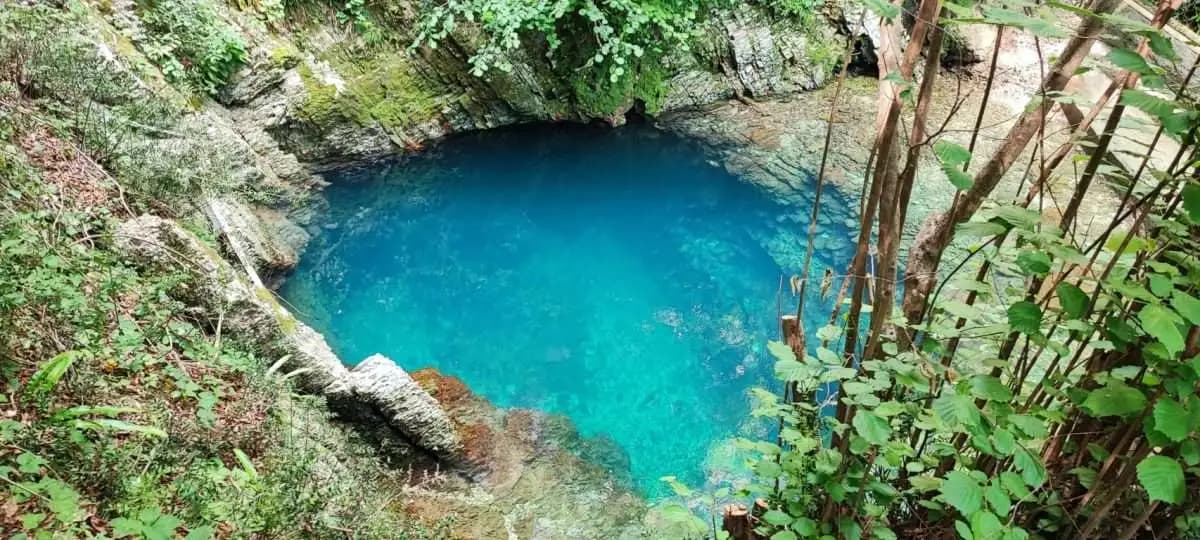
Framed by riparian plants such as cattails and watercress, the hollows once subject to waterlogging are now clear little ponds, from whose surface water lilies and ribbons of water emerge.
In this quiet, unspoiled environment, where the fox, weasel and hare find their habitat, the attentive observer will spot wood pigeons, turtle doves, pheasants, woodpeckers, hoopoes and birds of prey such as the tawny owl, the long-eared owl and the buzzard.
The Sanctuary of the Madonna
Near the memorial stands the sanctuary dedicated to the Virgin, whose construction, proposed in the 1950s by the parish priest of Moriago, Don Pietro Ceccato (1908-1996), was approved by the diocesan Bishop Mons. Giuseppe Carraro. The project was entrusted to the architect Alberto Alpago-Novello.
Work began on 16 July 1961 and was completed in 1965. On 29 June that year, the church was consecrated by Mons. Albino Luciani, Bishop of Vittorio Veneto and future Pope John Paul I.
Inside the church, accessible through a fine wooden portal carved by Giacomo Vincenzo Mussner of Ortisei (to a design by Enrico Tonello), references to the battles that devastated the area find evocative echoes in the lectern made of barbed wire, the crucifix fashioned from a hand grenade, the bronze holy water font depicting a soldier holding his helmet, made by Giaretta, and the oil painting by Albino Poloniato of Crocetta depicting the Piave, the Montello and the Island of the Dead, to mention only some of the works that adorn the place of worship.
Sculptures of the Island of the Dead
Erected on 30 October 1977, the bust of Ermete Giovanni Gaeta (Naples, 5 May 1884 – 24 June 1961), known as E. A. Mario (in honor of Alberto Mario, journalist, poet and patriot, collaborator of Mazzini), pays tribute to the author of the anthem La leggenda del Piave.
By the sculptor Marbal are the works “Vita per la Pace”, inaugurated on 16 June 1991, “Fiaccola con braciere” and “Santa Barbara”, inaugurated in 2002.
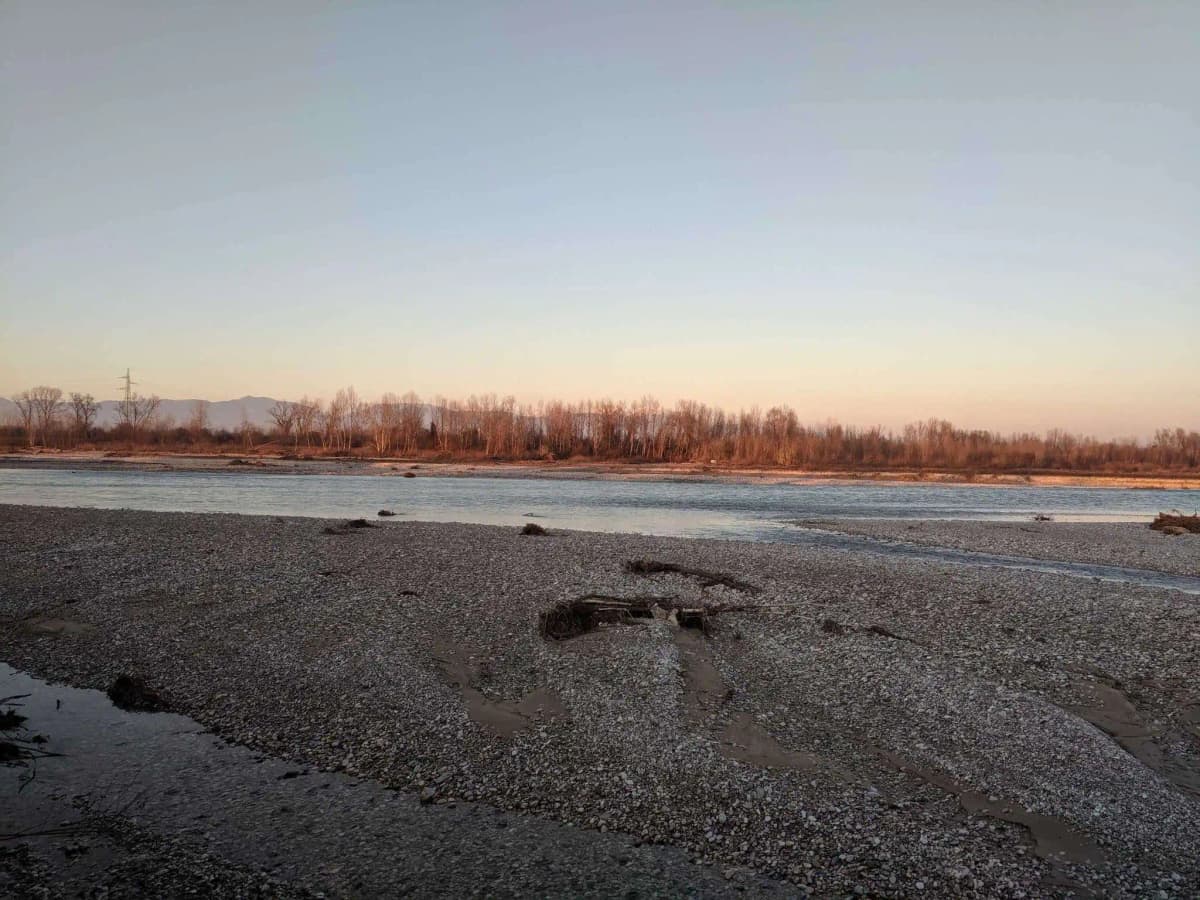
In this solemn place, the intertwining of the lime-tree avenues that branch out through the woodland and frame bronze monuments, white stone and barbed wire fades into the rough pioneer vegetation emerging from the gravel and water-smoothed pebbles that cover the Piave riverbed, recalling the vastness of the steppe. The regular arrangement of Scots pines and Austrian black pines gives way to manna ash, cornel, hawthorn, hornbeam, alder and many other shrubs and tall trees growing wild beneath their prickly crowns.
Once you pass through the entrance to the monumental garden, you enter a majestic and luxuriant setting that invites silence, contemplation of nature and reflection on the death that, a little over a century ago, scattered the islands and banks of the river sacred to the Fatherland with the bodies of thousands of soldiers, whose current still returns macabre reminders in the form of cartridges, magazines, mortar shells and uprooted helmets surfacing from the water’s edge.