
Who is Giovanni Bortoluzzi?
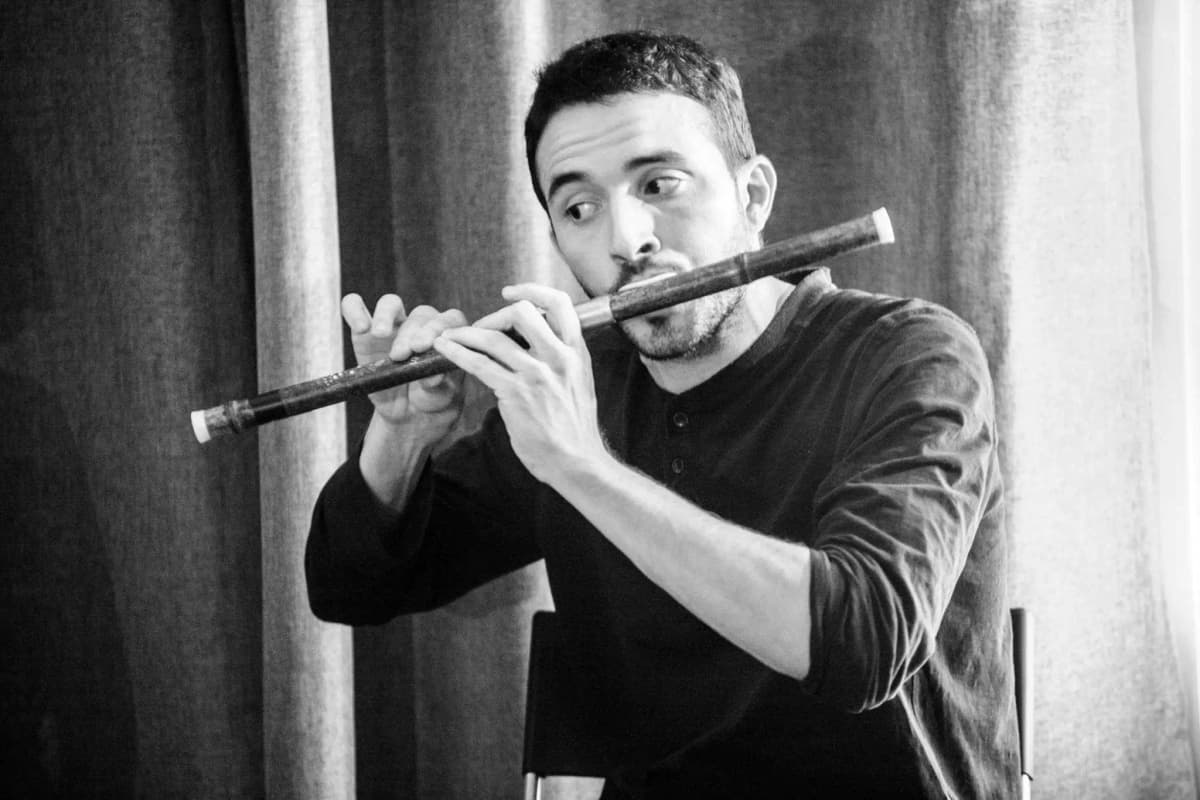
Giovanni Bortoluzzi, an all-round musician and harmonic singing teacher, co-founder of the website www.cantoarmonico.eu, tells us his story in an exclusive interview, explaining how he got into harmonic singing and what this very particular singing technique consists of.
Our Interview
Hello Giovanni, to start, why don’t you tell us a bit about yourself?
“I’m 33, born and raised in the countryside north of Treviso. I love spending time outdoors and being with friends. My passions are music and building musical instruments.”
When was your passion for music born?
“Since I was little, my father always made me listen to a lot of good music, and he still does!
At age 18 I picked up a guitar. A few months later, a local band was looking for a bassist… and that’s where the adventure began.
Nothing special really, millions of musicians started exactly this way!”
How many musical instruments can you play?
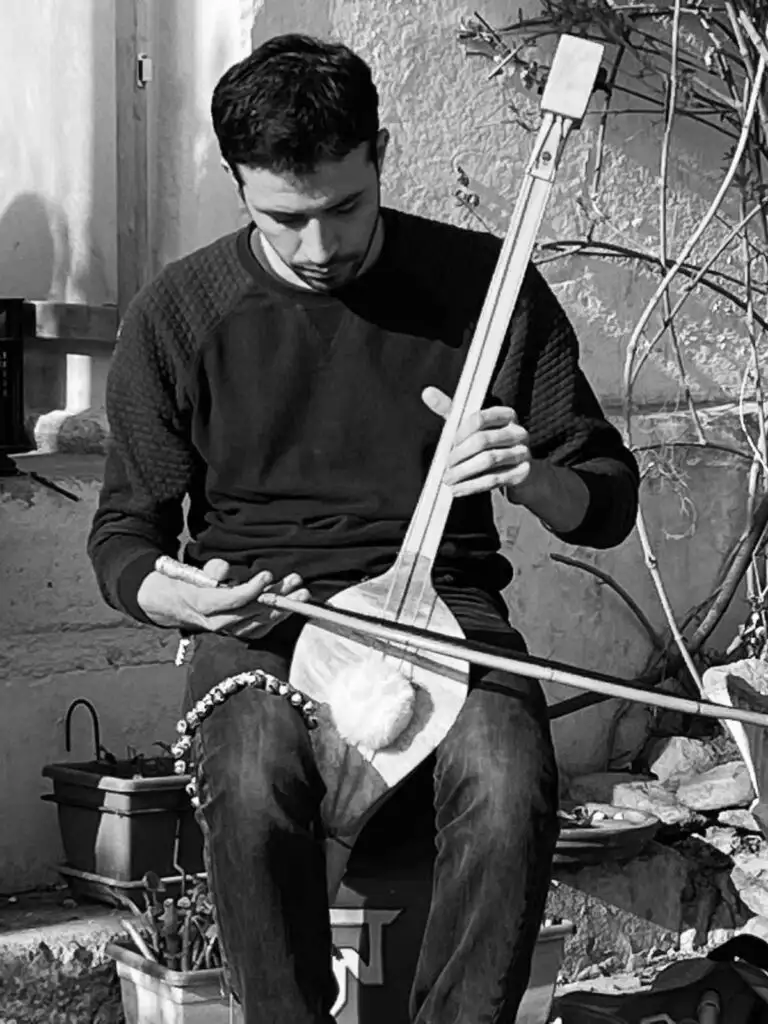
“At a good level I can play the Irish flute, guitar, electric bass and drums. I know where to put my hands on a piano keyboard, but that’s where I stop.
Then… I dabble with circular breathing on the didgeridoo and the Chinese bawu, while in Sardinia I learned to sustain some steady rhythms with the jaw harp.
I am a very curious person, and this leads me to constantly research new instruments. Every instrument gives me the opportunity to learn different styles and approaches to music, thus increasing my cultural background. Currently I am practicing a lot with a Tuvan instrument, “Igil”, a particular two-stringed cello: an experience that is nothing short of exciting, that of bowed string instruments!”
A bit of a banal question but… favorite music genre?
“Spaghetti western! From Ennio Morricone to Franco Micalizzi, to be clear.”
Among all the instruments you can play and your unique favorite genre, I’m curious to know more about your career as a musician!
“I was lucky to start with the electric bass, because it is an instrument that teaches you to be at the service of the music, to refine listening and interplay.
I started as a bassist in blues bands: I learned a lot on stage, especially at jam sessions. I also played guitar a lot, in a tribute band, and in some jazz ensembles.
I never took off but I gained a lot of experience.
The real career began with the discovery of harmonic singing.”
Let’s get to the point: what is harmonic singing and how does it work?
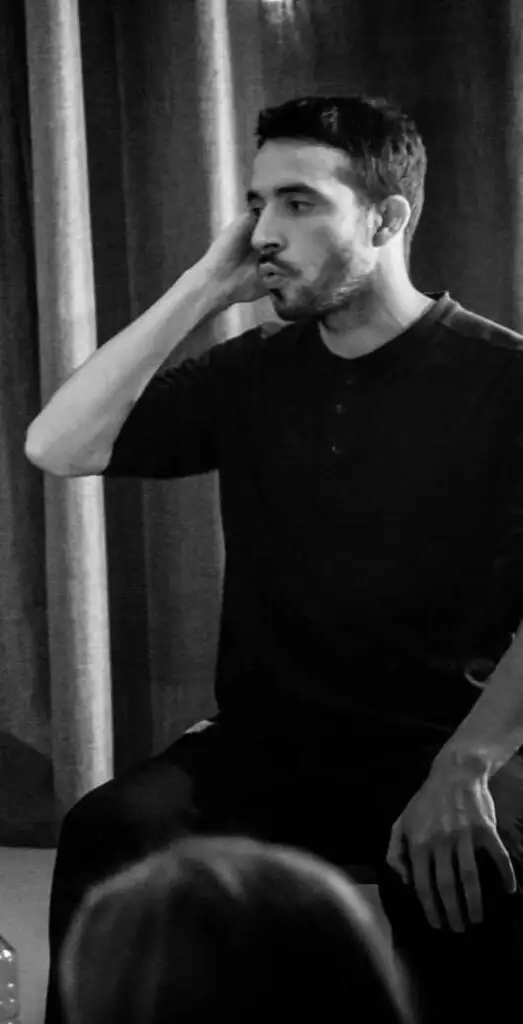
“Harmonic singing is the ability to manage the overtones of the voice as if they were a separate musical instrument. By controlling the timbre and the emission of breath, one can learn to select the overtones and create melodic and rhythmic patterns. The effect it has is always surprising.”
You have mentioned Diphonic Singing several times. Is it wrong to call it Harmonic? Are they synonyms or are they two different types of singing?
“Until recently they were considered synonyms. In reality they are two different things.
“Harmonic singing” appeared starting from the 70s, but it is the result of an incorrect translation from the English “overtone singing”, which correctly translated becomes “singing the overtone” or “singing the overtones”.
The correct term accepted today is “Diphonic Singing”, since di-phonic explicitly indicates the action of producing two sounds.
Harmonic Singing continues to be used to indicate any type of singing that somehow brings harmony and well-being. Harmonic singing, harmonious singing, sing and you’ll feel better… it’s all the same!
Diphonic Singing is instead in line with the English Overtone Singing, the French Chant Diphonique, the German Obertongesang, and so on.”
When and why was your passion for harmonic singing born?
“Maybe you meant Diphonic Singing… hehe… Let’s say for convenience we’ll continue to call it harmonic singing!
Anyway, it happened by pure chance. One day, browsing the internet looking for detailed information on overtones as an acoustic phenomenon, I found myself watching a video tutorial on harmonic singing.
The teacher was Miroslav Grosser, from Berlin, who soon became my remote mentor, since in Italy I had not yet found a teacher who suited my needs.
The passion was born immediately, like love at first sight, and it took off when, after a few months, I realized that in Italy harmonic singing had not yet been explored in depth, and this gave me a strong motivational boost and… here I am, teacher and researcher of harmonic singing techniques!”
What kind of studies and exercises are needed to learn to master this art?
“Listening. It is listening that is the key that opens the doors of diphonic singing. It is essential to spend a lot of time listening carefully, even to the smallest nuances present in sounds.
Then, one would think that it takes a lot of practice… in reality I believe that the quality of the exercises is more important, not the amount of time spent doing ineffective exercises.
(Years ago I attended a course where the teacher repeatedly stressed that he had studied for twenty years under the guidance of Asian masters. Nevertheless, he was unable to create even a simple melody, while most of my students today, after a day or even a few hours, are already able to hint at well-defined melodies.)”
Are there other types of harmonic singing?
“There are several but the main two are: the traditional Tuvan one and the one that developed from the 1990s in Germany. The Tuvan is the oldest, has many stylistic variants with great attention to detail.
In the Republic of Tuva, besides being an art form, diphonic singing is above all a discipline, a philosophy of life.
The type of diphonic singing that spread in the West can be defined as contemporary, and technically it is only partly inspired by the Tuvan school. If we want to go into specifics, there are truly many ways to sing the overtones.
In this regard, in 2019, together with a team of medical researchers, we published an important study on diphonic singing that is now on Pubmed®.
It is an accurate analysis of all types of diphonic singing performed with real-time MRI. A magnificent experience to say the least, I spent about eight hours singing inside the MRI machine, which emits a deafening noise when in operation!”
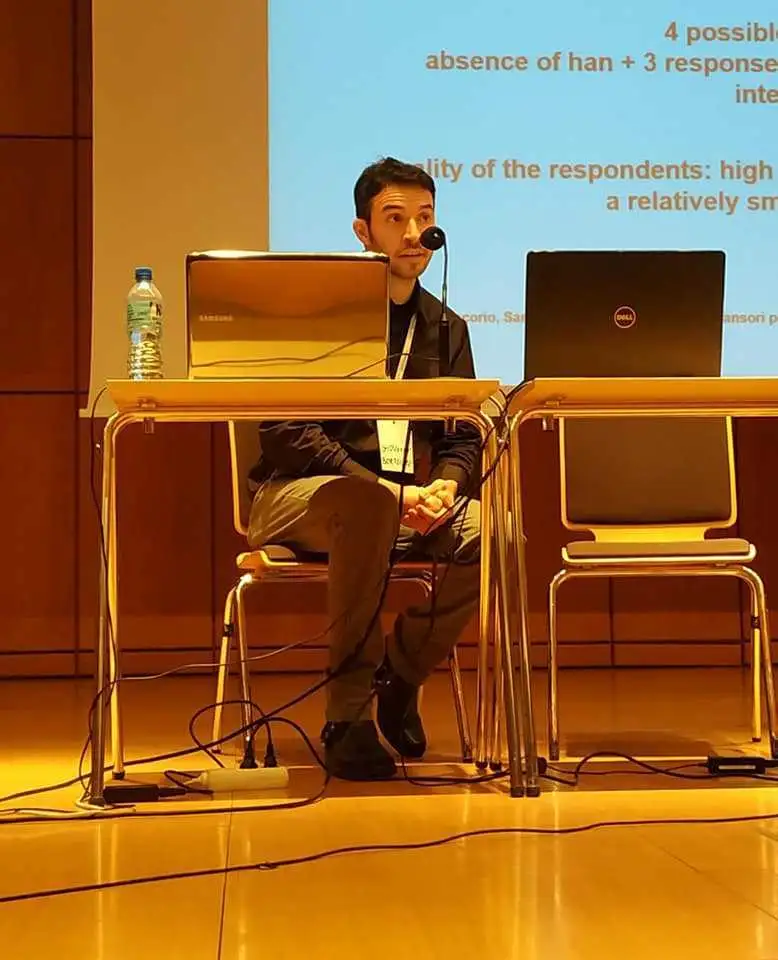
You mentioned that there are also harmonic instruments, what kind of instruments are they? Can you tell us more in detail?
“Yes, they are instruments whose operation mainly involves the use of natural overtones: the jaw harp is the most obvious example, but there are many others, including the Slovak harmonic flute in its two variants Koncovka and Fujara, both of which can be made from PVC pipes. I myself have built dozens of them, it’s easy and fun, and above all low cost.
Other interesting examples are found in the brass family, particularly the trumpet: with only three pistons, it uses numerous combinations of natural overtones to form scales.
Think of ‘silence’: a melody built solely with natural overtones.”
In the title of the interview we said that you are the greatest expert in Italy as a scholar and teacher of harmonic singing. Would you like to comment on this statement?
Since my first courses as a teacher, I have done my best to spread diphonic singing in the most complete and up-to-date way possible, but I didn’t do it all alone. I was lucky enough to meet many other singers with whom I could share experiences and learn a great deal. In particular Walter Mantovani, from Turin, a friend with whom I spent sleepless nights doing research and studying the possibilities of overtones, and Ilaria Orefice, a singer from Oristano, one of the very few Italian throat singers. Together we created the first school of Diphonic Singing in Italy, the “Sherden Overtone Singing School”, which in recent years has become one of the points of reference for diphonic singing enthusiasts in Italy and around the world.
I don’t know if we can talk about primacy, but what really matters is that the art of diphonic singing be increasingly recognized and appreciated for what it truly is:
a way to express oneself artistically, but also a discipline with which to find well-being, balance, and strength to face everyday life.
If you liked the article, share it and follow us on social media so you don’t miss our interviews and articles on music!